

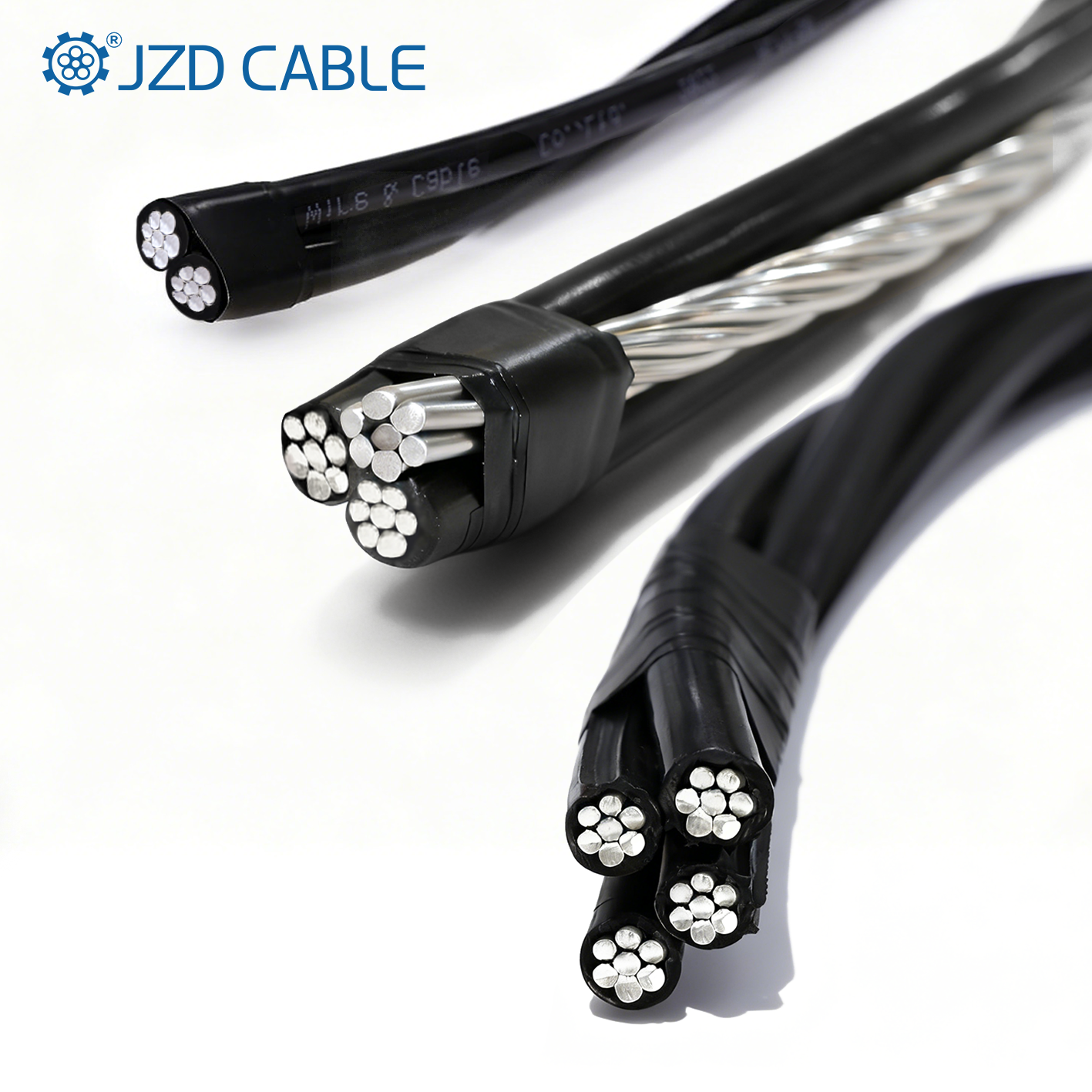
When planning an overhead power distribution line, choosing the right conductor is critical for safety, reliability, and cost-efficiency. Two common options you’ll encounter are AAC (All Aluminum Conductor) and ABC (Aerial Bundled Cable). While their names sound similar, they are fundamentally different in design and application.
This guide from JZD Cable (jzdcable.com) will demystify these two cable types, comparing their structures, performance, and ideal use cases to help you make an informed decision for your next project.
Core Definitions: It’s More Than Just a Name
First, let’s clarify what each term actually means.
- AAC Cable (All Aluminum Conductor): This refers specifically to a bare wire. It is a stranded conductor made of pure, unalloyed aluminum (1350 grade, ≥99.7% purity). It has no insulation or jacket. AAC is a single, bare wire used in overhead transmission and distribution lines, typically mounted on insulators.
- ABC Cable (Aerial Bundled Cable): This refers to a complete cable system. ABC consists of multiple insulated cores (which can use AAC, AAAC, or ACSR as the conductor material) that are twisted or bundled together. Each core is individually insulated (usually with XLPE or HDPE), making it a self-contained, multi-core cable designed for low-voltage overhead distribution.
The key takeaway: AAC is a material/component(a bare conductor), while ABC is a finished product(an insulated, multi-core cable).
Head-to-Head: AAC vs. ABC Cable Comparison
|
Feature
|
AAC Cable (All Aluminum Conductor)
|
ABC Cable (Aerial Bundled Cable)
|
|---|---|---|
|
Core Structure
|
Single, bare stranded aluminum wire. No insulation.
|
Multiple insulated cores bundled into one cable.
|
|
Conductor Material
|
100% pure aluminum (1350-H19).
|
Conductors can be AAC, AAAC, or ACSR. Neutral core is often reinforced.
|
|
Insulation & Safety
|
None. Fully exposed, posing risks of short circuits, electrocution, and vegetation faults.
|
Fully insulated. Provides protection against phase-to-phase contact, electric shock, tree contact, and theft.
|
|
Number of Cores
|
Single-core (1 wire per phase).
|
Multi-core: 2-core (single-phase), 3-core (three-phase), 3+1 core, or 4-core.
|
|
Voltage Rating
|
Low to High Voltage (0.4kV up to 500kV).
|
Primarily Low Voltage (0.6/1kV standard), with some medium-voltage (10kV/20kV) options.
|
|
Mechanical Strength
|
Lower tensile strength. Higher sag. Suitable for shorter spans (typically ≤ 50m).
|
Better tensile strength due to bundling. Lower sag. Suitable for moderate spans.
|
|
Installation
|
Individual wires mounted on insulators. Requires larger poles and clearances.
|
Entire bundle is strung as one unit. Allows for smaller poles, narrower rights-of-way, and can be mounted on walls.
|
|
Typical Applications
|
Urban short spans, coastal areas, substation busbars, high-voltage transmission lines.
|
Rural LV networks, urban renewal projects, forested/mountainous areas, street lighting, service drops.
|
|
Relative Cost
|
Lower (conductor material only).
|
Higher (includes insulation, bundling, and more complex manufacturing).
|
|
Key Standards
|
IEC 61089, GB/T 1179
|
IEC 60502, GB 12527, ANSI/ICEA S-76-474
|
In-Depth Look: Advantages, Disadvantages & Best Uses
AAC Cable: The Bare Workhorse
Key Advantages:
- High Conductivity: Pure aluminum offers excellent electrical conductivity (approx. 61% IACS).
- Lightweight & Corrosion Resistant: Easy to handle and performs well in coastal environments.
- Cost-Effective: The most economical choice for bare conductor applications.
Limitations to Consider:
- No Insulation: Presents safety hazards and is vulnerable to outages from wind, animals, or tree contact.
- Lower Strength: Higher sag limits span lengths, often requiring more support poles.
- Complex Installation: Requires careful spacing and more hardware (insulators, spacers).
Ideal for: High-voltage transmission lines on large towers, substation buswork, and low-voltage distribution in areas with wide, clear corridors and where cost is the primary driver.
ABC Cable: The Modern, Insulated Solution
Key Advantages:
- Enhanced Safety & Reliability: Insulation prevents accidental contact, reduces fire risk, and is highly resistant to faults caused by vegetation or animals.
- Simplified Installation: The bundled design is faster to install, requires fewer poles, and can be routed through tight spaces or along walls.
- Reduced Right-of-Way: Cores are closely bundled, minimizing the space needed overhead. Ideal for congested urban or residential areas.
- Theft Deterrent: Insulation and bundling make conductor theft more difficult.
Limitations to Consider:
- Higher Initial Cost: The added materials and manufacturing process increase the price per meter compared to bare AAC.
- Current Rating: Slightly lower ampacity than an equivalent bare conductor due to reduced heat dissipation.
- Voltage Limit: Primarily designed for low-voltage distribution networks.
Ideal for: Low-Voltage (LV) Distribution in rural electrification projects, old city center upgrades, forested or mountainous regions, street lighting circuits, and the final service drop from a transformer to buildings.
How to Choose Between AAC and ABC Cable
Your choice ultimately depends on your project’s specific requirements. Ask these questions:
- What is the Voltage Level?
- HV Transmission (>33kV): AAC (or ACSR/AAAC) is the standard.
- LV Distribution (≤1kV): ABC is the modern, safer, and more reliable choice.
- What is the Installation Environment?
- Wide-open areas, coastal regions: Bare AAC can be a cost-effective fit.
- Congested streets, forested areas, near buildings: ABC is strongly recommended for safety and practicality.
- What are the Key Priorities?
- Lowest Upfront Cost: AAC.
- Safety, Reliability, & Reduced Long-Term Maintenance: ABC.
- What are the Local Regulations?
- Many utilities and municipalities now mandate insulated conductors (like ABC) for all new low-voltage overhead installations due to safety codes.
Conclusion
AAC and ABC cables serve distinct purposes in the power grid. AAC is the fundamental, high-conductivity bare conductor used across a wide voltage range. ABC is an innovative, insulated cable system that has revolutionized the safety and efficiency of low-voltage overhead distribution.
For modern distribution networks—especially in residential, rur al, or environmentally sensitive areas—ABC cable is increasingly becoming the industry standard due to its overwhelming safety and operational benefits.
Still unsure which cable is right for your project? Contact the experts at JZD Cable today. We provide high-quality AAC conductors and ABC cables manufactured to international standards. Let us help you design a safer, more reliable, and cost-effective power distribution system.
Visit us at jzdcable.com for more technical resources and product information.