

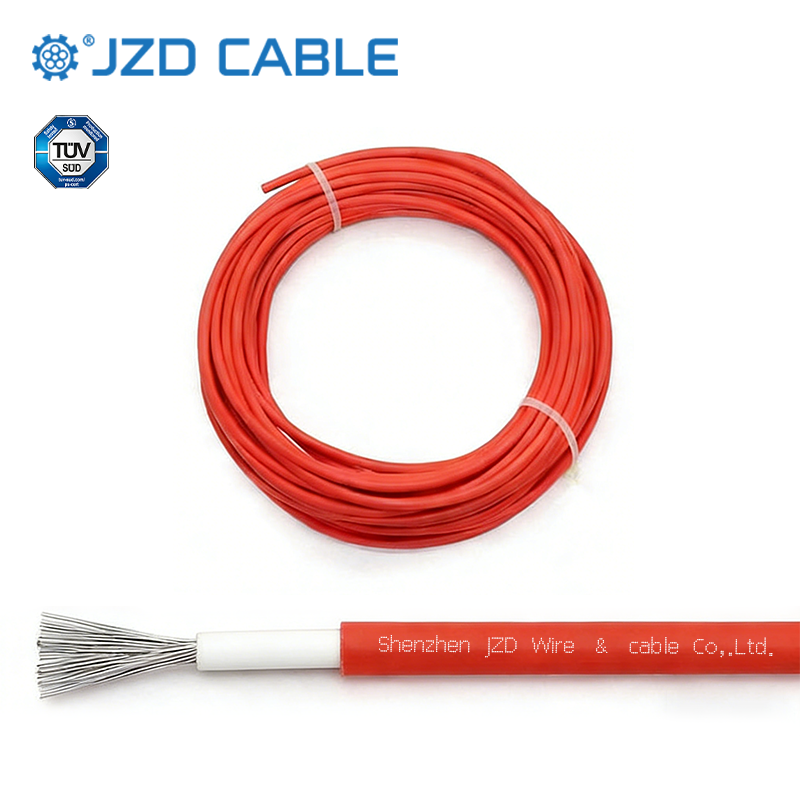
In any solar photovoltaic (PV) system, cables are the vital arteries carrying generated power. Using the wrong type is not just inefficient—it can be a safety hazard. Primarily, two cables are used: PV DC Cables and PV AC Cables. They are fundamentally different and must not be interchanged. The key dividing point is the inverter, the heart of the system that converts direct current (DC) from the panels into alternating current (AC) for grid or home use.
The Inverter: The Clear Demarcation Line
- DC Side: Everything from the solar panel strings to the inverter’s input uses PV DC Cables.
- AC Side: Everything from the inverter’s output through the distribution board and to the grid uses PV AC Cables.
Detailed Comparison: PV DC Cable vs. PV AC Cable
1. Voltage & Electrical Nature
|
Feature
|
PV DC Cable
|
PV AC Cable
|
|---|---|---|
|
Rated Voltage
|
Typically 1.8kV DC or 1.5kV DC.
|
Commonly 0.6/1kV AC.
|
|
Current Type
|
Direct Current (Constant, unidirectional flow).
|
Alternating Current (Periodically reverses direction).
|
|
Key Safety Concern
|
High Risk: DC arcs are single-polarity and do not have a natural zero-crossing point, making them extremely hard to extinguish. This demands higher, more rigorous insulation standards.
|
Lower Relative Risk: AC arcs naturally extinguish at the current’s zero-crossing point, allowing for conventional safety design margins.
|
2. Electrical Performance
- PV DC Cable: Carries constant current with minimal power loss (primarily determined by DC resistance). Highly resistant to electromagnetic interference. Ideal for the high-voltage, steady-current environment on the panel side.
- PV AC Cable: Carries alternating current, which suffers from the skin effect—where current flows mostly on the conductor’s surface. This increases effective resistance and leads to higher power losses compared to DC for the same conductor size.
3. Application & Specifications
1.PV DC Cable:
- Application: Used for connecting solar panels in series, combining strings in parallel, and running from DC combiner boxes to the inverter. It is designed for outdoor use and must have excellent UV, ozone, and temperature resistance.
- Common Spec: For residential systems with string inverters, 4mm² DC cable is typically sufficient. Our standard product for this is the highly durable, irradiated cross-linked polyolefin insulated cable (H1Z2Z2-K).
2.PV AC Cable:
- Application: Used for connections from the inverter to transformers, distribution panels, and the main grid. Mostly installed in indoor or protected environments.
- Common Spec: Depends on single-phase or three-phase output. Common types include power cables like YJV, YJLV, VV, or VLV.
4. Cost & Lifespan
- PV DC Cable: Requires specialized materials and complex manufacturing to meet stringent insulation and weatherproofing demands, making it generally more expensive per meter than standard AC cable. However, it is engineered for a longer operational lifespan in harsh conditions.
- PV AC Cable: While individual cores may be less costly, multi-core cables for high-power systems add up. Standard AC cables, though robust, can be more susceptible to long-term insulation degradation in demanding applications.
Conclusion: Choose Right for Safety and Performance
Mixing up DC and AC cables in a PV system compromises safety, efficiency, and reliability. The PV DC cable is your specialized, weather-hardened choice for the high-voltage DC side up to the inverter. The PV AC cable is the standard-bearer for distributing converted AC power to your property and the grid.
As a professional manufacturer, JZD Cable provides the precise, certified cables your solar project demands. For the DC side, trust our premium H1Z2Z2-K series, and for the AC side, our reliable YJV/YJLV power cables. Using the correct cable ensures your investment delivers clean, safe power for decades to come.
Visit jzdcable.com to explore our full-range PV wiring solutions or contact our experts for a consultation.