

Choosing the right power cable is critical for the safety, efficiency, and longevity of any electrical system. The terms “low,” “medium,” and “high” voltage are commonly used, but what do they actually mean, and how do you decide which one your project needs? This guide from JZD Cable will break down the key differences, applications, and technical specifications of LV, MV, and HV cables to help you make an informed decision.
Defining the Voltage Classes
The classification is primarily based on rated operating voltage, though specific ranges can vary slightly by regional standards.
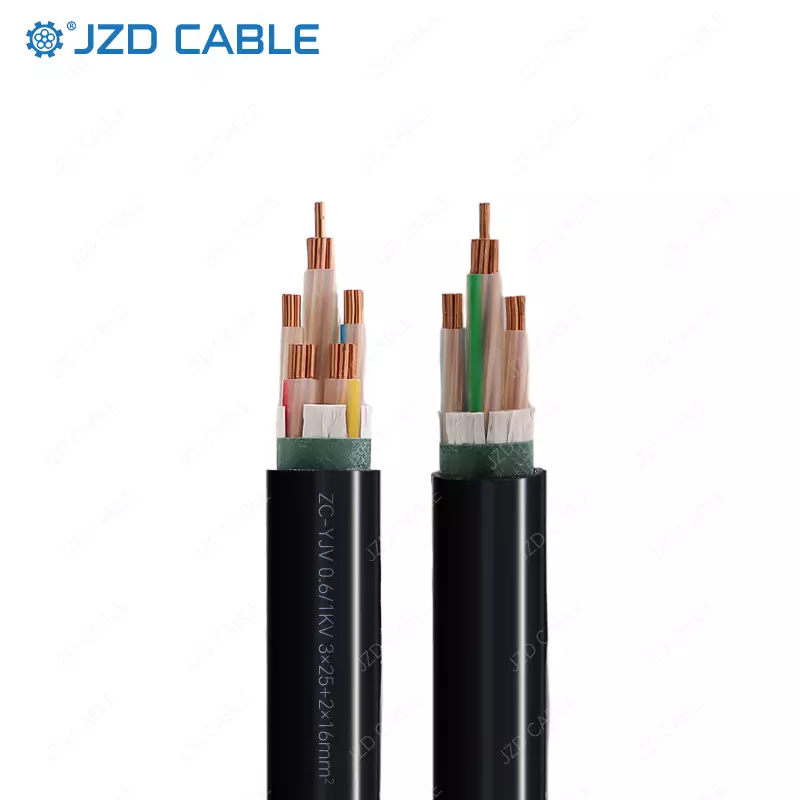
- Low Voltage (LV) Cables: These are used for the distribution of lower power levels. The standard rated voltage is 1kV and below (common standards: 0.6/1kV). They are the workhorses of everyday electrical connectivity.
- Medium Voltage (MV) Cables: These cables handle medium-level power distribution. The typical voltage range is from 3kV up to 35kV (with 8.7/15kV being an extremely common rating). Note: In everyday conversation, MV cables are sometimes mistakenly called “high voltage.”
- High Voltage (HV) Cables: Designed for transmitting large amounts of power, HV cables operate from 35kV up to 110kV. Systems above this (e.g., 220kV and up) are typically categorized as Extra/Ultra High Voltage (EHV/UHV).
Application Scenarios: Where is Each Type Used?
The application is directly tied to the cable’s voltage handling capability.
1.Low Voltage Cable Applications:
- Building Wiring: Powering sockets, lighting, and appliances in residential, commercial, and industrial buildings.
- Internal Plant Wiring: Connecting machinery, control panels, and equipment within factories and workshops.
- Control & Instrumentation Circuits: Transmitting signals for automation and control systems.
2.Medium Voltage Cable Applications:
- Primary Distribution: Feeding power from substations to distribution transformers within urban grids, industrial parks, and large facilities.
- Underground Power Networks: Commonly used in buried city distribution systems.
- Large Facility Supply: Providing the main power feed to large buildings, hospitals, universities, and manufacturing plants.
3.High Voltage Cable Applications:
- Bulk Power Transmission: Moving electricity over long distances from power generation plants (like hydro, thermal, or wind farms) to main grid substations.
- Submarine Power Links: Underwater cables connecting grids across bodies of water.
- Grid Interconnections: High-capacity links between regional or national power networks.
Construction & Technical Comparison
The internal structure becomes progressively more complex as voltage increases to manage higher electrical stress.
|
Feature
|
Low Voltage (LV) Cable
|
Medium Voltage (MV) Cable
|
High Voltage (HV) Cable
|
|---|---|---|---|
|
Typical Voltage
|
Up to 1 kV (e.g., 0.6/1kV)
|
3 kV to 35 kV (e.g., 8.7/15kV)
|
35 kV to 110 kV and above
|
|
Primary Insulation
|
PVC (Polyvinyl Chloride) or XLPE (Cross-linked Polyethylene)
|
XLPE (Standard) or EPR (Ethylene Propylene Rubber)
|
XLPE or HEPR (Hard EPR)
|
|
Conductor
|
Stranded, circular (non-compacted or compacted) or shaped.
|
Mandatory circular compacted conductor for uniform shape.
|
Precision circular compacted conductor with strict smoothness requirements.
|
|
Shielding
|
Often unshielded. May have armor for mechanical protection.
|
Three-layer co-extrusion: Conductor Screen + Insulation + Insulation Screen. Metallic screen (copper tape/wire) is essential for grounding.
|
Advanced multi-layer shielding. Includes conductor screen, insulation, insulation screen, metallic water barrier (e.g., corrugated aluminum/lead sheath), and anti-corrosion outer sheath.
|
|
Typical Core Count
|
1, 2, 3, 4, 5 cores (e.g., 3+1, 4+1)
|
1-core or 3-core (for balanced three-phase systems).
|
Primarily 1-core. Three single-core cables are used per circuit for flexibility and to reduce losses.
|
|
Basic Structure
|
Conductor + Insulation + Filler + Bedding + Armor (optional) + Outer Sheath
|
Conductor + 3-Layer Co-extrusion + Metallic Screen + Filler + Bedding + Armor (optional) + Outer Sheath
|
Conductor + Screen + Insulation + Screen + Water Barrier + Metallic Sheath (Sealed) + Outer Sheath
|
How to Choose the Right Cable for Your Project
Selecting the correct cable type is a matter of matching specifications to your system’s demands.
- System Voltage & Regulation: The most critical factor. Always choose a cable with a rated voltage equal to or higher than the maximum operating voltage of your system.
- Current Carrying Capacity (Ampacity): Calculate the expected load current. The cable’s cross-sectional area (e.g., 50mm², 240mm²) must be sized to carry this current without overheating, considering installation conditions (buried, in air, in conduit).
- Installation Environment: Is the cable going underground, in ducts, in cable trays, or underwater? This determines requirements for mechanical protection (armor), corrosion resistance, and UV protection for the outer sheath.
- Short-Circuit Withstand: The cable must withstand the thermal and mechanical stress of a potential short-circuit fault for the time it takes the protection system to operate.
- Standards & Compliance: Ensure the cable meets national and international standards (e.g., IEC, BS, ASTM, GB) relevant to your project’s location and industry.
Key Takeaway
Low voltage cables are for end-use power delivery. Medium voltage cables are the backbone of local distribution networks. High voltage cables are the long-distance arteries of the national grid. The construction evolves from simple to highly engineered to manage increasing electrical stress.
Still unsure which cable specification is perfect for your application? The experts at JZD Cable are here to help. We manufacture a wide range of reliable power cables tailored to your specifications. Contact us today for a technical consultation and quote. Let us power your project safely and efficiently.