

In the complex world of electrical systems and industrial automation, seamless control and precise signal transmission are paramount. This critical task falls to a specialized type of cable: the control cable. Functioning as the nervous system of modern machinery and control panels, control cables are essential for the operation of factories, power plants, and automated processes. But what exactly are they, and how do they differ from the power cables that deliver energy? This guide delves into the core definition, structure, applications, and key distinctions of control cables.
Core Definition: The Signal Conduit
A Control Cable is specifically designed to transmit control signals, measurement signals, protective signals, or low-voltage electrical signals. Unlike power cables that carry high currents to drive motors and heavy equipment, control cables are the communication links in electrical control systems and secondary circuits. Their primary role is to connect devices like Programmable Logic Controllers (PLCs), Distributed Control Systems (DCSs), relays, instruments, solenoid valves, and switchgear within a control panel or between panels.
They transmit commands for start/stop operations, interlock signals, sensor feedback, and status indicators, enabling precise system control and safety protection. Control cables are standardized with a typical rated voltage of 450/750V, classifying them under the series of cables for electrical installations, designed for reliability in low-voltage signal transmission.
Structure and Material Composition
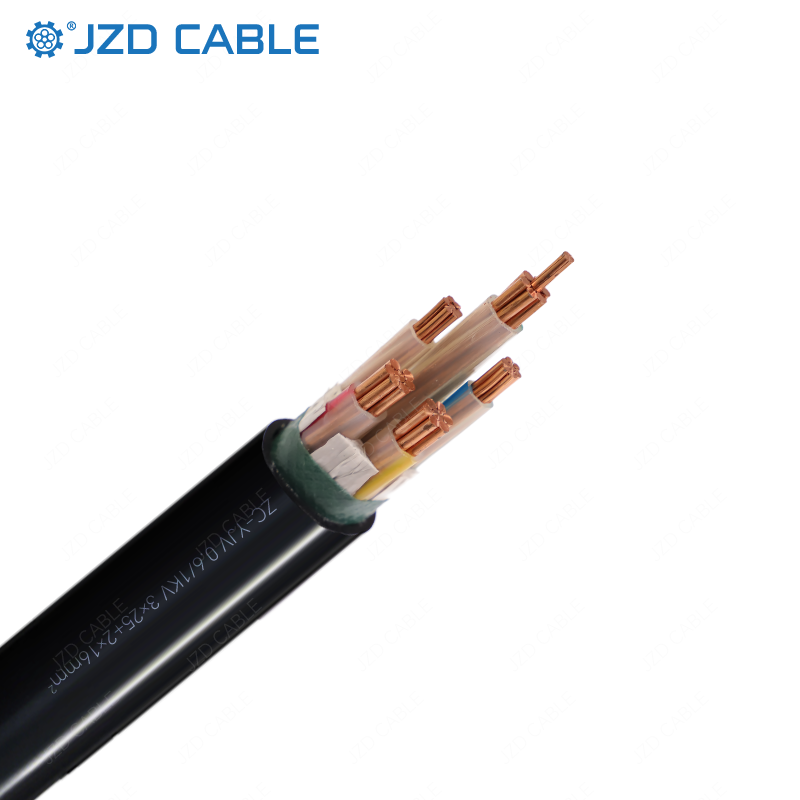
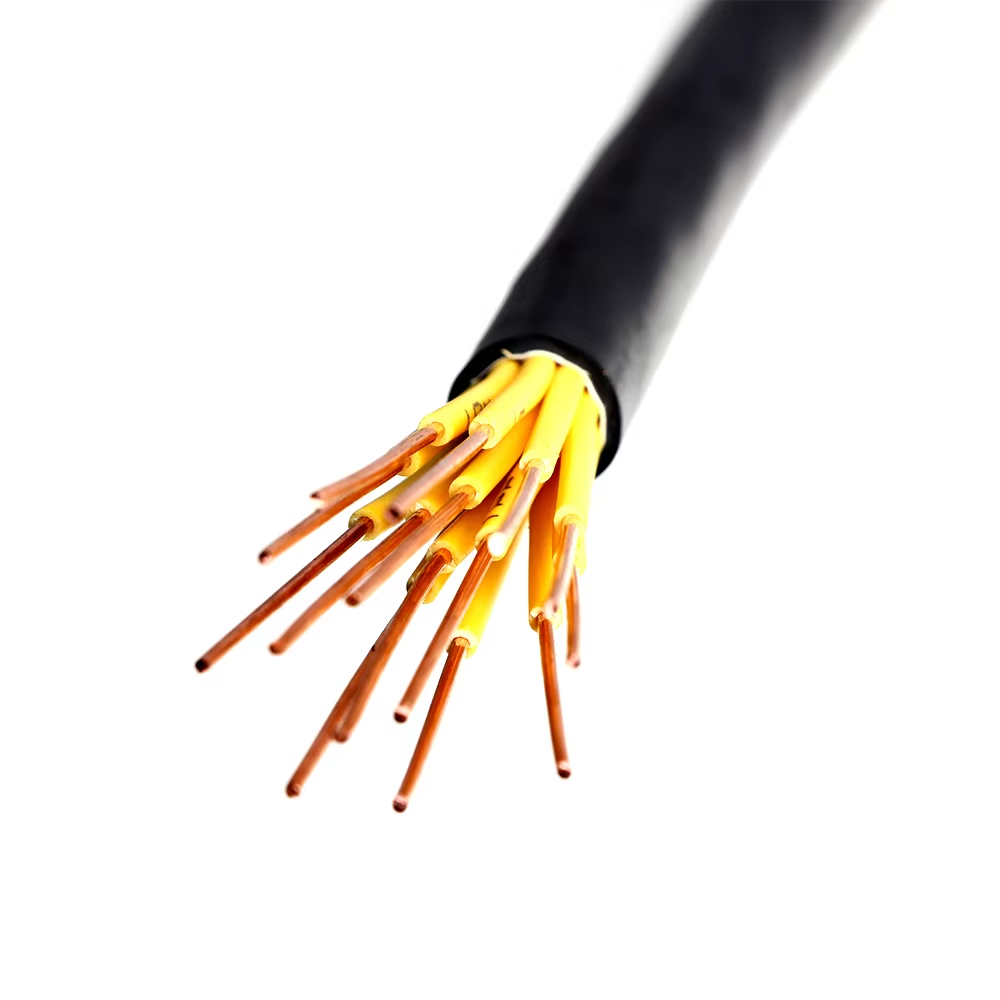
The construction of a control cable is optimized for flexible, multi-circuit signal transmission and protection against interference.
- Conductor: Typically made of copper for superior conductivity, though aluminum may be used. The conductor cross-sections are relatively small, ranging from 0.5 mm² to 10 mm². A defining feature is the high number of cores, commonly from 2 to 61 cores, packed into a single cable to manage multiple control circuits efficiently.
- Insulation: Individual conductors are insulated, usually with Polyvinyl Chloride (PVC) or Cross-Linked Polyethylene (XLPE). This layer provides essential electrical isolation between the cores.
- Shielding (Optional): For environments with significant electromagnetic interference (EMI) from nearby power cables or heavy machinery, a copper tape or braided shield is often added. This shield protects the sensitive control signals from distortion, ensuring signal integrity.
- Armouring (Optional): For cables installed in harsh environments, directly buried, or requiring extra mechanical protection, a steel wire or tape armour layer is applied. This guards against crushing, impact, and rodent damage.
- Outer Sheath: The final protective layer is a durable PVC sheath. It provides overall mechanical strength, resistance to abrasion, oils, and chemicals, ensuring long-term reliability in industrial settings.
Control Cable vs. Power Cable: Key Differences
Understanding the distinction between control and power cables is crucial for correct application and system safety.
|
Feature
|
Control Cable
|
Power Cable
|
|---|---|---|
|
Primary Function
|
Transmit control, measurement, and signal commands.
|
Transmit electrical energy to power equipment.
|
|
Rated Voltage
|
Low voltage, typically 450/750V.
|
Medium to high voltage, commonly 0.6/1 kV and above.
|
|
Conductor Size
|
Smaller cross-section (0.5–10 mm²).
|
Larger cross-section to handle high current loads.
|
|
Number of Cores
|
High (e.g., 4, 7, 12, 19, 24, 61 cores).
|
Usually fewer (1, 2, 3, 4, or 5 cores for standard power).
|
|
Insulation/Sheath
|
Generally thinner, optimized for flexibility and multi-core use.
|
Thicker, designed for higher voltage insulation and current capacity.
|
Primary Application Scenarios
Control cables are indispensable in any setting requiring automated control and monitoring:
- Industrial Automation & Production Lines: Connecting PLCs or DCSs to field devices like sensors, limit switches, solenoid valves, and motor starters.
- Power Plants & Substations: Used in protection relay circuits, control signaling between switchgear, and connecting meters and transformers in measurement circuits.
- Control and Interlocking between Distribution Panels: Facilitating communication and safety interlocks between different sections of an electrical control room.
- Machinery Control: Providing the wiring for control pendants, position feedback systems, and actuator controls on industrial machines.
- Building Management Systems (BMS): Integrating controls for HVAC, lighting, and security systems.
Conclusion
Control cables are the unsung heroes of reliable industrial operation. Choosing the right cable—with the appropriate core count, shielding, and armouring—is vital for system accuracy, safety, and longevity. At JZD Cable, we specialize in manufacturing high-quality control cables designed to meet the rigorous demands of modern automation and control systems. Ensure your control signals are transmitted with precision and reliability.