

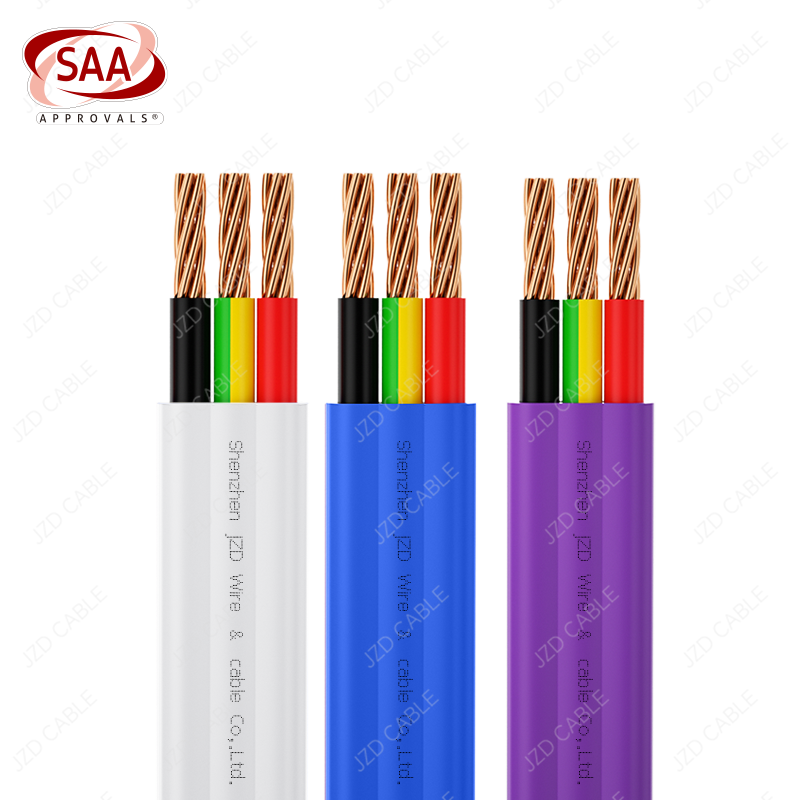
When selecting TPS (Thermoplastic Sheathed Flat Cable) for your next electrical project, you’ll encounter a choice of sheath colors: white, purple, and blue. While they share the same core electrical specifications—conforming to AS/NZS 5000.2, rated at 450/750V with V-90 insulation and 3V-90 (or 5V-90) PVC sheathing—the color is far from just cosmetic. It serves as a critical visual code for application, safety, and material compatibility. Choosing the wrong color can lead to installation issues or non-compliance with best practices.
This guide from JZD Cable, your trusted wire and cable manufacturer, breaks down the differences to help you make an informed decision.
The Core Differences at a Glance
The sheath color on a TPS cable primarily indicates its intended use case and special properties. Here’s a quick comparison:
|
Feature
|
White Sheath TPS
|
Purple Sheath TPS
|
Blue Sheath TPS
|
|---|---|---|---|
|
Standard Status
|
Default & Standard color in Australia/NZ (AS/NZS 3000)
|
Non-standard but widely accepted industry-specific color
|
Dedicated identifier color for functional separation
|
|
Primary Function
|
General-purpose fixed wiring
|
Prevents damage to sensitive materials
|
Clear separation of low-voltage/power circuits
|
|
Key Material Trait
|
Standard 3V-90 PVC (often with anti-yellowing)
|
Non-migratory PVC sheath
|
Standard 3V-90 PVC (sometimes enhanced fire retardancy)
|
Deep Dive: Application & Selection Guide
1. White Sheath TPS Cable: The Universal Workhorse
The white sheath is the standard and most common type of TPS cable in Australia and New Zealand.
- Applications:
- General fixed wiring in residential and commercial buildings.
- Powering lighting circuits, power outlets (GPOs), and small appliances.
- Suitable for a wide range of installations: surface mounting, concealed wiring, in conduits, or direct burial (where rated).
- When to Choose It: For most standard electrical circuits where no special material compatibility or circuit separation is required. It offers the best cost-effectiveness and general availability.
2. Purple Sheath TPS Cable: The Specialist for Sensitive Materials
The purple sheath is an industry-adopted solution for a very specific problem: plasticizer migration.
- The Key Feature: Non-Migratory Sheath. Standard PVC can leach plasticizers over time. These chemicals can damage certain plastics, causing cracking, clouding, or softening.
- Applications:
- Wiring in contact with or near sensitive materials like polystyrene, acrylic, ABS, polycarbonate (common in decorative panels, insulation, and certain enclosures).
- Communication and data lines (e.g., NBN cabling runs) where cross-contamination must be avoided.
- Dedicated circuits that need visual differentiation from standard power circuits.
- When to Choose It: Whenever the cable will be in prolonged contact with vulnerable plastics. Using purple sheath prevents costly damage to decorative finishes or insulation materials.
3. Blue Sheath TPS Cable: The Identifier for Safety & Control
The blue sheath is dedicated to identifying specific, non-standard power circuits, primarily for safety and clarity.
- Applications:
- Fire alarm systems and emergency call systems.
- Building automation and control wiring (BMS).
- Signal transmission lines for industrial equipment.
- Any dedicated low-voltage or extra-low-voltage circuit that must be unmistakably distinguished from standard 230V mains wiring (which uses white, black, or orange sheaths).
- When to Choose It: For all fire services, safety circuits, and control/signal wiring. It ensures electricians and maintenance personnel can instantly recognize these critical circuits, reducing the risk of errors during modifications or repairs.
Important Note: Do not confuse the external blue sheath of a TPS cable with an internal blue insulated neutral conductor. The sheath color identifies the cable’s function, while the internal conductor color identifies its role within the circuit(neutral). Always follow cable and conductor identification standards on-site.
How to Choose the Right TPS Cable Color
Follow this simple selection logic for your project:
- Standard Home/Commercial Wiring? → Choose WHITE Sheath. It’s your default, cost-effective choice for lights and power.
- Running Cables Near Plastic Insulation, Decorative Panels, or Data Lines? → Choose PURPLE Sheath (Non-Migratory). This is a preventative measure to protect building materials.
- Installing Fire Alarms, Emergency Systems, or Control Wiring? → Choose BLUE Sheath. This is crucial for safety, compliance, and clear power/weak current separation.
Still unsure which TPS cable is right for your specific application? At JZD Cable, we offer a full range of AS/NZS compliant TPS cables in various sheath colors and configurations. Our experts can help you specify the correct cable for performance, safety, and longevity.
Browse our certified cable range or contact our team for technical support at jzdcable.com.