

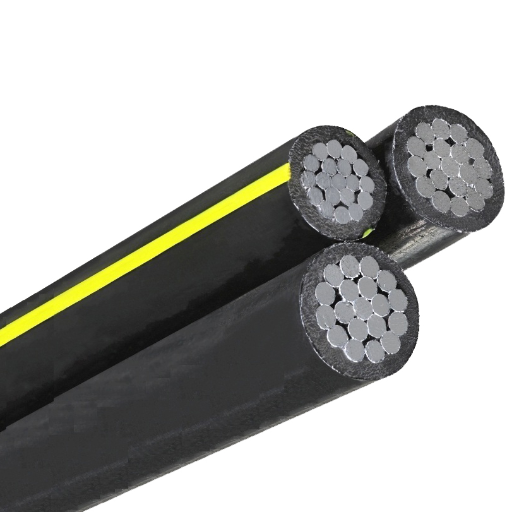
A common question arises when specifying URD (Underground Residential Distribution) Cable: “Why is it almost exclusively made with aluminum or aluminum alloy conductors instead of copper?” The answer is not a compromise. For the specific application of low-voltage, direct-buried residential power distribution—especially in North America and regions following its standards—aluminum is the engineered optimal solution, balancing performance, cost, safety, and longevity. Here’s a deep dive into the six key reasons why.
1. Perfect for Low-Voltage, High-Current Design
URD cable operates at 600V, which is low-voltage secondary distribution. In such systems, high current flow necessitates conductors with a large cross-sectional area.
- While aluminum has a higher electrical resistivity than copper, this is easily compensated for in URD applications by slightly increasing the conductor’s size.
- Since URD cables are inherently large-diameter cables, aluminum conductors readily meet all voltage drop and ampacity requirements.
- The Bottom Line: Copper performs better conductively, but in the realm of large, low-voltage cables, aluminum delivers more than adequate performance at a drastically better value, making its “size-for-conductivity” trade-off a clear winner.
2. Massive Cost Savings at Scale
The economic argument is decisive, especially for municipal-scale projects.
- Raw material costs: Copper is approximately 3 to 4 times more expensive than aluminum.
- URD cable is used in vast quantities for entire neighborhoods, commercial parks, and city-wide grids.
- Switching to aluminum conductors can cut the overall cable material cost by nearly half. This massive saving makes aluminum the unequivocal choice for utilities, developers, and contractors focused on budget-conscious, large-scale deployment.
3. Lighter Weight, Easier Installation
Underground installation is labor-intensive. Cables are often pulled long distances, fed through conduits, and laid in trenches by crews.
- Aluminum is about one-third the density of copper, making URD cables significantly lighter.
- This reduced weight translates directly to:
- Easier handling and manual pulling.
- Reduced worker fatigue and lower risk of installation injuries.
- Simplified bending and placement in trenches.
The lightweight nature of aluminum makes the entire construction process faster, safer, and more efficient.
4. Built-In Protection Against Oxidation
A primary historical concern with aluminum is oxidation. URD cable’s design nullifies this issue.
- URD cable features a fully sealed structure with XLPE insulation, a concentric neutral shield, and an outer jacket.
- Once installed, the aluminum conductor is in a stable, sealed, underground environment—protected from air, moisture, and temperature cycling that accelerate corrosion.
- Connections are made with dedicated, UL-listed aluminum connectors and sealing kits, ensuring a reliable, oxide-free interface.
- In this protected system, aluminum remains highly stable for decades.
5. The North American Standard Ecosystem
In the U.S., Canada, and other regions using American standards, aluminum is the established norm for residential power distribution.
- Key standards from UL, ICEA, and the RUS are written with aluminum conductors in mind.
- An estimated over 90% of underground residential distribution in these regions uses aluminum or aluminum alloy conductors.
- The entire supply chain—from lugs and connectors to splicing kits and utility practices—is optimized for aluminum. Using copper becomes a non-standard, custom, and expensive alternative.
6. Proven Longevity Matching System Needs
Modern AA-1350 series aluminum alloy conductors, when part of a URD cable system, offer more than sufficient service life.
- When combined with 90°C rated XLPE insulation and the physical protection of the concentric neutral, URD cables with aluminum conductors have a proven direct-buried service life of 30 to 50 years.
- This lifespan perfectly aligns with the long-term infrastructure planning for residential and commercial developments.
Conclusion: Not a Compromise, but the Smart Choice
The use of aluminum conductors in URD cable is a result of precise engineering for a specific application. It leverages aluminum’s strengths—light weight, low cost, and ample conductivity at larger sizes—while its design and environment mitigate traditional weaknesses. For safe, reliable, and cost-effective underground power delivery to communities, aluminum-conductor URD cable isn’t just an option; it’s the industry-standard, optimized solution.
JZD Cable supplies high-performance URD cables built to exacting standards, utilizing aluminum conductors for optimal value and reliability. Contact our expertsto specify the right cable for your next underground distribution project.