

In industrial equipment and moving machinery, cable failures often trace back to a selection mismatch: standard cable used in dynamic service, or flexible cable not matched to the application in conductor class, lay length, jacket, and bending radius. The difference is not just soft versus hard; it involves stranding, stress distribution, fatigue life, and installation factors. This analysis examines those from an engineering selection perspective.
Failure Mode: Why Standard Cable Has a Short Life in Dynamic Applications
1. Conductor Rigidity in Fixed vs. Dynamic Service
Standard cable conductors are typically Class 1 (solid) or Class 2 (stranded). Class 2 conductors may contain 7, 19, 37, or even 127 strands, but the individual strands are relatively thick, giving the conductor high overall rigidity. In fixed installation, this structure holds its shape and is easy to pull through conduit and terminate.
Under repeated bending, the stress state is completely different. When a cable bends, outer strands are under tension and inner strands are under compression. The thicker the individual strand, the greater the surface strain during bending, and the more stress is concentrated on fewer strands. After tens of thousands of cycles, outer strands develop fatigue cracks and eventually break. Broken strands can pierce the insulation, reducing insulation resistance or causing a short circuit.
2. Typical Failure Sequence in Cable Chains
In cable chains or moving equipment, the typical failure sequence for standard cable is:
- Outer strand fatigue and breakage;
- Broken strands pierce the insulation;
- Jacket cracks at the repeated bending point;
- Moisture or oil penetrates, further degrading insulation performance.
This process often completes within a few months, not years. To understand this failure mechanism, we need to start with conductor stranding.
Conductor Structure: Class 5 and Class 6 Are More Than Just Strand Count
1. Class 5 vs. Class 6: Strand Count and Stress Distribution
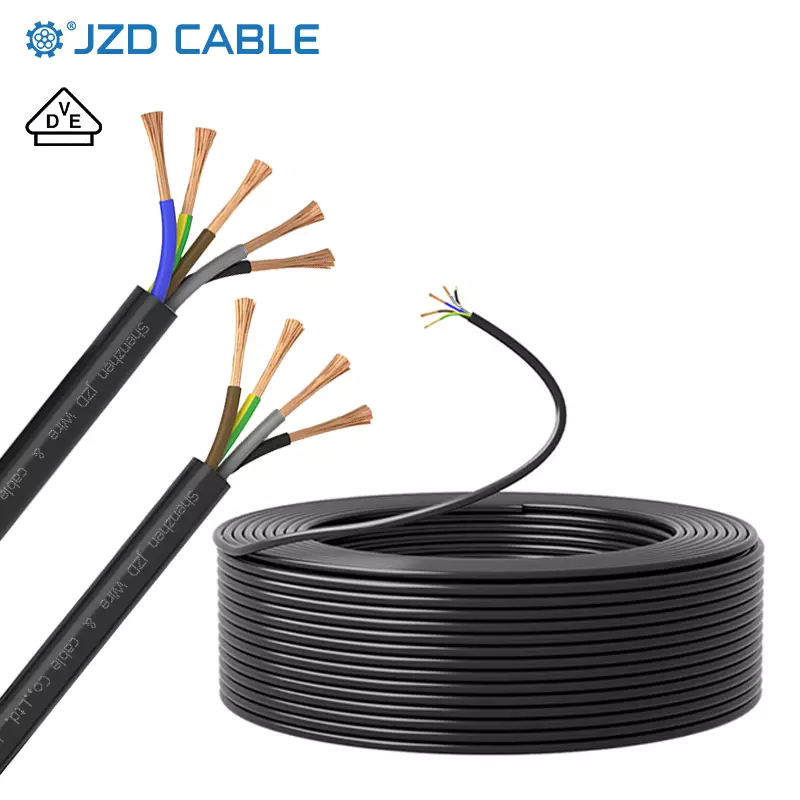
Flexible cable uses finely stranded conductors, corresponding to Class 5 or Class 6 under IEC 60228 / VDE 0295. Class 5 is finely stranded, with strand count depending on cross-section; for example, at 16 mm² and above, it typically exceeds 100 strands. Class 6 is extra-finely stranded, and at 4 mm² and above, it often exceeds 200 strands, and the individual strand diameter is significantly smaller.
The purpose of fine stranding is to distribute bending stress. The thinner the individual strand, the lower the surface strain during bending, and the longer the fatigue life. At the same bending radius and cycle count, Class 6 conductors typically last significantly longer than Class 5, and Class 5 far outlasts Class 2.
The table below compares the conductor classes.
| Conductor Class | Stranding | Individual Strand Diameter | Flexibility | Fatigue Life |
| Class 1 | Solid | – | Very low | Very short |
| Class 2 | Stranded (7–127 strands) | Thick | Low | Short |
| Class 5 | Fine stranded (>100 strands at ≥16 mm²) | Thin | High | Long |
| Class 6 | Extra-fine stranded (>200 strands at ≥4 mm²) | Very thin | Very high | Very long |
2. Beyond Strand Count: Lay Length and Cabling
But strand count is not the only variable. Flexible cable for continuous motion also requires:
- Shorter lay length. The distance over which strands complete one full twist is shorter, reducing relative movement between strands and internal friction.
- Multiple stranding. Conductors are first bunched, then stranded, and finally cabled. Alternating stranding directions reduces torsional stress.
- Optimized cabling lay length. Shorter cabling lay length means less length variation among cores during bending, preventing individual cores from being overstretched.
3. When Fine Stranding Alone Is Not Enough
If a conductor uses fine stranded but has a long lay length and loose cabling, the cable can still experience strand breakage and core displacement under continuous bending. Beyond conductor structure, the behavior of the jacket and insulation under dynamic conditions is equally critical.
Jacket and Insulation: Material Behavior Under Dynamic Conditions
1. PVC Jackets: Limited Dynamic Performance
PVC jackets are low-cost and provide adequate weather resistance and insulation for general requirements, but under repeated bending they are prone to compression set and notch propagation. At low temperatures, PVC becomes hard and cracks more easily during bending. Therefore, PVC flexible cable is usually suitable only for occasional movement or static installation.
2. PUR Jackets: Common for Dynamic Applications
PUR jackets are more common in dynamic applications. PUR offers better abrasion resistance, oil resistance, and tear resistance than PVC, and maintains good flexibility under repeated bending. However, its long-term resistance to moisture is not as good as some rubber materials, so it must be evaluated based on the specific application.
3. Rubber Jackets: Stable Under Harsh Conditions
Rubber jackets, such as chloroprene rubber or CPE, perform more stably in combined low-temperature, oil, and mechanical stress environments. The cross-linked structure of rubber does not rely on plasticizers, so it does not harden easily after long-term bending. The drawbacks are higher weight and higher manufacturing cost.
4. Insulation Materials Under Dynamic Load
Insulation materials also matter under dynamic conditions. PVC insulation is low-cost but may harden after repeated bending. XLPE insulation offers better thermal aging resistance and is suitable for high-temperature dynamic environments. Silicone insulation is used for higher temperatures or special applications. Selection should evaluate both jacket and insulation, not just one of them.
In addition to materials, the bending radius during installation directly affects cable life.
The table below compares common jacket materials for dynamic applications.
| Jacket Material | Abrasion Resistance | Oil Resistance | Low-Temp Flexibility | Moisture Resistance | Relative Cost |
| PVC | Moderate | Low | Poor | Good | Low |
| PUR | High | High | Good | Moderate | Medium |
| Rubber (CPE/CR) | High | High | Excellent | High | High |
Bending Radius: Dynamic Requirements Are Much Higher Than Static
1. Static vs. Dynamic Bending Radius
Bending radius is one of the most underestimated parameters in selection.
For fixed installation, standard cable typically allows a minimum bending radius of 4–6 times the outer diameter. For flexible cable in static installation, the minimum is usually 3–4 times OD. But in cable chains, reels, or continuous bending applications, the dynamic bending radius requirement is typically 6–10 times OD, depending on cable construction and cycle frequency.
2. Consequences of Insufficient Bending Radius
If a dynamic cable is installed at a static bending radius, it is forced into tighter bends than its construction allows. Problems may not appear immediately, but jacket and conductor fatigue accelerates. In cable chains, an insufficient bending radius can also cause the cable to slide and twist inside the chain links, further shortening life.
3. Installation Practices in Cable Chains
Installation method in cable chains is equally critical. Cables should have appropriate slack, not be taut. Multiple cables should use separators to maintain spacing and avoid mutual friction. The bending direction of the cable should match the conductor stranding direction to reduce torsional stress. Once bending radius and installation method are determined, ampacity and derating are the next parameters to verify.
Ampacity and Derating: Flexible Does Not Automatically Mean Higher Ampacity
1. Temperature Rating and Ampacity
Flexible cable does not automatically have a higher ampacity than standard cable of the same cross-section just because it is “flexible.” Ampacity depends on conductor size, insulation temperature rating, and installation conditions.
But two factors are important for engineering selection:
Temperature rating. Flexible cable is available with 70°C, 90°C, or higher insulation ratings. After derating, a 90°C flexible cable can carry more current than a 70°C standard cable of the same gauge.
2. Bundled Conductor Derating
Bundled derating. When multiple current-carrying conductors are cabled or bundled, ampacity must be derated per applicable codes. Flexible cables in cable chains are often densely packed, making bundled conductor derating a routine consideration. If this is ignored, the cable may operate above its allowable ampacity, accelerating insulation aging.
3. Shielding and EMC in Servo/VFD Applications
In addition, flexible cable used for servo drives or variable frequency drives must consider shielding and capacitance effects on the system. Shielding can be damaged under repeated bending, degrading EMC performance. Selection should confirm whether the shield structure is suitable for dynamic applications, such as braided shield coverage and stranding method. These performance requirements ultimately need to be verified through certification and testing.
Certification and Testing: Verification Points
Common Certifications
Flexible cable for industrial export markets typically carries one or more of the following certifications:
- IEC 60228 / VDE 0295: conductor class designation (Class 5 or Class 6);
- UL 758: Appliance Wiring Material; or UL 62: flexible cord;
- VDE / EN 50525: European flexible cable types such as H07RN-F;
- VW-1: vertical wire flame test;
- CE: EU market access marking.
FAQ
1. Is flexible cable always more expensive than standard cable?
Generally, yes. Fine stranding, tighter cabling, and higher-performance jacket materials increase manufacturing cost. But in dynamic applications, downtime and replacement labor from repeated standard cable failures often exceed the initial price difference.
2. Can standard cable be used in a cable chain?
Not reliably. Standard cable will experience conductor fatigue and jacket wear under continuous bending, and its life is typically far shorter than a properly specified flexible cable. The cycle life difference can be 10× or more.
3. Does a higher strand count always mean better flexibility?
Not necessarily. Strand count is necessary but not sufficient. Lay length, insulation material, jacket material, and cable geometry also determine performance under repeated bending.
4. What is the minimum bending radius for flexible cable?
It depends on whether the application is static or dynamic. Static installation typically allows 3–4× OD; continuous bending typically requires 6–10× OD. Always verify against the manufacturer’s specification for the specific cable construction.
If you are selecting flexible cable for industrial equipment, automation, or moving machinery applications and need conductor class verification, certification documents, or bulk supply options, please contact us for more information.