

Navigating cable specifications involves understanding the materials that define their performance and safety. Two critical terms you’ll encounter are LZSH (Low Smoke Zero Halogen) and XLPE (Cross-Linked Polyethylene). A common misconception is that they are directly comparable cable types. In reality, they represent different dimensions of cable design: LZSH is a safety-first material system, while XLPE is a performance-first insulating material. This guide will demystify their core differences, show how they are brilliantly combined in cables like WDZ-YJV, and provide a clear framework for selection.
Part 1: Core Definitions and Fundamental Differences
At their heart, LZSH and XLPE serve different primary purposes in cable construction.
|
Aspect
|
LZSH (Low Smoke Zero Halogen)
|
XLPE (Cross-Linked Polyethylene)
|
|---|---|---|
|
Definition
|
A material system defined by its composition: insulation and sheathing that contains no halogens and produces low smoke and non-toxic fumes when burned.
|
An insulation material where polyethylene is chemically or physically treated to create cross-links, drastically improving its thermal and electrical properties.
|
|
Primary Role
|
Can be used for both insulation and sheathing. Focus is on life safety and environmental protection during a fire.
|
Primarily used as the insulation layer. Focus is on electrical integrity, thermal stability, and longevity under operational stress.
|
|
Key Standards
|
IEC 60754 (Halogen Acid Gas), IEC 60332 (Flame Propagation), IEC 61034 (Smoke Density)
|
IEC 60228 (Conductors), IEC 60502 (Power Cables), GB/T 12706 (Chinese National Standard)
|
|
Core Advantage
|
Fire Safety: Minimal smoke, no corrosive halogen gases, environmentally friendly.
|
Performance: High long-term thermal rating (90°C), excellent short-circuit withstand (250°C), higher current capacity, and very low dielectric loss.
|
|
Main Limitation
|
Higher cost, slightly lower flexibility, and generally inferior weather resistance compared to some specialized compounds.
|
In its standard form, it can produce smoke and potentially halogen gases when burned. It is also more expensive than ordinary PE.
|
Part 2: Key Performance Comparison
|
Property
|
LZSH Material
|
XLPE Material
|
|---|---|---|
|
Fire Behavior
|
Excellent. Low smoke, no halogen acid gases, self-extinguishing (with flame-retardant formulations).
|
Poor (in standard form). Can produce smoke and halogens. However, when formulated as LZSH-XLPE, it combines the best of both.
|
|
Temperature Rating
|
Typically 70-90°C, depending on the specific compound.
|
Superior. Rated for continuous operation at 90°C and can withstand short circuits up to 250°C.
|
|
Electrical Performance
|
Adequate for low-voltage applications. Dielectric loss is generally higher than XLPE.
|
Excellent. Low dielectric constant (~2.3) and extremely low dissipation factor (<0.0003). Ideal for medium-voltage, high-frequency, and long-distance power distribution.
|
|
Mechanical & Environmental
|
Good flexibility. Resistance to environmental stress cracking can vary.
|
Excellent toughness, tear resistance, and superior resistance to Environmental Stress Cracking (ESCR).
|
Part 3: The Best of Both Worlds: The WDZ-YJV Cable
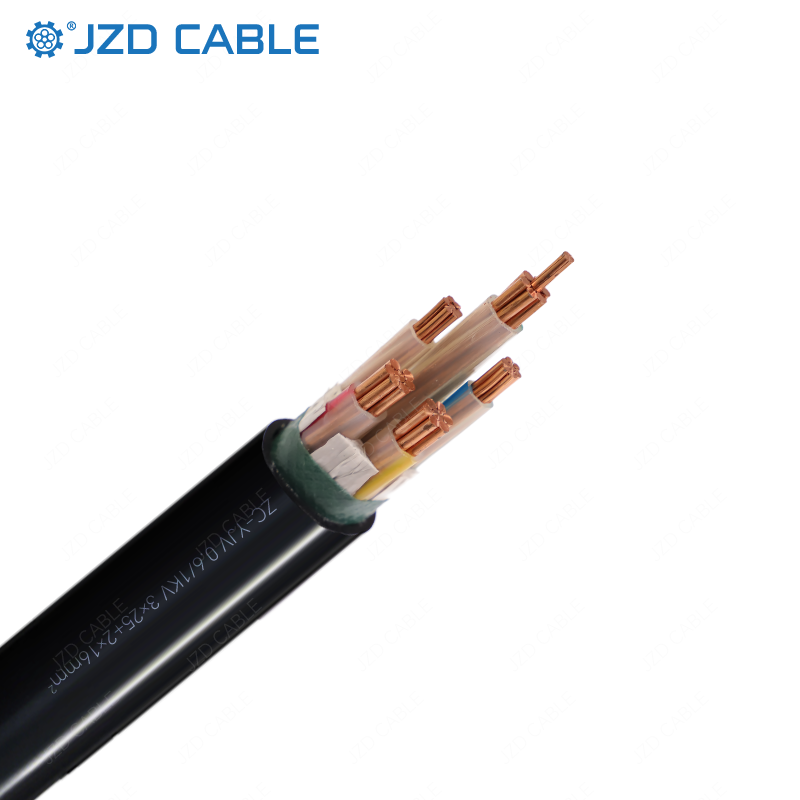
The engineering solution isn’t always a choice betweenLZSH and XLPE, but a strategic combination. The WDZ-YJV cable is a prime example:
- Insulation: Uses XLPE for its superior electrical and thermal performance.
- Sheathing/Jacket: Uses LZSH compounds to provide the crucial low-smoke, zero-halogen, and flame-retardant properties.
This hybrid design delivers a cable fit for modern safety-critical applications without compromising on electrical efficiency or current-carrying capacity.
Part 4: Application Scenarios & Selection Guide
Choosing the right material depends overwhelmingly on the installation environment and priority.
1.Choose LZSH-Based Cables (or LZSH-Sheathed Cables) when safety in fire is paramount:
- Public Transport: Subways, railway stations, airports.
- High-Rise Buildings: Escape routes, atriums, elevator shafts.
- Confined Spaces: Data centers, server rooms, telecommunications hubs, shipboard and offshore platform wiring.
- Public Venues: Shopping malls, hospitals, cinemas, theaters.
2.Choose XLPE-Insulated Cables (often with PVC sheath) for pure performance and durability:
- Power Distribution: Urban grid networks, utility power lines.
- Renewable Energy: Solar (PV) farms, wind farm collection systems.
- Industrial Power: Factory floor power distribution, motor feeder cables.
- Medium-Voltage Networks: Where low dielectric loss is critical.
Choose Composite Cables like WDZ-YJV for the optimal balance:
- When you need both the high current capacity and thermal stability of XLPE and the fire safety of LZSH. This is increasingly the standard for new installations in commercial and critical infrastructure.
Part 5: Frequently Asked Questions (FAQ)
Q: Is XLPE fireproof?
A: No. Standard XLPE is flammable. Its advantage is operational thermal stability. For fire safety, it must be combined with flame-retardant and low-smoke zero-halogen (LSZH) sheathing materials.
Q: Can a cable be both LZSH and XLPE?
A: Absolutely. This is a common and high-performance design. The XLPE provides the primary insulation, and an LZSH compound is used for the outer sheath (and sometimes the bedding). The cable is described as “XLPE insulated, LZSH sheathed.”
Q: Which is more expensive, LZSH or XLPE cable?
A: Cables using LZSH compounds are generally more expensive than standard PVC cables. XLPE insulation also adds cost compared to standard PE. Therefore, a high-performance cable using both XLPE insulation and an LZSH sheath (like WDZ-YJV) represents a premium product justified by its combined safety and performance benefits.
Q: For a standard industrial plant, which should I choose?
A: Assess the risk. For well-ventilated, non-public areas with separate fire compartments, standard XLPE/PVC (e.g., YJV) may suffice. For any area with personnel, control rooms, or escape paths, specifying an XLPE/LZSH (e.g., WDZ-YJV) cable is a safer, more modern, and often code-mandated choice.
Make the Informed Choice with JZD Cable
At JZD Cable, we specialize in manufacturing cables that meet precise application needs. Whether your project demands the ultimate fire safety of LZSH systems, the robust performance of XLPE, or the advanced hybrid technology of our WDZ-YJV range, we provide reliable, standards-compliant solutions.
Contact us today to discuss your specific cable requirements and get a quote for your project. Visit our website for more technical information on our product portfolio.