

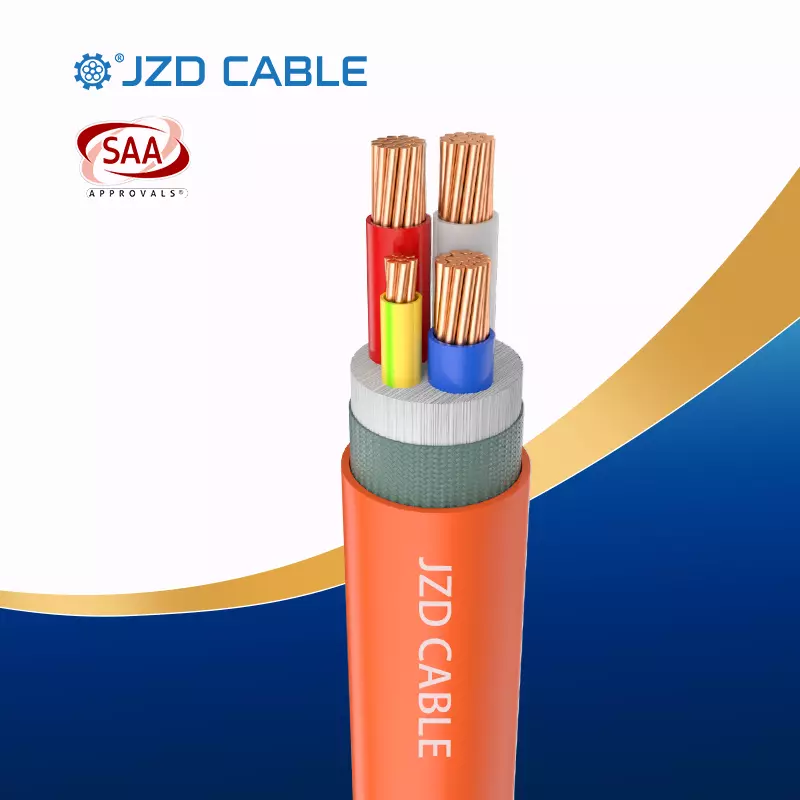
Orange power cables are widely used in Australian and New Zealand markets, especially under the AS/NZS standard where two common types exist: V-90 (PVC insulated) and X-90 (XLPE insulated) . While both share the same distinctive orange sheath, their internal insulation materials differ significantly—affecting performance, safety, and application suitability.
Material Composition
PVC (V-90) – Polyvinyl chloride is a thermoplastic material. It softens when heated and can be remelted repeatedly. This makes it easy to process but limits its thermal stability.
XLPE (X-90) – Cross-linked polyethylene is a thermoset material. Its molecular structure forms a three-dimensional network that does not melt or deform under high temperatures. Once cured, the change is irreversible.
Performance Comparison
|
Parameter
|
PVC (V-90)
|
XLPE (X-90)
|
|---|---|---|
|
Continuous operating temperature
|
90°C
|
90°C
|
|
Short-circuit withstand temp (≤5s)
|
160°C
|
250°C
|
|
Current carrying capacity (same cross-section)
|
Baseline
|
~20% higher
|
|
Dielectric constant
|
3.4–3.6
|
≈2.3 (lower loss)
|
|
Breakdown strength
|
18–30 kV/mm
|
30–40 kV/mm (higher)
|
|
Thermal aging resistance
|
Poor – becomes brittle at high temps
|
Excellent – long-term stable
|
|
Weathering / UV resistance
|
Moderate – outdoor use may cause degradation
|
Good – suitable for prolonged outdoor exposure
|
|
Burning characteristics
|
Self-extinguishing but releases toxic HCl gas
|
Low smoke, zero halogen, low toxicity
|
|
Voltage rating
|
Mainly low voltage (≤1kV)
|
Low / medium / high voltage (up to 500kV)
|
|
Cost
|
Lower
|
Slightly higher (approx. 10–20%)
|
Application Scenarios
PVC (V-90) Orange Cable
- Indoor installations, dry environments, low-voltage distribution.
- Cost-sensitive projects without high-temperature or outdoor requirements.
- Suitable for general building wiring where flame retardance is needed but toxicity is less of a concern.
XLPE (X-90) Orange Cable
- Outdoor use, direct burial, solar/wind farms, high-temperature industrial settings.
- Applications demanding higher current capacity, longer service life, and enhanced safety (e.g., public buildings, data centers).
- Medium to high voltage power transmission (up to 500kV).
Which One Should You Choose?
Choose PVC V-90 when budget is tight, the environment is indoor and dry, and voltage is below 1kV. Choose XLPE X-90 when you need superior thermal performance, higher ampacity, better UV resistance, and low-smoke halogen-free safety—especially for critical infrastructure or outdoor/harsh conditions.
At JZD Cable, we supply both PVC and XLPE orange power cables fully compliant with AS/NZS standards. Contact us to find the perfect solution for your next project.