

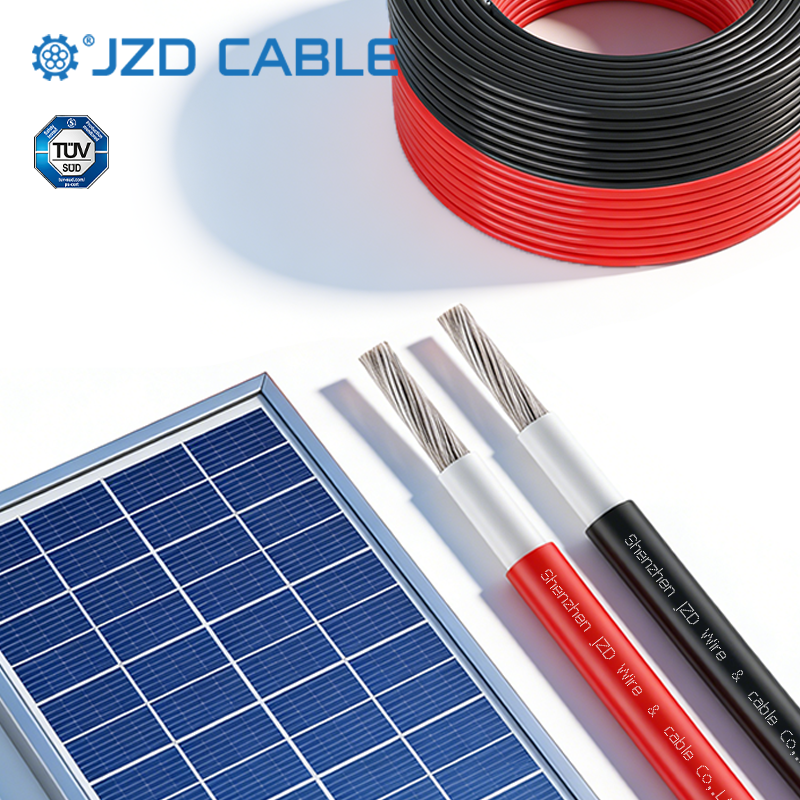
Are you planning a coastal or offshore solar project and wondering if your standard photovoltaic (PV) cable is up to the task? The direct answer is a firm no. Using ordinary PV cable (like the common H1Z2Z2-K type) in a marine environment is a shortcut to premature system failure, safety risks, and costly repairs. The sea presents a uniquely harsh set of challenges that land-based cables are not engineered to withstand.
At JZD Cable, we specialize in durable cable solutions. Understanding the right cable for the right environment is crucial for the longevity and ROI of your solar investment. Let’s dive into why standard cables fail at sea and what you trulyneed.
Part 1: The Sea’s “Killer Combo” – Why Ordinary PV Cable Fails Offshore
Standard PV cables are certified for terrestrial and rooftop environments. The marine setting, however, attacks cables with a destructive combination of factors:
- Salt Mist Corrosion: Airborne salt particles combined with moisture create a highly corrosive saline mist. This accelerates the aging of the insulation and outer sheath. More critically, it causes rapid corrosion of any metallic components, like shielding or connection terminals, leading to increased resistance, hot spots, and potential arc faults.
- High Humidity & Mold: Constant high humidity is the norm offshore. Ordinary cable materials can absorb moisture, promoting the growth of mold and fungi. This biological attack can cause the layers of the cable to delaminate, crack, and lose their insulating properties.
- Intense UV & Constant Motion: Offshore sites experience stronger, more direct sunlight, demanding superior UV resistance. Furthermore, cables are subjected to persistent wind, wave action, and tidal forces, causing constant flexing, twisting, and abrasion. A standard cable sheath will quickly wear through, exposing conductors to the elements.
Part 2: The 4 Non-Negotiable Specs for True Offshore PV Cable
A cable designed for marine photovoltaic applications must be built to a far more rigorous standard. Look for a cable explicitly rated as “Salt-Resistant, Seawater-Resistant, Fungus-Resistant, and UV-Reinforced.” It must possess:
- Superior Resistance to Salt, Humidity, and Fungus: The jacketing and insulation compounds must be specially formulated to resist saltwater corrosion, prevent moisture ingress, and include biocides to inhibit mold growth.
- Direct Seawater Immersion/Splash Resistance: The cable should maintain its integrity and electrical properties even when fully immersed in or constantly sprayed with seawater.
- Enhanced UV Stabilization: The outer sheath requires advanced UV stabilizers to prevent cracking, chalking, and degradation from relentless sun exposure.
- Excellent Torsion, Flexing & Fatigue Resistance: The cable’s construction must withstand constant mechanical stress—twisting, bending, and vibration—without damage to its core components. This ensures long-term reliability on floating platforms or in dynamic coastal installations.
Part 3: Quick Guide: Choosing the Right Cable for Your Project
Making the correct choice is simpler when you define the environment clearly:
- For Near-Shore & Coastal Rooftop Projects: If your installation is on a seaside building or a structure very close to the coast, a heavy-duty, salt-mist resistant PV cable is typically sufficient. It offers enhanced protection against the corrosive coastal atmosphere.
- For True Offshore or Floating PV Plants: For any installation on floating pontoons, buoys, or structures directly on the open water, only a dedicated offshore/marine-grade PV cable is acceptable. This is non-negotiable for safety, compliance, and project bankability.
Conclusion: Don’t Let Your Cables Be the Weakest Link
The immense potential of offshore solar is matched by the severity of its environment. Compromising on cable specification is a high-risk decision that jeopardizes the entire system’s performance and safety. Investing in the correctly rated cable from the start is the most cost-effective strategy over the project’s lifetime.
For your next coastal or marine solar project, ensure its foundation is built with reliability. The right cable is the first step. Explore robust, application-specific cable solutions designed for demanding environments at jzdcable.com.
-4-3.jpg)