

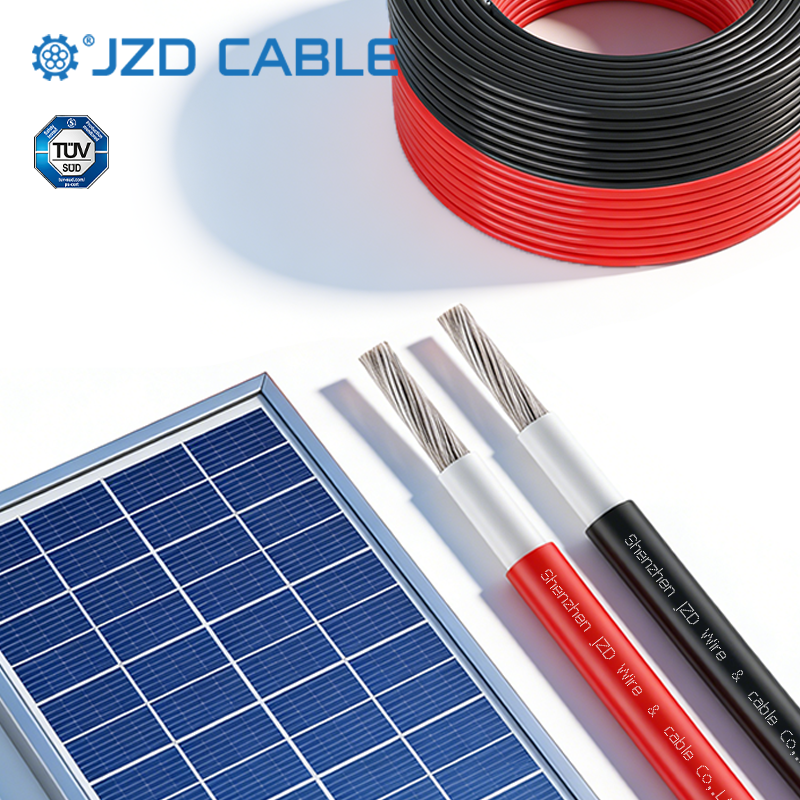
In the world of photovoltaic (PV) power plants, every component plays a crucial role in maximizing energy yield and ensuring long-term reliability. While panels and inverters often steal the spotlight, the cabling that connects them is the unsung hero. Among these, the 6mm² photovoltaic cable (commonly corresponding to 10 AWG) stands out as the industry’s go-to workhorse for DC-side connections. At JZD Cable, we understand that choosing the right cable is foundational to system performance. This guide delves deep into why the 6mm² solar cable is indispensable for modern PV installations.
Core Role: The DC-Side Power Highway
The 6mm² PV cable is specifically designed for the direct current (DC) side of a solar array. It is the standard conductor for carrying generated power from the solar panels to the inverter. Its primary applications include:
- Module Interconnection: Connecting individual solar panels in series to form a “string.”
- String to Combiner Box: Serving as the main DC branch line from a series string to a combiner/ junction box.
- Combiner Box to Inverter: Acting as the DC main line where multiple strings are combined before reaching the inverter.
Important Note: This cable is not used for the AC grid-connection side. It is optimized for the specific demands of rooftop (residential/commercial), ground-mount, and distributed generation systems.
Technical Specifications: The Foundation of Safe Selection
Choosing a 6mm² cable isn’t just about size; it’s about certified performance. JZD Cable’s 6mm² PV cables comply with international standards like IEC 62930, EN 50618, and GB/T 32129, and carry essential TUV certification.
Here are the key parameters that define its capability:
- Conductor: Multi-stranded, tinned soft copper for excellent flexibility, oxidation resistance, and corrosion prevention.
- DC Resistance: ≤ 3.39 Ω/km at 20°C, ensuring minimal power loss.
- Current Carrying Capacity (Ampacity): This is the core specification. With single cable free-air installation at 40°C ambient temperature, the continuous current rating is approximately 55A. This de-rates to ~50A at 60°C and ~45A at 70°C, making temperature correction vital for design.
- Short-Circuit Withstand: Can withstand 250°C for up to 5 seconds.
- Voltage Rating: Rated for DC 1.8kV, making it fully compatible with both 1000V and 1500V system voltages. Use PV1-F 1x6mm² for 1000V systems and H1Z2Z2-K 1x6mm² for 1500V systems.
- Insulation/Sheath: Made from cross-linked polyolefin (XLPO), offering superior resistance to UV radiation, ozone, weather, and abrasion. It is halogen-free, low-smoke, and flame-retardant. Operating temperature range: -40°C to +120°C.
- Lifespan: Designed for an outdoor service life of 25 years or more.
- Minimum Bending Radius: ≥ 6 x cable diameter (~48-54mm), allowing for easy installation on roofs and mounting structures.
Key Application Scenarios: Where to Use 6mm² PV Cable
Understanding where to apply this cable ensures efficiency, safety, and compliance.
1. Within PV Strings (Module Interconnection)
- Use Case: Connecting high-power modules (550W and above) in series. As module Imp (Current at Maximum Power) increases to 12-15A or more, the 6mm² cable provides a lower voltage drop and reduced thermal loss compared to smaller 4mm² cables, maximizing string output.
2. String to Combiner Box (DC Branch Lines)
- Use Case: In installations where string lengths are between 15-40 meters, or in high-temperature environments (e.g., hot roofs, desert climates), the 6mm² cable is preferred. It ensures the voltage drop from the string to the combiner box remains within the industry standard of ≤2%, preserving system efficiency.
3. Combiner Box to Inverter (DC Main Lines)
- Use Case: Ideal for small to medium-scale systems where the distance between the combiner box and inverter is 20-50 meters. It is used when the total combined current from multiple parallel strings does not exceed its safe ampacity (e.g., 55A at 40°C ambient).
4. Demanding Environments
- Use Case: The robust construction of cables like JZD Cable’s 6mm² makes it suitable for challenging conditions: mountainous terrain, coastal/salty air, high UV regions, high altitudes, and even short DC connections in battery energy storage systems (BESS).
Installation & Wiring Best Practices
Proper installation protects your investment and guarantees performance.
- Outdoor Exposure: Secure the cable along mounting rails or structures using UV-resistant ties or clamps at intervals ≤ 80cm to prevent wind-induced abrasion. Always use IP67-rated MC4 connectors; never leave splices exposed.
- In Conduit or Cable Tray: Maintain a minimum separation of 30cm from AC cables to avoid electromagnetic interference. Do not fill conduits beyond 40% capacity to allow for proper heat dissipation.
- Direct Burial: For underground runs, always use an armored version (e.g., PV1-F-22) inside a PVC or PE conduit, buried at a depth of at least 70cm to protect against rodent damage and mechanical stress.
Conclusion: A Critical Component for Optimal Performance
The 6mm² solar cable is far more than just a wire; it is a precisely engineered component critical to the safety, efficiency, and longevity of any photovoltaic plant. By specifying a high-quality, certified 6mm² PV cable from a trusted manufacturer like JZD Cable, system designers and installers can ensure lower lifetime costs, higher energy yields, and unwavering reliability.
Ready to specify the right cable for your next project? Explore JZD Cable’s range of certified and high-performance photovoltaic cables at jzdcable.com.