

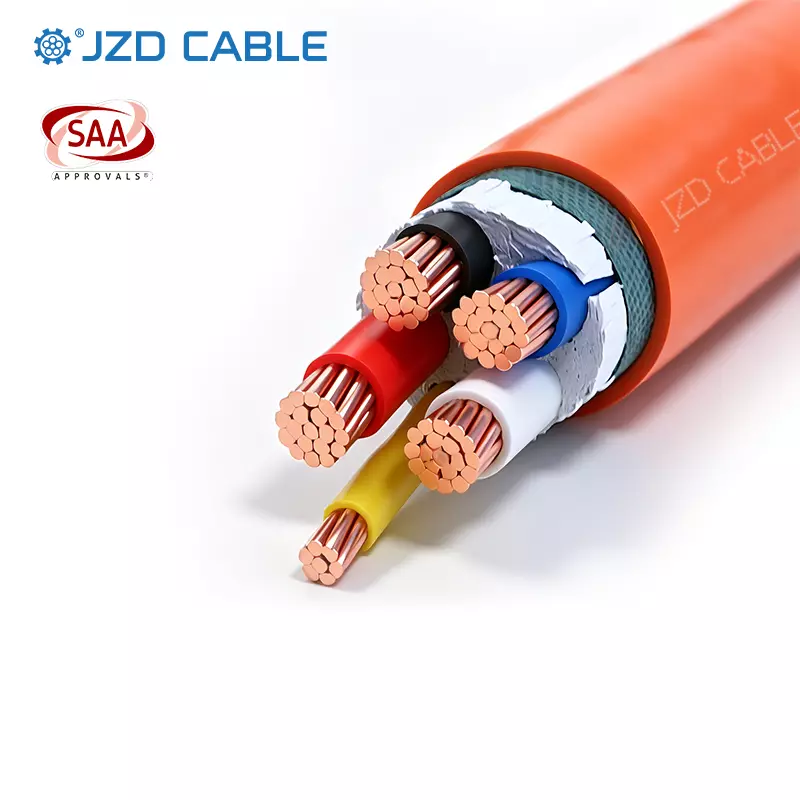
When specifying orange circular power cables for Australian and New Zealand projects, the choice between 3C+E and 4C+E is fundamental. Both are AS/NZS 5000.1 compliant and share the distinctive orange outer sheath, but their internal structure dictates entirely different applications. Choosing incorrectly can lead to system incompatibility, safety issues, and costly rework.
This guide from JZD Cable, a professional manufacturer of AS/NZS standard cables, breaks down the key differences to ensure you select the perfect cable for your electrical design.
The Core Difference at a Glance
While they look similar, the heart of the matter is the neutral conductor.
|
Feature
|
3C+E Orange Cable (3 Core + Earth)
|
4C+E Orange Cable (4 Core + Earth)
|
|---|---|---|
|
Conductor Makeup
|
3 phase conductors (L1, L2, L3) of equal cross-section + 1 Earth (PE)
|
3 phase conductors (L1, L2, L3) + 1 Neutral (N) + 1 Earth (PE)
|
|
Standard Colours
|
Red, White, Blue (Phase) + Green/Yellow (Earth)
|
Red, White, Blue (Phase), Black (Neutral) + Green/Yellow (Earth)
|
|
Key Differentiator
|
No independent neutral conductor (N).
|
Includes an independent neutral conductor (N).
|
Electrical Systems & Applications: Why Structure Dictates Use
The presence or absence of the neutral wire directly links to the type of electrical system and the loads being served.
1.Where to Use 3C+E Orange Cable
This cable is designed for three-phase, three-wire systems. It is the ideal choice for balanced three-phase loads where the neutral current is negligible or zero.
- Primary Application: Pure three-phase equipment.
- Common Uses:
- Industrial motors, pumps, compressors, and HVAC systems.
- Factory and workshop machinery supply.
- Main power feeders in industrial settings with no single-phase branch circuits.
- IT or TT earthing systems without significant single-phase loads.
- Important: It cannot be used to supply standard 230V single-phase outlets, lighting, or appliances directly, as it lacks a dedicated neutral conductor.
2.Where to Use 4C+E Orange Cable
This is the standard cable for three-phase, four-wire systems (TN-S). It is essential in any installation where three-phase and single-phase loads are combined.
- Primary Application: Mixed three-phase and single-phase power distribution.
- Common Uses:
- Commercial buildings, shopping centers, and residential apartment mains.
- Office floors, data centers, and retail spaces with lighting, power sockets, and IT equipment.
- Any circuit with potentially unbalanced three-phase loads (where the neutral carries the imbalance current).
- The standard main riser and distribution cable for most modern buildings.
How to Choose: Key Decision Factors
1.For 3C+E:
- Cost & Size Efficient: Generally more cost-effective and has a smaller overall diameter for a given conductor size, simplifying installation.
- Load Specific: Use only for dedicated, balanced three-phase loads (e.g., a large motor).
- No Single-Phase Power: Never select it if you need to derive 230V single-phase power from the circuit.
2.For 4C+E:
- Full Compatibility: The default, future-proof choice for building power distribution. It handles both three-phase equipment and all single-phase devices.
- Carries Imbalance: The neutral wire safely carries the return current from unbalanced single-phase loads.
- The Standard for Buildings: It is the typical specification for mains, sub-mains, and final sub-circuits supplying a mix of loads.
Conclusion: Matching the Cable to the System
The choice is clear-cut:
- Select 3C+E when you are wiring a dedicated, balanced three-phase machine or a pure three-phase circuit in an industrial setting.
- Choose 4+CE for virtually all general building and facility power distribution where a combination of three-phase and single-phase (230V) power is required.
Understanding this critical distinction ensures a safe, compliant, and functional electrical installation. For your next project requiring reliable, standards-compliant Orange Circular Cables, ensure you specify correctly.
Need help specifying the right cable for your project? Contact the experts at JZD Cable for technical support and quotations on AS/NZS 5000.1 compliant cables.