

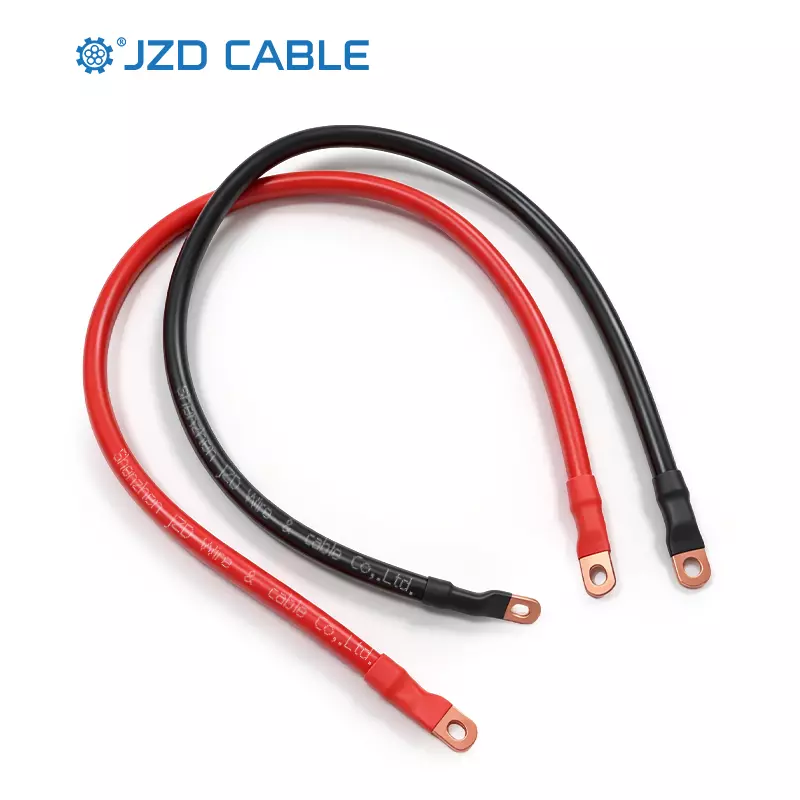
When selecting a battery cable for your automotive, solar, energy storage, or industrial project, two of the most common options are PVC battery cable and silicone battery cable. While both serve the same basic function — carrying DC current between batteries and loads — they differ dramatically in performance, durability, and cost.
Choosing the wrong type can lead to premature cable failure, fire risk, or unnecessary expense. This guide breaks down the key differences across ten critical dimensions, helping you make the right decision for your specific application.
At a Glance: PVC vs Silicone Battery Cable
|
Comparison Dimension
|
PVC Battery Cable
|
Silicone Battery Cable
|
|---|---|---|
|
Insulation Material
|
Polyvinyl chloride (PVC)
|
Silicone rubber (SiR)
|
|
Temperature Range
|
Standard: –20°C to +70°C
Heat-resistant: up to +105°C |
Standard: –60°C to +180°C
Premium: –60°C to +200°C (peak 250°C) |
|
Flexibility
|
Moderate; becomes stiff in cold
|
Extremely soft across entire temperature range
|
|
Bending Radius
|
≥ 6 × cable outer diameter
|
≥ 3 × cable outer diameter
|
|
Flame Retardancy
|
Standard VW-1; may drip at high temperature
|
UL94 V-0 / VW-1; self-extinguishing, no dripping, low smoke
|
|
Weather & UV Resistance
|
3–5 years outdoor; hardens and cracks
|
8–10 years outdoor; excellent UV and ozone resistance
|
|
Oil & Chemical Resistance
|
Moderate; long-term contact degrades PVC
|
Good; resists oils, acids, alkalis, moisture
|
|
Current Capacity
|
Baseline (standard ampacity)
|
~20% higher than same-size PVC (better heat dissipation)
|
|
Price
|
Low (best value)
|
2–3× higher than PVC
|
|
Mechanical Protection
|
Hard surface, good scratch and wear resistance
|
Soft surface; prone to cuts from sharp edges
|
Detailed Comparison
1. Insulation Material
PVC battery cable uses polyvinyl chloride as the insulation layer. It is a thermoplastic material that provides a good balance of electrical insulation, mechanical strength, and low cost. Some grades include heat-resistant or flame-retardant additives.
Silicone battery cable uses silicone rubber (silicon dioxide-based elastomer). It is a thermoset material that remains stable across an exceptionally wide temperature range and does not melt or drip when exposed to flame.
2. Temperature Range
This is the single biggest differentiator:
- PVC: Standard grades operate from –20°C to +70°C. Heat-resistant PVC can reach +105°C, but performance degrades near the upper limit. Below –20°C, PVC becomes brittle and may crack during installation or vibration.
- Silicone: Standard silicone operates from –60°C to +180°C. Premium grades extend to +200°C continuously, with short-term peaks up to 250°C. Silicone remains flexible even at –60°C — no cold cracking.
Impact: If your cable runs through an engine compartment (summer heat), an Arctic outdoor solar farm, or a battery pack that heats up during fast charging, silicone is the only safe choice.
3. Flexibility & Bend Radius
- PVC: Moderate flexibility at room temperature. As temperature drops, PVC stiffens noticeably. Minimum bend radius is 6× cable outer diameter. Repeated bending can cause stress cracking over time.
- Silicone: 3–5× softer than PVC of the same gauge. Minimum bend radius is only 3× outer diameter. The ultra-fine copper stranding (often 0.08 mm filaments, hundreds of strands) combined with soft silicone allows tight routing in cramped spaces and hundreds of thousands of flex cycles without failure.
Impact: For robotics, drone battery leads, EV battery pack internal wiring, or any application with frequent movement, silicone is vastly superior.
4. Flame Retardancy
- PVC: Meets VW-1 / IEC 60332-1-2 — self-extinguishing under controlled conditions. However, PVC can drip molten material at high temperatures, potentially spreading fire to surrounding components.
- Silicone: Achieves UL94 V-0 — the highest flammability rating for plastics. It self-extinguishes immediately, produces no dripping, generates minimal smoke, and emits non-toxic gases.
Impact: For enclosed battery boxes, lithium-ion systems, and fire-sensitive installations (data centers, hospitals, residential ESS), silicone provides a critical safety margin.
5. Weather & UV Resistance (Outdoor Lifespan)
- PVC: Outdoors, PVC degrades under UV exposure. After 3–5 years, it typically hardens, cracks, and loses flexibility. Not recommended for permanent outdoor exposed runs.
- Silicone: Naturally UV and ozone resistant. Outdoor lifespan is 8–10 years without significant degradation. Remains flexible and crack-free.
Impact: For rooftop solar, outdoor storage containers, marine decks, or any permanently exposed installation, silicone is the clear winner.
6. Oil & Chemical Resistance
- PVC: Moderate resistance. Short-term contact with grease and mild oils is acceptable, but prolonged exposure to petroleum products, strong acids, or alkalis causes swelling, hardening, or embrittlement.
- Silicone: Good resistance to a wide range of chemicals including engine oils, diesel, acids, alkalis, and moisture. Chemically inert — does not react with battery electrolyte fumes.
Impact: In engine bays, hydraulic equipment, or industrial plants with chemical vapors, silicone outperforms PVC.
7. Current Capacity (Ampacity)
Due to better heat dissipation, silicone-insulated cables can carry approximately 20% more current than the same-size PVC cable at the same temperature rise. This means:
- For a given load, you can sometimes downsize the conductor gauge with silicone, saving weight and space.
- Alternatively, silicone provides a safety margin in high-current applications.
Example: A 25 mm² silicone cable may carry ~140 A where a 25 mm² PVC cable is limited to ~115 A (values depend on ambient temperature and installation method).
8. Price
- PVC: The most economical option. Widely available, low material cost, and simple manufacturing. Best for budget-constrained projects.
- Silicone: Typically 2–3× the price of PVC due to higher raw material cost (silicone rubber) and more complex extrusion process.
Value perspective: The premium for silicone is justified when its temperature, flexibility, fire safety, or longevity benefits are needed. For benign indoor fixed installations, PVC remains the smart economic choice.
9. Mechanical Protection
- PVC: The insulation is relatively hard and rigid. It offers good scratch and abrasion resistance for fixed installations. However, it can crack under repeated impact or in severe cold.
- Silicone: The insulation is soft and compliant. It absorbs vibration well but is prone to cuts and punctures from sharp edges. For routes with high mechanical abuse, a jacketed silicone cable (with an outer TPE or silicone sheath) is recommended.
Impact: If the cable drags on concrete or rubs against metal edges, PVC or rubber may be more durable. For protected internal wiring, silicone’s softness is an advantage for ease of routing.
Application Guide: Which One Should You Choose?
|
Scenario
|
Recommended Cable
|
Reason
|
|---|---|---|
|
Indoor fixed wiring, normal temperature, budget priority
|
PVC
|
Lowest cost, adequate performance
|
|
Automotive engine compartment (underhood, >80°C)
|
Silicone
|
Withstands engine heat, oil resistance
|
|
Arctic outdoor solar farm (–40°C winter)
|
Silicone
|
Remains flexible in extreme cold
|
|
Drone / RC hobby battery leads
|
Silicone
|
Ultra-flexible, high current density, lightweight
|
|
Robotics / cable chain (continuous flexing)
|
Silicone
|
Millions of flex cycles without failure
|
|
Home energy storage battery pack (fire safety critical)
|
Silicone
|
UL94 V-0, no dripping, low smoke
|
|
Temporary / seasonal outdoor setup (budget)
|
PVC (replace every few years)
|
Lower upfront investment
|
|
Permanent rooftop solar DC wiring
|
Silicone (or PV wire)
|
8–10 year UV life, wide temperature tolerance
|
|
Workshop battery charger leads (occasional flex)
|
PVC or Silicone
|
Depends on temperature and oil exposure
|
|
Enclosed battery box (lithium-ion)
|
Silicone
|
Fire safety, no toxic fumes
|
Frequently Asked Questions
Q: Can I use PVC battery cable in an electric vehicle battery pack?
A: For internal battery pack wiring where temperatures can exceed 80°C and fire safety is paramount, silicone is strongly recommended. PVC may be used for external low-current auxiliary circuits if temperature is controlled.
Q: Does silicone cable always cost 3× more than PVC?
A: Typically 2–3× depending on gauge, stranding complexity, and certifications. The gap narrows for very large gauges where copper cost dominates.
Q: Is silicone cable harder to strip than PVC?
A: No — silicone insulation is soft and strips cleanly with standard tools. However, the ultra-fine stranding requires care to avoid nicking individual strands.
Q: Can I mix PVC and silicone cables in the same system?
A: Yes, electrically they are compatible. Just ensure each segment is rated for its local environment (temperature, moisture, flex).
Q: Which cable type has better vibration resistance?
A: Silicone’s softness absorbs vibration better. However, PVC’s hardness can lead to fatigue cracking under sustained vibration. For engines and mobile equipment, silicone or rubber is preferred.
Summary Decision Matrix
|
Priority
|
Choose
|
|---|---|
|
Lowest cost
|
PVC
|
|
Highest temperature tolerance
|
Silicone
|
|
Best cold weather flexibility
|
Silicone
|
|
Maximum fire safety
|
Silicone (V-0)
|
|
Best outdoor UV life
|
Silicone
|
|
Best mechanical toughness
|
PVC (hard surface)
|
|
Best for continuous flexing
|
Silicone
|
|
Best for oil-rich environments
|
Silicone
|
|
Best for budget indoor fixed wiring
|
PVC
|
Why Choose JZD Cable for Your Battery Cable Needs?
At JZD Cable we manufacture both PVC battery cables and silicone battery cables to international standards, so you can source both types from a single trusted partner:
PVC Battery Cable:
- Bare or tinned copper, Class 5/6 stranding
- Standard PVC (–20°C to +70°C) or heat-resistant PVC (up to +105°C)
- VW-1 flame retardant
- Sizes: 2.5 mm² to 95 mm² (AWG 14 to 3/0)
Silicone Battery Cable:
- Ultra-fine tinned copper stranding (0.08 mm filaments)
- –60°C to +200°C premium silicone insulation
- UL94 V-0 / VW-1 flame rating
- Sizes: 2.5 mm² to 240 mm² (AWG 14 to 500 kcmil)
- 600 V / 1000 V options
Both types available in red, black, and custom colors, bulk spools or custom-cut lengths.
Need help deciding? Contact our engineering team at jzdcable.com/contact — send your application details (current, ambient temperature, environment, flex requirements) and we’ll recommend the optimal cable type and gauge.