

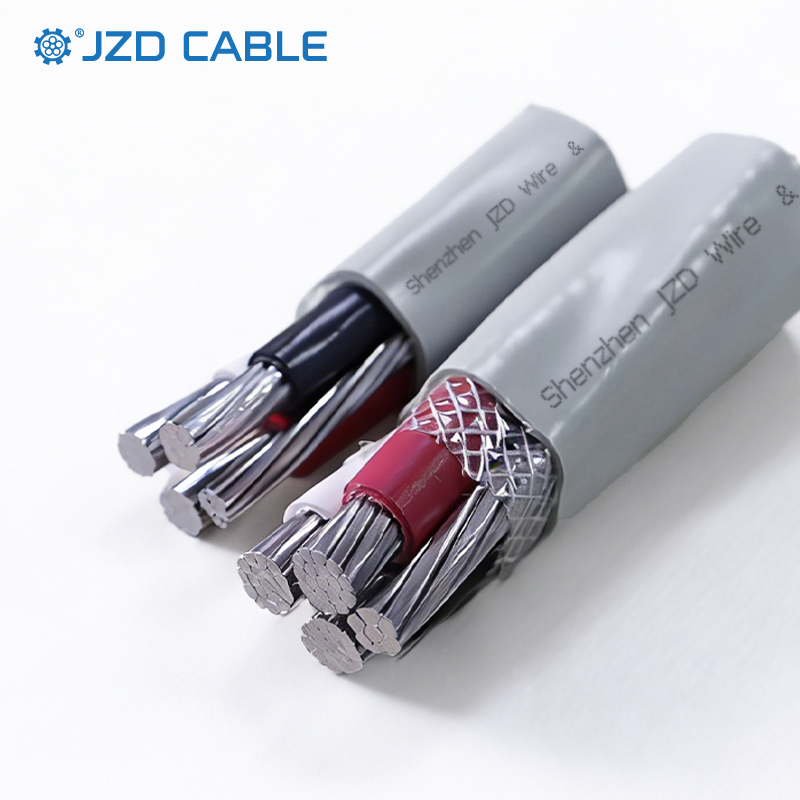
SER (Service Entrance Cable, Style R) is the most commonly specified service entrance cable for U.S. residential and light commercial buildings. It carries power from the utility drop to the meter and from the meter to the main panel. Per NEC 338.12(A)(2), SER is not permitted underground even in conduit.
The 600V rating covers 240V residential services as well as multi-family and light commercial applications.
Aluminum dominates larger service sizes for economic reasons: it costs about one-third as much as copper for equivalent ampacity and weighs about one-third as much—saving material and shipping costs on large projects.
SER Cable Construction: UL 854 Requirements
SER aluminum conductors are manufactured from AA-8000 series alloy, meeting ASTM B800/B801/B836 standards. Compared to the earlier AA-1350 alloy, AA-8000 series offers:
- Lower coefficient of thermal expansion (closer to copper), reducing termination loosening under load cycling
- Superior creep resistance to maintain tight connections over time
- Higher tensile strength for installation and service stresses
- Compact stranding (Class B) for a smoother surface and more reliable terminations
AA-8000 series alloy is used in large stranded feeders and services with AL/CU dual-rated terminations. UL 854 listing confirms the reliability of AA-8000 series for service entrance applications.
1. Insulation: XHHW-2 vs. THHN/THWN
| Property | XHHW-2 | THHN/THWN |
| Material | Cross-linked polyethylene (XLPE) | Thermoplastic PVC |
| Wet location rating | 90°C | 75°C (THWN) / 90°C (THHN dry only) |
| Moisture resistance | Excellent | Fair |
| Heat aging resistance | Excellent (thermoset) | Fair (thermoplastic) |
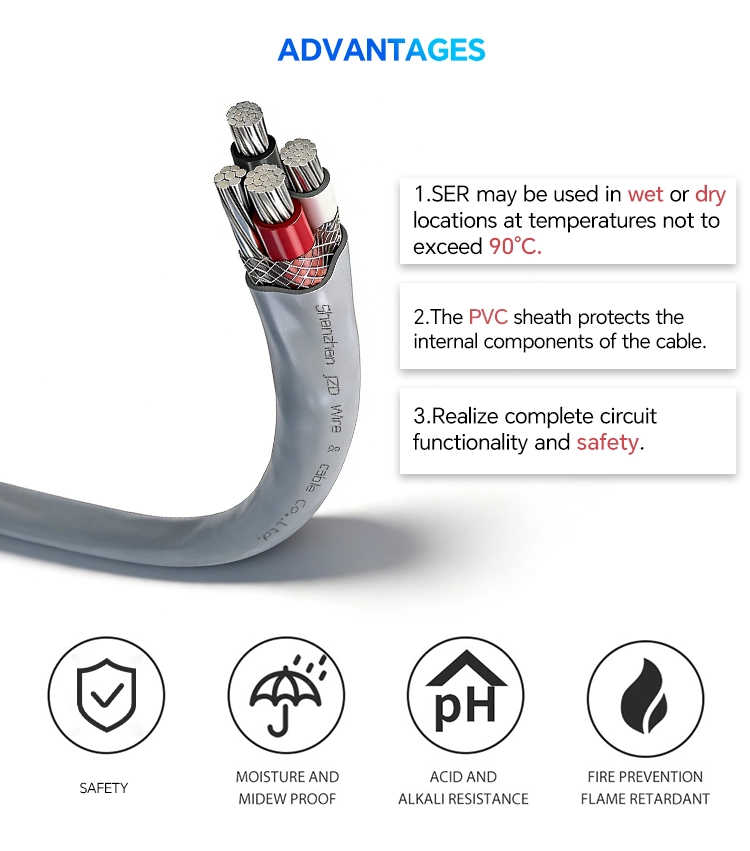
Service entrance cables are routinely exposed to outdoor moisture. XHHW-2’s 90°C wet location rating ensures the cable maintains full ampacity in rain, snow, and condensation.
2. Phase, Neutral, and Equipment Grounding Conductors
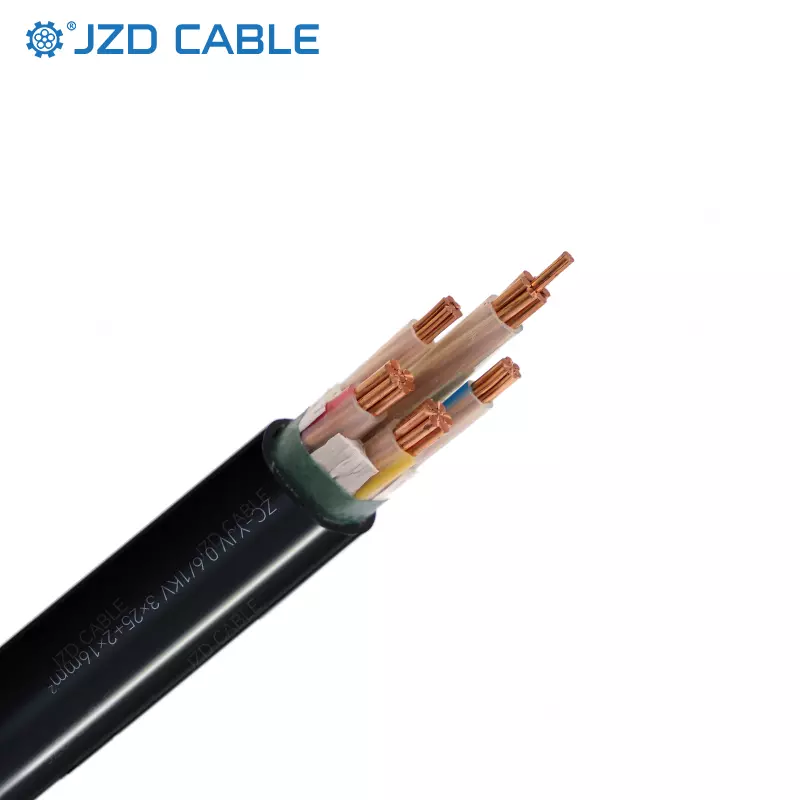
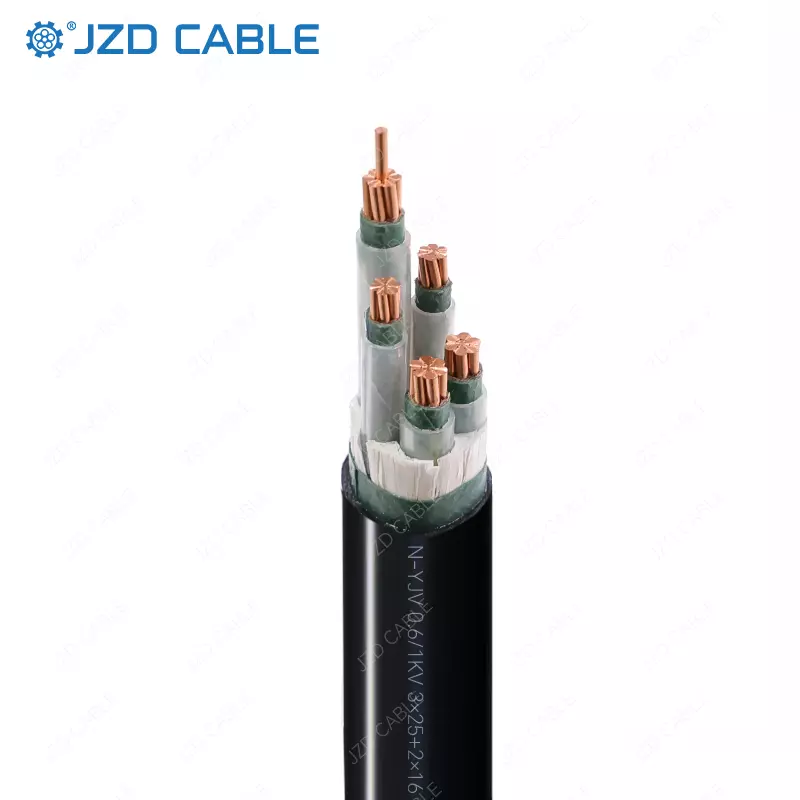
SER cables are available in multi-conductor configurations. Typical constructions include:
- 3-conductor: Two insulated phase conductors + one insulated neutral conductor (no separate ground) — used where grounding is provided by other means
- 4-conductor: Two insulated phase conductors + one insulated neutral conductor + one bare or insulated equipment grounding conductor — required for subpanel feeders and applications after the service disconnect where neutral and ground must be separated
This distinguishes SER from SEU: SEU uses a concentric neutral—bare wires wrapped around the insulated phase conductors—which serves as both neutral and ground, with no separate grounding conductor. SER’s separate bare grounding conductor (in 4-conductor configurations) makes it the correct choice for any application after the service disconnect where neutral and ground must be separated.
3. Reinforcing Tape (Style R) and Sunlight-Resistant Jacket
The “R” designates a fiberglass reinforcing tape beneath the outer jacket for added mechanical protection. The outer jacket is sunlight-resistant gray PVC, UV-stabilized for outdoor exposure. UL 854 requires the jacket to pass 720-hour accelerated aging testing with no cracking or significant discoloration, verifying long-term outdoor durability. This makes SER suitable for the exposed run from the weatherhead to the meter base.
UL 854 Testing Requirements: SE vs. USE
UL 854 is the certification standard for service entrance cables, with different test requirements for SE type (SER/SEU) and USE type cables.
SE Type: 70,000 Btu/h Vertical Tray Flame Test
UL 854 requires SE type cables to pass the 70,000 Btu/h (20.5 kW) vertical tray flame test:
- Multiple cable samples are vertically mounted on an 8-foot tray
- A 20 kW ribbon burner applies flame for 20 minutes
- Pass/fail: Flame must not propagate to the top of the cable and must self-extinguish
USE-type cables are not required to pass this flame test.
The difference is grounded in installation environment: USE cables are buried underground with no flame spread risk; SE cables are exposed inside and outside buildings where flame retardancy is a basic fire safety requirement. UL 854 listing means SER’s flame-retardant jacket has passed this test and can be used indoors and outdoors where fire protection is required.
Mechanical Durability Tests
Beyond the flame test, SE-type cables must also pass UL 854’s crush test and joist pull test. The crush test verifies structural integrity under compression; the joist pull test verifies tensile strength when pulled through wood framing members. Both tests correspond directly to actual installation conditions—pulling cable through walls and wood framing—ensuring the cable maintains structural integrity during installation and throughout its service life.
AA-8000 Series Alloy: Mandatory Requirement
UL 854 Section 1.1 requires aluminum conductors to be AA-8000 electrical grade alloy. This is a prerequisite for UL listing.
SER vs. SEU: Grounding Configuration and Application Boundaries
Physical Comparison
| SER | SEU | |
| Shape | Round | Flat or oval |
| Grounding conductor | Available with separate bare ground (4-conductor) | None (concentric neutral serves as ground) |
| Reinforcing tape | Yes | No |
| Typical configurations | 3-conductor (no ground) or 4-conductor (with ground) | 2-conductor with concentric neutral |
Application Boundaries
NEC requires separation of neutral and ground after the main service disconnects.
SEU’s concentric neutral serves as both neutral and ground. On the line side of the service disconnect, this configuration is compliant. On the load side, neutral and ground must be separated—neutral carries return current, ground carries only fault current.
SEU is suitable for line-side applications before the service disconnect. SER (4-conductor with separate ground) is the specified choice for load-side applications.
| Application | Recommended Cable | Why |
| Weatherhead to meter | SER or SEU | Line side; service disconnect not yet established |
| Meter to main panel | SER or SEU | Line side; service disconnect not yet established |
| Main panel to subpanel | SER (4-conductor with ground) | Load side; neutral and ground must be separated |
| Range/oven feeder | SER (4-conductor with ground) | Load side; neutral and ground must be separated |
SER vs. USE: Installation Environment Determines the Choice
The choice between SER and USE comes down to installation environment—above-ground vs. underground.
| Feature | SER | USE / USE-2 |
| Primary application | Above-ground service entrance | Underground service entrance |
| Direct burial | Not permitted | Permitted |
| Flame-retardant jacket | Required (passes 70,000 Btu/h flame test) | Not required |
| Voltage | 600V | 600V |
| Temperature | 90°C | 90°C (USE-2) |
NEC 338.12(A)(2) explicitly prohibits SE cable (including SER) from underground use. The two cable types are designed for different environments: SER’s flame-retardant jacket addresses fire safety requirements in above-ground buildings; USE/USE-2’s jacket is formulated for underground soil conditions (moisture, chemicals, mechanical pressure).
Underground service entrances require USE or USE-2 cable.
NEC 338.10(B)(4)(a): The Critical Ampacity Sizing Rule
NEC 338.10(B)(4)(a) contains a specific ampacity rule for SER that differs from general NEC rules:
- For #10 AWG and smaller ungrounded conductors installed in thermal insulation: ampacity is based on the 60°C column
- For #8 AWG and larger or installations not in thermal insulation: the 75°C or 90°C column applies, depending on termination temperature ratings
Engineering Implications
The same #2 AWG aluminum SER conductor has different usable ampacities depending on installation:
| Installation Scenario | Temperature Column | Ampacity (#2 AWG Aluminum) |
| #10 and smaller in insulation | 60°C | Significantly reduced |
| Indoor through-wall (non-insulated) | 75°C (termination limit) | 90A |
| Outdoor aerial (90°C terminations) | 90°C | 100A |
This is a frequently overlooked detail in engineering sizing. When #2 AWG aluminum SER is used for a 100A service in a non-insulated through-wall installation, the actual ampacity is only 90A—requiring #1 AWG to achieve full 100A capacity.
JZD UL 854 Certified SER Aluminum Cable
Product Specifications
| Feature | Specification |
| Certification | UL 854 (Service Entrance Cable) |
| Voltage | 600V |
| Conductor | AA-8000 series aluminum alloy, compact stranded |
| Conductor size range | #14 AWG – 750 kcmil (aluminum) |
| Configurations | 3-conductor or 4-conductor (with separate ground) |
| Insulation | XHHW-2 (XLPE) |
| Temperature | 90°C wet and dry |
| Jacket | Sunlight-resistant gray PVC (720-hour accelerated aging test) |
| Construction | Style R (reinforcing tape) |
| Standard lengths | 500 ft / 1000 ft spools |
Key Certified Features
- UL 854 listed: Passes 70,000 Btu/h vertical tray flame test plus crush and joist pull tests—approved for above-ground service entrance
- AA-8000 series aluminum: Meets UL 854 Section 1.1 mandatory alloy requirement
- XHHW-2 insulation: 90°C wet location rating for outdoor moisture exposure
- Sunlight-resistant jacket: 720-hour accelerated aging test validated; suitable for weatherhead-to-meter outdoor runs
- 4-conductor option: Separate bare ground conductor for subpanel and load-side applications
Conclusion
SER cable is the standard choice for residential and light commercial service entrance installations. Its construction—AA-8000 aluminum conductors, XHHW-2 insulation, and optional separate grounding conductor—meets all NEC Article 338 requirements for SE type cables.
Selection Logic:
- Feeding a subpanel or large appliance from the main panel → Choose SER (4-conductor with separate ground; neutral and ground must be separated after the service disconnect)
- Feeding from service drop to meter or main panel only → SER or SEU (neutral and ground may be combined on the line side)
- Underground direct burial required → Choose USE/USE-2 (SER is not permitted underground)
The core difference between SER and SEU is the grounding configuration: SER offers a separate bare grounding conductor (in 4-conductor configurations), making it the specified choice after the service disconnect. The core difference between SER and USE is flame testing and installation environment: SER passes the 70,000 Btu/h vertical tray flame test for above-ground use; USE is designed for underground. Sizing must also account for NEC 338.10(B)(4)(a) ampacity adjustments based on installation conditions.
JZD’s UL 854 certified SER aluminum cable delivers code-compliant, independently verified service entrance solutions for residential and light commercial projects.
Need UL 854 certified SER aluminum cable? Contact JZD for technical specifications and sizing assistance.