

In commercial construction, cable selection mistakes often don’t surface until inspection—and by then, the cost of tear-out and rework far exceeds the cable’s price difference.
MC cable is one of the most widely used wiring methods in commercial construction. Per NEC Article 330, it is permitted in ceiling spaces, exposed runs, wet locations, and more. Specifying MC cable isn’t an “upgrade”—it”‘s a code requirement.
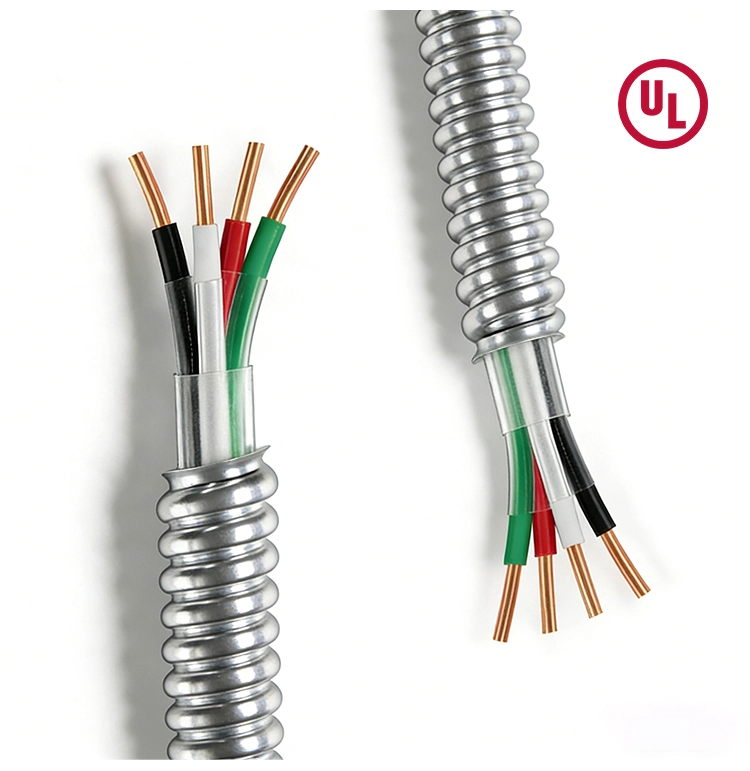
If you’re looking for UL-listed MC cable that meets NEC Article 330 and UL 1569 standards for your commercial or industrial project, the choice comes down to a few key engineering factors—armor material, grounding, and installation method.
MC Cable vs. NM-B (Romex): Why Commercial Projects Can’t Use NM-B
NM-B is cost-effective in residential applications, but its limitations become clear in commercial settings. The differences come down to four key areas: mechanical protection, code compliance, wet-location suitability, and temperature rating.
1. Mechanical Protection
NM-B has only a thin PVC jacket. In commercial ceiling spaces, equipment rooms, and corridors, cables can be stepped on, crushed, or damaged by tools from other trades. MC cable’s metal armor provides a physical barrier against impact and rodents—NM-B’s plastic jacket offers almost no protection against these risks.
2. Commercial Ceiling Spaces
NEC 334.10 restricts NM-B to residential and dry locations. In commercial ceiling spaces, NM-B is generally not code-compliant. MC cable is explicitly permitted by NEC 330.10 for these applications.
3. Wet Locations
Commercial buildings frequently have wet or damp environments—basements, rooftop equipment platforms, near cooling towers, washdown areas. NM-B’s PVC jacket is not rated for wet locations. Unjacketed MC cable is suitable for dry indoor locations; MC cable with a PVC jacket is suitable for wet locations.
4. Temperature Rating
NM-B conductors are typically rated 60°C or 75°C (NEC 334.80 requires NM cable ampacity to be based on the 60°C column). MC cable’s THHN/THWN-2 conductors are rated 90°C. This means that at the same conductor size, MC cable can carry the same current in higher ambient temperatures—or provide more ampacity margin at the same temperature.
| Factor | NM-B (Romex) | MC Cable |
| Mechanical protection | Thin PVC jacket only | Metal armor—resists impact and rodents |
| Commercial ceiling spaces | ❌ Generally not permitted | ✅ Permitted per NEC 330.10 |
| Wet locations | ❌ Not rated | ✅ With PVC jacket |
| Temperature rating | 60°C (NEC 334.80) | 90°C (THHN/THWN-2) |
Bottom line: NM-B is designed for residential dry locations. For commercial projects requiring mechanical protection, code-compliant ceiling installations, wet-location capability, or higher temperature ratings, MC cable is the specified choice.
MC Cable vs. AC Cable (BX): More Than “One Extra Wire”
Many contractors assume MC and AC (Armored Cable, often called BX) are essentially the same—both have metal armor and look similar. But the differences between them directly determine whether they can be used on a given project.
1. Grounding: The Critical Difference
AC cable (BX) relies on its armor and an internal bonding strip as the grounding path. The problem: armor connections can be compromised by bending, corrosion, or improper installation. The armor’s conductivity as a grounding conductor is far inferior to copper.
MC cable includes a full-sized, dedicated grounding conductor (insulated or bare), providing a reliable, low-impedance grounding path. The armor of MC cable is generally not recognized as an equipment grounding conductor—the internal ground wire must be used.
| Feature | AC Cable (BX) | MC Cable |
| Grounding | Armor + bonding strip | Dedicated full-sized grounding conductor |
| Wet locations | Dry only | Wet and dry (with PVC jacket) |
| Support spacing | 4.5 ft | 6 ft |
| Temperature rating | 75°C | 90°C |
| Anti-short bushing | Required | Not required by NEC |
2. U.S. vs. Canadian Standards: A Critical Distinction
The terminology confusion doesn’t stop at AC vs. MC. Cross-border projects add another layer:
| Aspect | U.S. Standard | Canadian Standard |
| Cable type | MC Cable | AC90 |
| Standard | UL 1569 | CSA C22.2 No. 51 |
| Grounding | Internal insulated copper ground | Armor serves as ground |
| Wet locations | Yes (with PVC jacket) | Typically dry only |
| Insulation | 90°C rated (THHN/THWN-2) | 75°C or 90°C |
MC cable certified to UL 1569 does NOT meet CSA C22.2 No. 51 requirements for AC90. A cable approved for the U.S. market cannot be used on a Canadian project, and vice versa. Always confirm the applicable standard—UL 1569 for U.S. jobs, CSA C22.2 No. 51 for Canadian jobs.
Bottom line: AC cable (BX) is suitable for dry residential and light commercial applications. MC cable is the right choice for commercial projects requiring reliable grounding, wet-location capability, or higher temperature ratings. And if your project crosses the border, make sure you’re specifying the right standard—UL or CSA.
Aluminum Armor vs. Steel Armor: An Engineering Trade-Off
MC cable armor is available in two materials—aluminum and steel. The engineering differences directly affect specification decisions:
Aluminum armor advantages:
- Lighter weight—typically 30% lighter than steel armor, easier to handle and install
- Corrosion resistance—aluminum doesn’t rust, suitable for wet and coastal environments
- Better conductivity—aluminum armor’s end-to-end conductivity is about 5 times better than steel
- Better flexibility—tighter bending radius, easier to pull
Steel armor advantages:
- Higher mechanical strength—suitable for heavy impact and extreme physical damage environments
- Better electromagnetic shielding—steel’s higher magnetic permeability provides superior shielding
- Pulls more smoothly through metal studs
Specification guidance:
- Wet, coastal, or applications requiring frequent bending → aluminum armor
- Maximum electromagnetic shielding needed (data centers, sensitive electronics) → steel armor may be preferable
- Extreme physical damage risk → steel armor
- Weight and installation convenience prioritized → aluminum armor
Why Data Centers, Industrial Facilities, and Healthcare Projects All Choose MC Cable
MC cable is the go-to choice for these applications because of three shared requirements: mechanical protection, reliable grounding, and wet-location capability—all of which MC cable delivers.
Data Centers: The MC cable market continues to grow, with data centers among the fastest-growing end-use applications. Critical power distribution, EMI shielding, high-power-density wiring—MC cable’s metal armor provides mechanical protection and electromagnetic shielding. Shielded MC cable options are available for EMI-sensitive environments.
Industrial Facilities: Heavy machinery, motor controls, conveyor systems, control circuits, and equipment connections require resistance to physical impact, vibration, and high temperatures. MC cable’s armor and 90°C rating meet these demands.
Healthcare Facilities: Hospitals and clinics—critical equipment power, operating room wiring—demand the highest reliability and safety. MC cable’s dedicated grounding conductor provides a reliable fault current path.
Commercial Buildings: Office buildings, retail spaces, and schools—lighting circuits, receptacle branch circuits, HVAC systems, elevators, and backup generators. NEC requires MC cable or conduit wiring in commercial ceiling spaces.
MC Cable Installation Essentials
Securing and Support
- Secure within 12 inches of every box, fitting, or termination
- Support at intervals not exceeding 6 feet
- For vibration-prone locations, shorter spacing may be required
Bending Radius
Minimum bending radius is 7× the cable diameter. Exceeding the manufacturer’s bend radius limits can damage the armor.
Anti-Short Bushings
For AC cable, anti-short bushings are required. For MC cable, the NEC does not require them, though many manufacturers supply them. They protect conductors from sharp edges of the interlocked metal tape.
Grounding
The integrated bare copper grounding conductor must be terminated at all junction boxes and equipment. The MC cable armor itself should not be used for grounding—the internal ground wire must be used.
Exposed Runs
MC cable must closely follow the building surface or running boards. When installed on the underside of floor or ceiling joists, it must be secured at each joist.
JZD MC Cable
With over 25 years of manufacturing experience, JZD Cable exports to more than 100 countries and regions including the U.S., Canada, Europe, and Australia. Key advantages of JZD’s MC cable:
- UL 1569 certified—meets U.S. standards
- NEC Article 330 compliant
- THHN/THWN-2 conductors—90°C performance
- Integrated bare copper grounding conductor
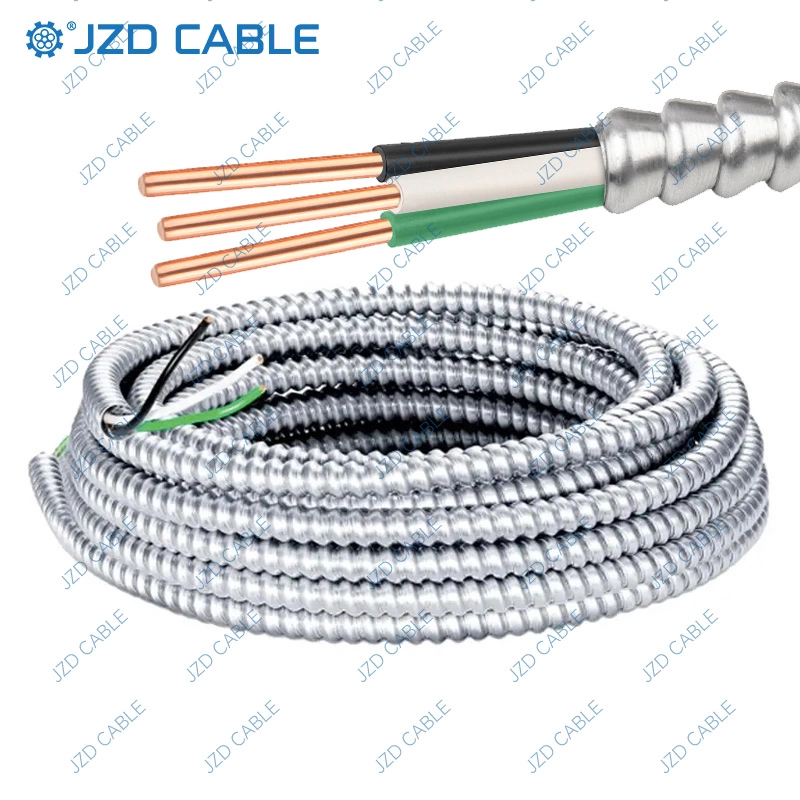
- Lightweight aluminum interlocked armor—30% lighter than steel armor
- 600V rating
- Multiple configurations: 2, 3, or 4 conductors, 14 AWG to 4/0 AWG and larger
- certification: UL listed for both U.S. projects
Conclusion
MC cable is the standard choice for commercial and industrial wiring in the United States.
Key takeaways:
- NM-B is generally not permitted in commercial buildings—using it can result in rework and significant cost overruns
- MC cable ≠ AC cable: dedicated grounding conductor, wet-location capability, and 90°C rating are the critical differences
- Aluminum armor vs. steel armor: weight, corrosion resistance, and electromagnetic shielding requirements drive the decision
- MC cable (UL 1569) ≠ AC90 (CSA C22.2 No. 51): U.S. and Canadian standards are not interchangeable
- Install it right: secure within 12 inches of boxes, support every 6 feet, use anti-short bushings, terminate the internal ground
For commercial, industrial, and institutional projects, MC cable is the proven choice. Contact JZD for free samples and technical specs.