

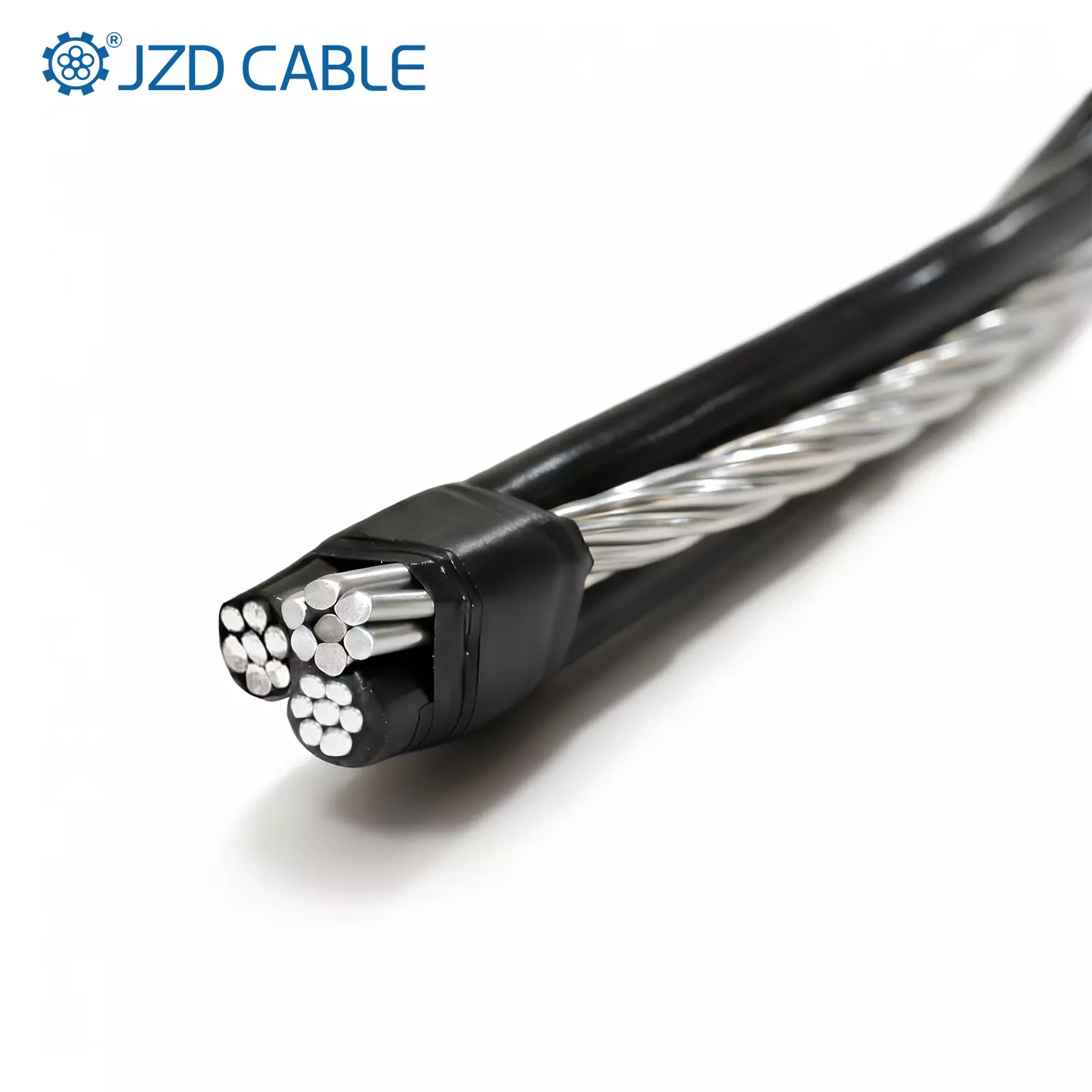
Bare conductors suffer from electrocution risks and tree outages. Aerial Bundled Cable (ABC) is not just insulated wire—it’s a system-level evolution of the distribution grid. For engineers, understanding its material mechanisms matters more than spec sheets.
What is ABC Cable?
ABC is an overhead distribution system where multiple insulated phase conductors and a neutral/messenger conductor are factory-assembled into a single twisted bundle.
Unlike traditional bare conductors, its key difference lies in system integration. Each phase conductor is extruded with weather-resistant cross-linked polyethylene (XLPE) insulation, while the messenger wire handles both mechanical tension and neutral return. This compact bundled structure eliminates bulky cross-arms and insulators, allowing the cable to be attached directly to building facades or routed through dense vegetation.
Why Choose ABC?
1. The Material Game: Why Aluminum Alloy is Mandatory
In bare overhead lines, pure aluminum (such as 1350) was once widely used. But in ABC, phase and messenger conductors typically use AA-6201 or AA-6101 aluminum alloy. Pure aluminum is highly susceptible to creep under sustained tension, leading to loose connections and excessive sag. Aluminum alloy, enhanced with magnesium and silicon, significantly boosts tensile strength and creep resistance. This is especially critical for the messenger wire, which must maintain structural integrity under wind loads and ice accumulation.
2. The Insulation Defense Line: XLPE vs. Tracking
The greatest threat to outdoor insulation is not voltage breakdown but tracking. Rainwater, dust, and bird droppings form a conductive water film on the insulation surface; under the electric field, this creates localized high temperatures that eventually carbonize the insulation. ABC uses high-density XLPE, which not only withstands continuous temperatures above 90°C but also offers strong tracking resistance (passing rigorous IEC 60587 tests). This is also why phase insulations feature longitudinal ribs—not only for phase identification but to increase the surface creepage distance.
3. The Impedance Mystery: Why Line Loss Drops by 5-10%
Once bundled, the distance between phase conductors is extremely compressed, making ABC’s inductance much lower than a spread-out bare conductor system. Combined with the bundled structure preventing external leakage currents, an ABC of the same cross-section will have significantly lower transmission losses than traditional architectures.

Topology and Selection: 2-Core, 3-Core, and 4-Core Scenarios
The core configurations of ABC are not arbitrary; they directly correspond to distribution topologies and transformer secondary connections:
- 2-Core ABC: One phase, one neutral. Commonly used in single-phase scenarios, such as rural grid extensions or transformer drops for remote farms.
- 3-Core ABC: Often three phases, or two phases plus earth (for streetlights or specific industrial equipment). Excels in light commercial areas and low-voltage three-phase balanced loads.
- 4-Core ABC: The standard three-phase, four-wire system (three phases plus neutral), the backbone for urban residential areas and high-density commercial streets. Some 4-core structures include an additional 16 mm² or 25 mm² streetlight control core for multi-purpose use.
Once the core count is selected, on-site tension control and installation craftsmanship will directly determine whether the cable survives its 20-year design life.
The Physical Boundaries of Installation: Beyond the Manual
Although ABC is installed quickly, ignoring mechanical boundaries can easily leave hidden hazards.
1. Tension and Creep Control
ABC is a self-supporting structure, and the installation tension typically must not exceed 50%-60% of the messenger wire’s rated breaking load. When installed in hot weather, thermal expansion must be considered with sufficient sag reserved. If pulled too tight, winter contraction could tilt poles or snap conductors.
2. Bending Radius and Pulling
ABC’s overall diameter is often large, and its minimum bending radius must not be less than 18 times the overall diameter. During stringing, never pull individual cores directly. A swivel connector or pulling grip must be used to distribute tension evenly across the bundle. If forced into sharp bends at corners, micro-cracks will form in XLPE insulation; moisture ingress over a few years will inevitably lead to breakdown.
3. Heat Accumulation and Derating
When multiple insulated wires are tightly bundled, heat dissipation is worse than spread-out bare conductors. In tropical or desert projects, if ambient temperatures exceed 40°C, ampacity must be derated strictly according to the manufacturer’s curves. A cable rated at 180A may only safely carry 150A at 50°C.
Procurement Verification: How to Identify Poor-Quality ABC
In international procurement, the profit margins of ABC cables often tempt suppliers to cut corners:
- Check the Standards: Not only verify compliance with IEC 60502-1, but also regional standards (such as BS 7870, NF C 33-209, AS/NZS 3560.1).
- Measure Insulation Thickness: Poor-quality cables often reduce insulation thickness to save material. If eccentricity is too high, it will directly cause phase-to-phase short circuits in extreme weather.
- Verify Weathering Test Reports: XLPE insulation must undergo thousands of hours of UV and xenon arc aging tests. If a supplier cannot provide third-party test reports, their formulation may rely on cheap carbon black, and the cable won’t last 5 years.
- Verify Messenger Wire Specs: The breaking load (kN) must match the design span and wind load zone; there is no room for error here.
For ABC cable specifications (2-core, 3-core, 4-core) compliant with IEC 60502-1 or other international standards, or third-party test reports, please contact us.
FAQ
1. What voltage levels does ABC cover?
Low-voltage ABC is typically rated 0.6/1 kV and is widely used in distribution networks; medium-voltage ABC (e.g., 6/10kV, 10/20kV) is used for industrial park main lines.
2. Can existing poles be directly upgraded to ABC?
Yes. ABC is lightweight and compact, usually requiring no pole or cross-arm replacement—only hardware adjustments to complete the “bare-to-insulated” upgrade.
3. Is ABC suitable for coastal areas?
Highly suitable. ABC’s aluminum alloy conductors and XLPE insulation offer strong resistance to salt spray and industrial pollution, far outlasting bare copper or aluminum wires that easily corrode.
For ABC cable specifications, certification documents, or engineering support for overhead distribution projects, please contact us.