

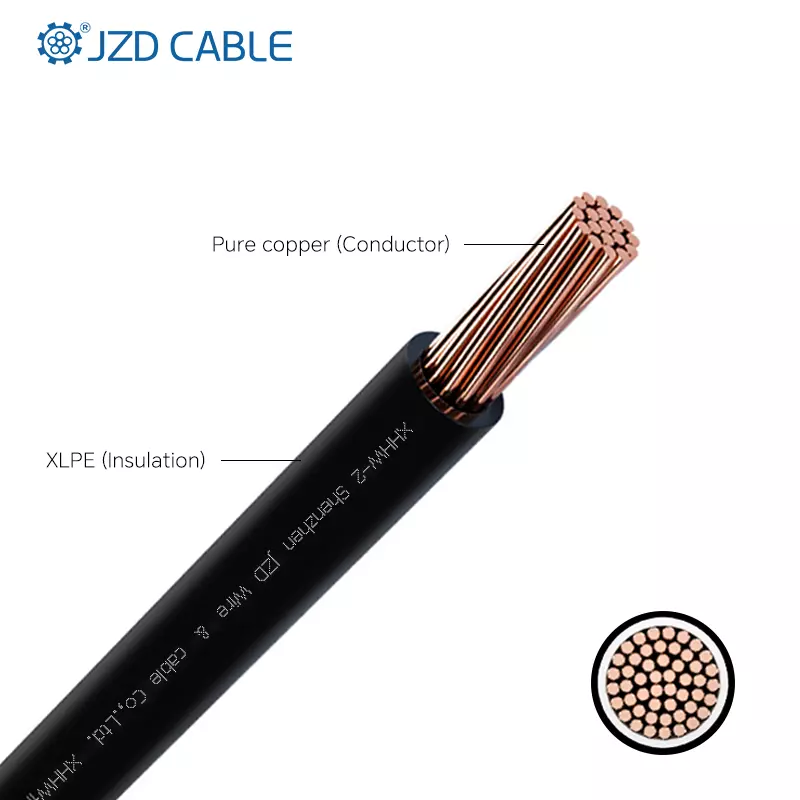
If you’re specifying building wire under UL 44 and NEC Table 310.15, you’ve likely encountered the XHH family: XHH, XHHW, and XHHW-2. They look similar on a quote — all use XLPE (cross-linked polyethylene) insulation, no PVC jacket, 600V (with 1 kV common for photovoltaic feeders) — but the three-letter suffixes decide whether your run survives a damp basement, an outdoor conduit, or a rooftop solar combiner.
This article breaks down exactly what each code means, how they compare side-by-side, and which one belongs on your bill of materials.
Decoding the Name
|
Letter / Suffix
|
Meaning
|
|---|---|
|
X
|
XLPE insulation (cross-linked polyethylene, thermoset)
|
|
HH
|
High Heat – 90°C dry rating
|
|
W
|
Water / moisture resistant (wet location rated)
|
|
-2
|
Unified 90°C rating for both dry and wet locations
|
So:
- XHH = XLPE, Heat-resistant, Heat-resistant (dry only, 90°C)
- XHHW = XLPE, Heat + Water resistant (wet at 75°C)
- XHHW-2 = XLPE, Heat + Water, unified 90°C (dry and wet)
Think of them as three tiers of the same XLPE platform, differentiated by moisture formulation and wet-location temperature cap.
Full Comparison Table
|
Parameter
|
XHH
|
XHHW
|
XHHW-2
|
|---|---|---|---|
|
Code meaning
|
X=XLPE, HH=high heat (dry only)
|
X=XLPE, HH+W=heat+moisture, wet 75°C
|
X=XLPE, HH+W+2=unified 90°C dry/wet
|
|
Insulation material
|
XLPE
|
XLPE with standard moisture-resistant formula
|
Modified XLPE with full-temp moisture formula
|
|
Dry rating
|
90°C
|
90°C
|
90°C
|
|
Wet rating
|
Not permitted (no W suffix)
|
75°C
|
90°C
|
|
Moisture resistance
|
None – dry indoor only
|
Moisture-capable, wet at de-rated 75°C
|
Full moisture + high temp, 90°C wet operation
|
|
Voltage
|
600V (1 kV optional)
|
600V (1 kV optional)
|
600V / 1000V (common in PV feeders)
|
|
Ampacity rule
|
NEC 90°C column (dry only); wet = prohibited
|
Dry 90°C / Wet 75°C – must use lower column in wet
|
90°C column in ALL conditions – no de-rating
|
|
Oil / chemical
|
Excellent (XLPE base)
|
Excellent
|
Best (modified XLPE, acid/alkali/oil/ozone)
|
|
Installation limits
|
Dry indoor tray/conduit only; no basement, no outdoor, no direct burial
|
Damp/outdoor conduit OK, but wet ampacity limited to 75°C
|
Indoor / outdoor / trench conduit /预埋穿管 all-scenario; SUN RES required for exposed sunlight
|
|
Typical use
|
Dry switchgear, machine rooms, high-temp dry equipment
|
Legacy basements, standard damp conduit, non-high-temp outdoor
|
Commercial backbone, PV line sets, outdoor feeders, wet industrial plants – new-project default
|
|
US / CSA cross-reference
|
≈ R90 (CSA dry-only XLPE)
|
Intermediate
|
≈ RHW-2 performance class (but XLPE vs EPR)
|
Three Differences That Actually Matter on Site
1. Wet-Location Temperature = Ampacity Decision
The single biggest differentiator is what happens when the conduit is wet (and per NEC, underground conduit is always considered wet):
- XHH: You simply can’t use it. No W suffix = no wet rating. Putting XHH in a buried conduit is a code violation.
- XHHW: Legal in wet locations, but the insulation formulation caps the wet rating at 75°C. That forces you into the NEC 75°C ampacity column, which is ~10–15% lower than the 90°C column.
- XHHW-2: Wet location stays at 90°C. You stay in the 90°C column everywhere — same conductor size, higher allowable current, or downsize if the design is ampacity-limited.
2. XLPE Base = Superior Oil & Chemical vs. the RHH Family
Unlike the RHH/RHW/RHW-2 family (which can be EPR orXLPE), the XHH family is pure XLPE — and that matters in industrial settings:
- XLPE resists oil, gasoline, dilute acids/alkalis, and ozone far better than PVC or standard EPR blends.
- XHHW-2’s modified formulation pushes this further — it’s the go-to when the feeder runs past a compressor lube line, a battery room, or a wash-down area.
If your project previously specified R90 (CSA dry-only XLPE) for a dry industrial room, XHH is the closest UL44 equivalent. But once you step outside or into damp, XHHW-2 is the safe jump.
3. Sunlight (SUN RES) and PV 1 kV
Two details that trip up purchasers:
- SUN RES marking: None of XHH / XHHW / XHHW-2 is automaticallysunlight-resistant. To run in open tray or exposed conduit outdoors, the cable must carry “SUN RES” on the jacket. Most XHHW-2 SKUs offer this as standard or optional — confirm before ordering.
- 1 kV rating for PV: XHHW-2 is commonly stocked in 1000V for photovoltaic DC feeders (between string and combiner, or combiner to inverter). XHH and XHHW are usually 600V only unless special-ordered. If the BOQ says “PV wire 1000V,” XHHW-2 is the default, not XHHW.
Application Cheat-Sheet
|
Scenario
|
Pick
|
|---|---|
|
Dry industrial MCC, high-temp dry equipment, no moisture
|
XHH (economical)
|
|
Retrofit damp basement, legacy outdoor conduit (non-PV)
|
XHHW (if budget-constrained, accept 75°C wet)
|
|
New commercial backbone, PV DC feeders (1000V)
|
XHHW-2
|
|
Outdoor tray with SUN RES requirement
|
XHHW-2 (SUN RES)
|
|
Wet industrial / wash-down / near oil mist
|
XHHW-2
|
|
Canadian CSA project (dry-only XLPE reference)
|
Cross-refer R90 (not XHHW-2 — different standard C22.2 No.38 vs UL44)
|
Frequently Asked Questions
Q: Is XHHW-2 the same as RHW-2?
A: Similar performance envelope (90°C dry/wet), but insulation type differs: XHHW-2 = XLPE; RHW-2 = EPR orXLPE per UL44. XLPE (XHHW-2) has better oil/chemical resistance and a thinner wall for the same voltage; EPR (some RHW-2) has better flexibility on large gauges. Check the project spec — some engineers mandate “RHW-2 EPR” for specific bend-radius reasons.
Q: Can I use XHHW instead of XHHW-2 to save cost?
A: Only if the wet locations on the job truly never exceed 75°C and you’ve re-calculated ampacity to the 75°C column. For new work, the XHHW-2 premium is small and eliminates a whole class of inspector questions. Most EPCs default to XHHW-2 now.
Q: Does XHHW-2 need a separate ground?
A: Like THHN/THWN, XHHW-2 is typically supplied as single-conductor building wire. Grounding conductor is a separate pull (or use a multi-conductor MC/AC assembly if the spec allows).
Q: Can XHHW-2 be direct-buried?
A: XHHW-2 alone is not a direct-burial cable unless the spec adds “USE-2” or similar construction. For true direct burial without conduit, look at USE-2 or RWU90 (CSA). XHHW-2 typically requires conduit even outdoors — confirm with the UL marking.
Why Source XHH / XHHW / XHHW-2 from JZD Cable?
At JZD Cable , we stock the full XHH family under UL 44, NEC 310.15 compliant:
- XHH – dry-only, cost-efficient for machine-room feeders
- XHHW – legacy damp-location replacement
- XHHW-2 – 600V / 1000V PV-grade, SUN RES available, Cu & AA8000 Al
Sizes from 14 AWG through 750 kcmil, black / color / striped IDs, custom reel lengths, full mill test reports and UL traceability. We also support cross-referencing to CSA equivalents (R90 / RW90 / RWU90) for Canadian-border projects.
Need a quote or a cross-reference check against your BOQ?
Reach the JZD team at jzdcable.com/contact— send us the gauge, voltage (600V or 1kV), SUN RES / FT4 / CSA-dual-mark requirements, and we’ll turn it around within 24 hours.