

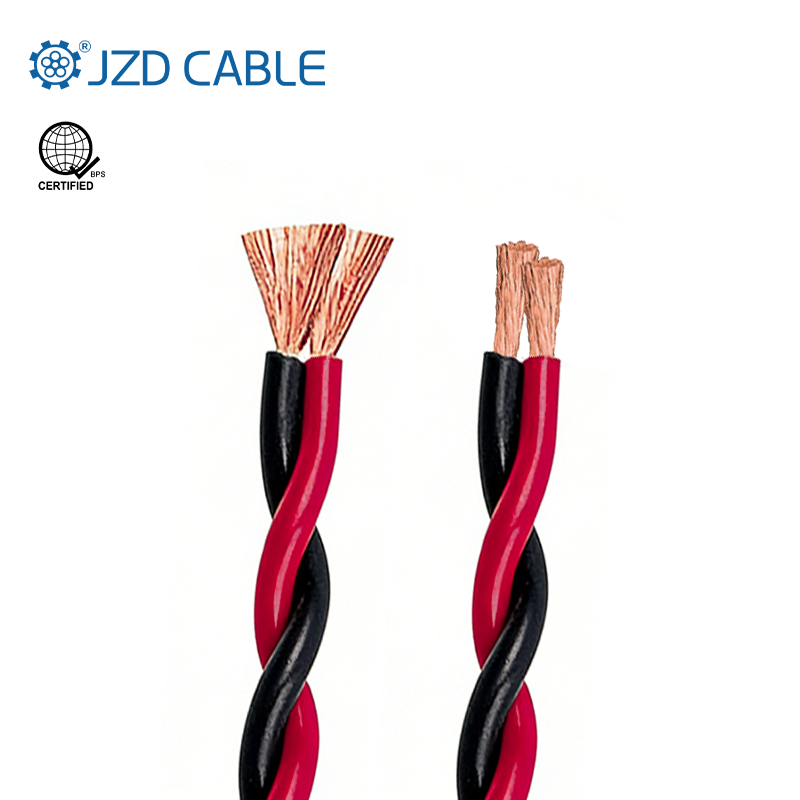
If you’ve ever worked with Ethernet cables, telephone lines, or any structured cabling system, you’ve noticed one thing: the wires inside are always twisted together in pairs. But have you ever wondered why they are twisted instead of being laid straight?
At JZD Cable, we manufacture high-performance twisted pair cables for networks, security systems, and industrial applications. In this article, we break down the five core reasons why twisting is essential — from electromagnetic interference cancellation to physical stability.
1. Cancel Electromagnetic Interference (EMI)
Each wire in a twisted pair carries current in opposite directions. When two wires are twisted together, the magnetic fields generated by each wire cancel each other out. This significantly reduces electromagnetic radiation from the cable itself and also makes it less susceptible to external electromagnetic noise (e.g., from motors, power lines, or radio signals).
Result: Cleaner signal transmission, fewer errors, and better performance in noisy environments.
2. Reduce Crosstalk Between Adjacent Pairs
In multi-pair cables (like Cat5e, Cat6, or Cat6a), signals from one pair can leak into another — a phenomenon called crosstalk. The twisting geometry ensures that any interfering signal picked up by one wire is also picked up by its partner but with opposite polarity, effectively canceling it out.
Result: Lower packet loss, no network lag, and stable communication even in high-density cabling setups.
3. Balance Impedance for Consistent Signal Quality
Twisting forces both wires to have nearly identical electrical characteristics — same length, same resistance, same inductance per unit length. This impedance balance minimizes signal reflection and attenuation along the cable.
Result: Uniform transmission loss across the entire cable length, which is critical for high-speed data (Gigabit Ethernet, PoE, etc.).
4. Improve Physical Durability and Flexibility
A twisted structure bundles the two conductors together naturally, preventing them from separating during handling or bending. This mechanical binding makes the cable more resistant to kinking, crushing, and conductor breakage when routed through tight spaces.
Result: Longer cable life, easier installation, and fewer field failures.
5. Simplify Pair Identification and Installation
Each pair has a different twist rate (lay length). These distinct twist patterns allow technicians to easily identify which wires belong to which pair based on color coding and twist pitch. This speeds up termination (punching down jacks or connecting RJ45 plugs) and reduces wiring mistakes.
Result: Faster, more accurate installations — especially in large-scale projects.
Conclusion
The humble twist in twisted pair cables is not just a manufacturing quirk — it’s a carefully engineered solution to multiple real-world challenges: electromagnetic noise, signal integrity, durability, and ease of use.
At JZD Cable, we produce twisted pair cables that meet international standards (ISO/IEC, TIA/EIA) and undergo rigorous testing to ensure every twist delivers optimal performance.
Need reliable cables for your next project? Visit jzdcable.com or contact our team for customized solutions.