

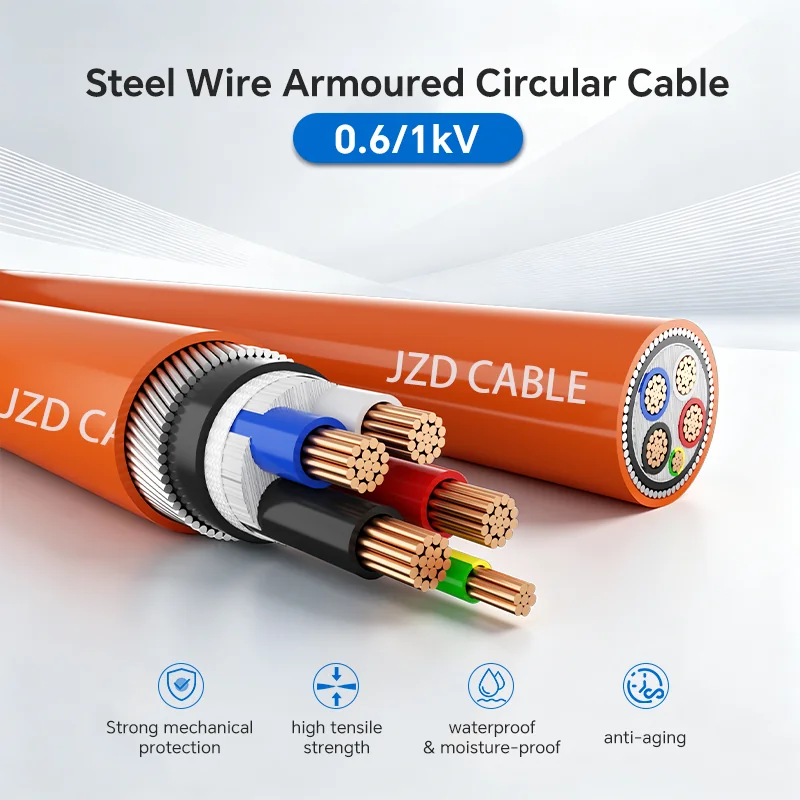
When your project requires steel wire armoured (SWA) XLPE power cable for vertical shafts, river crossings, or long-span burial, you face a fundamental choice: copper conductor (YJV32) or aluminum conductor (YJLV32) . Both share the same insulation (XLPE, 90°C), the same fine steel wire armour (tensile + crush), and the same PVC sheathing — but the conductor metal changes everything about cost, weight, ampacity, and installation logistics.
This guide breaks down the differences across nine critical dimensions, helping you decide which one belongs on your BOQ.
Decoding the Model Codes
|
Code
|
Meaning
|
|---|---|
|
YJV32
|
YJ = XLPE insulation, V = PVC sheath, 3 = fine steel wire armour, 2 = PVC outer sheath — Copper conductor (Chinese standard omits “T” for copper)
|
|
YJLV32
|
L = Aluminum conductor — same insulation, armour, and sheathing as YJV32
|
In short: YJV32 = copper core SWA cable; YJLV32 = aluminum core SWA cable. Everything else — XLPE 90°C rating, steel wire armour, PVC inner/outer sheath, 0.6/1kV voltage class — is identical.
Full Side-by-Side Comparison
|
Comparison Dimension
|
YJV32 (Copper)
|
YJLV32 (Aluminum)
|
|---|---|---|
|
Conductor material
|
Oxygen-free stranded copper
|
Stranded aluminum alloy
|
|
DC resistance at 20°C
|
Low (baseline)
|
~1.64× copper — higher resistance, greater voltage drop
|
|
Same-gauge ampacity
|
Higher (baseline)
|
Lower — to match copper ampacity, up-size 1–2 gauges
|
|
Cable weight
|
Heavy — 30–50% heavier than Al
|
Light — 30–50% lighter per metre
|
|
Material cost
|
Expensive (copper commodity)
|
~30% cheaper than copper equivalent
|
|
Tensile strength
|
High — copper stronger, less prone to stretch/break under pull
|
Lower — aluminum softer, must verify pull tension in vertical/long pulls
|
|
Connection / termination
|
Standard copper lugs, stable crimp, slow oxidation
|
Requires aluminum-specific lugs + conductive paste — oxide layer forms quickly
|
|
Heat / loss (long distance)
|
Low line loss, energy efficient
|
Higher line loss — significant voltage drop on long runs
|
|
Best for
|
Plant mains, high-rise, precision loads, short-to-medium distribution
|
Urban grid mains, long-distance overhead/vertical, budget outdoor lines
|
Five Critical Differences That Drive Selection
1. Conductivity & Ampacity — The Gauge Upsize Rule
Copper’s lower resistivity means a YJV32 cable of a given cross-section carries more current than the same-size YJLV32. To match the ampacity of a copper cable, you typically need to go 1–2 sizes larger in aluminum:
|
Target Ampacity (approx.)
|
YJV32 (Cu)
|
YJLV32 (Al)
|
|---|---|---|
|
200 A
|
70 mm²
|
95 mm²
|
|
300 A
|
120 mm²
|
150 mm²
|
|
400 A
|
185 mm²
|
240 mm²
|
Impact: If your project has tight tray/conduit space, copper (YJV32) fits more current into the same physical envelope. If space is abundant and cost is king, upsizing YJLV32 is viable.
2. Weight — The Vertical Shaft Decisive Factor
Aluminum weighs 30–50% less than copper for the same ampacity-adjusted size. In a vertical shaft where the cable hangs hundreds of metres, that weight reduction directly reduces:
- Tensile load on the steel wire armour
- Required clamp/spacing density
- Structural load on the building’s cable supports
- Transport and handling cost on site
Rule of thumb: For shafts over 100m drop, YJLV32 is often the default — the weight saving makes installation feasible where copper would require intermediate supports every few floors.
3. Cost — The 30% Savings Reality
Aluminum is roughly 30% cheaper than copper at the same cross-section. On a large project (kilometres of SWA cable), that saving can be substantial. However, remember:
- If you need to upsize YJLV32 by 1–2 gauges to match copper ampacity, the cost gap narrows
- Aluminum termination requires special lugs + conductive paste — small added cost per joint
- Long-term energy losses (higher I²R) may offset upfront savings on heavily loaded feeders
4. Mechanical Strength — Pull Tension Limits
Copper’s higher tensile strength means YJV32 can tolerate greater pulling forces during installation without conductor deformation. Aluminum (YJLV32) is softer — excessive pull tension can stretch or neck the conductor, creating a weak point at the pulling grip.
Critical: For long horizontal pulls (>500m) or steep inclines, always calculate the maximum pulling tension for YJLV32 and compare against the conductor’s rated limit. Never exceed it.
5. Connection Reliability — The Oxide Issue
Aluminum forms a non-conductive oxide layer instantly when exposed to air. If not properly managed, this oxide increases contact resistance → overheating → failure. YJLV32 requires:
- Aluminum-specific bi-metal lugs (not standard copper lugs)
- Oxide-inhibiting conductive paste applied to all connections
- Regular torque checks on bolted connections (aluminum creeps under pressure)
Copper (YJV32) is far more forgiving — standard copper lugs, no paste required, stable long-term connections.
Application Decision Tree
|
Project Scenario
|
Recommended
|
Why
|
|---|---|---|
|
High-rise vertical shaft, >100m drop
|
YJLV32
|
Weight saving critical for hanging load
|
|
Short industrial feeder, <50m, high current
|
YJV32
|
Copper fits smaller tray space, lower loss
|
|
Long-distance rural feeder, >1km
|
YJLV32
|
Cost saving dominant; upsized Al compensates for voltage drop
|
|
Precision equipment / sensitive load
|
YJV32
|
Lower voltage drop, stable connection
|
|
Budget-constrained project, abundant space
|
YJLV32
|
30% material saving, acceptable if upsized
|
|
Marine / offshore / high-vibration
|
YJV32
|
Copper more fatigue-resistant, fewer connection issues
|
|
City grid distribution, medium voltage
|
YJLV32
|
Industry norm for utility mains
|
|
Temporary / 5-year project
|
YJLV32
|
Lower upfront, shorter lifespan acceptable
|
Frequently Asked Questions
Q: Can YJLV32 directly replace YJV32 in an existing design?
A: Not without re-calculation. You must verify ampacity (likely need upsize), voltage drop (longer runs may exceed limits), and termination compatibility (existing lugs may be copper-only).
Q: Is YJLV32 suitable for direct burial?
A: Yes — the steel wire armour + PVC sheath provide the same mechanical and environmental protection as YJV32. The conductor material doesn’t affect burial suitability.
Q: Does YJLV32 have the same short-circuit rating as YJV32?
A: No. Aluminum has lower short-circuit current capacity than copper for the same cross-section. The 250°C XLPE short-circuit limit applies to both, but the conductor’s ability to carry fault current without exceeding that temperature is lower for Al. Always verify with the manufacturer’s data.
Q: Can I terminate YJLV32 with standard copper lugs?
A: No — you must use bi-metal (Al-Cu) transition lugs or aluminum-specific lugs. Direct copper-to-aluminum contact in a moist environment creates galvanic corrosion.
Q: Which is more environmentally friendly?
A: Aluminum production is energy-intensive but the material is lighter to transport and easier to recycle. Copper mining has higher ecological impact per tonne but lasts longer in service. The greener choice depends on the specific lifecycle assessment.
JZD Cable YJV32 & YJLV32 Product Range
At JZD Cable (jzdcable.com) , we manufacture both copper and aluminum steel wire armoured cables to GB/T 12706 and IEC 60502 standards:
YJV32 (Copper):
- Conductor: Oxygen-free stranded copper, 10–630 mm²
- Insulation: XLPE, 90°C, 0.6/1kV
- Armour: Fine round steel wire (tensile + crush)
- Sheath: PVC inner + PVC outer
YJLV32 (Aluminum):
- Conductor: Stranded aluminum alloy, 10–630 mm²
- Same XLPE, armour, and sheath as YJV32
- 30% lighter, ~30% lower material cost
Both available in single-core (non-magnetic armour) and multi-core configurations, with full mill test reports and third-party certification.
📩 Need help choosing between YJV32 and YJLV32 for your project?
Contact the JZD team at jzdcable.com/contact — send us the load current, route length, drop height, and budget constraints, and we’ll recommend the optimal conductor and gauge.