

Metal-Clad (MC) cable provides strong mechanical protection without the need for conduit bending. But passing inspection requires strict attention to grounding and support rules. This article covers MC cable types, comparisons, and practical termination tips.
What is MC Cable?
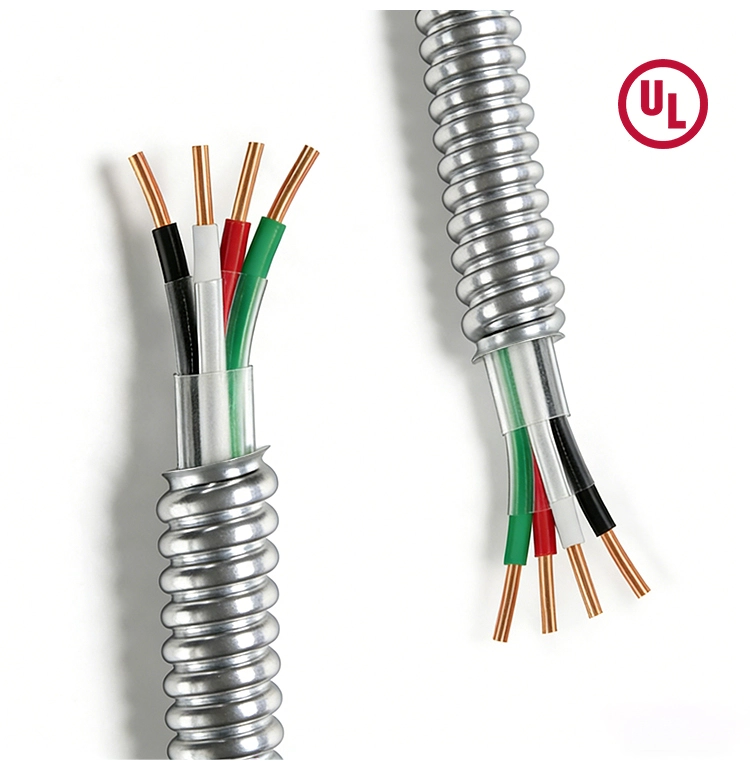
MC cable is a factory-assembled wiring product. Its core structure consists of insulated conductors, a dedicated Equipment Grounding Conductor (EGC), and an outer interlocked metal armor.
The internal conductors are typically THHN/THWN-2, rated 90°C dry/wet and 600V, with copper or aluminum conductors. The most common outer armor is interlocked aluminum, which offers flexibility and lighter weight; continuous corrugated welded aluminum armor is used for applications requiring higher physical protection.
A critical engineering fact: For most interlocked MC cables, the metal armor itself is not recognized as an Equipment Grounding Conductor. The green insulated grounding wire inside the cable is the only reliable path to ground. This is fundamentally different from older AC (BX) cables that rely on the armor for grounding, and it is a high-frequency point of failure during inspections.
What is MC Cable Used For?
According to NEC Article 330, MC cable is permitted for service entrances, feeders, and branch circuits in industrial, commercial, and multi-family residential buildings.
Specific applications range from open-ceiling retail spaces to data center power distribution. In wet or direct burial environments, Jacketed MC with a PVC/CPE/LSZH outer jacket must be used; bare armor versions are restricted to dry indoor areas. Regarding hazardous locations, MC cable is permitted in Class I Div. 2, Class II Div. 2, and Class III Div. 1, but Div. 1 is outside its scope.
Types of MC Cable
Different variants correspond to environmental boundaries and safety ratings, rather than a simple “upgrade” relationship.
Standard MC (Interlocked Aluminum Armor): The most common dry-location indoor model. It is lightweight and flexible, suitable for drop ceilings, cable trays, and exposed branch circuits.
Jacketed MC: By adding a PVC, CPE, or LSZH outer jacket over the aluminum armor, it qualifies for wet locations, outdoor use, and direct burial. When installed in wet areas, terminations must use liquid-tight connectors.
HCF MC (Health Care Facility): Its core feature is a redundant grounding path (meeting NEC 517.13(A) requirements for medical facilities). While some HCF MC products use Low Smoke Zero Halogen (LSZH) insulation to meet stricter fire safety demands, the redundant ground is the mandatory defining feature for hospitals and data centers.
MC-HL (Hazardous Locations): Uses a continuous corrugated metal sheath with a polymeric jacket to prevent gas migration along the cable core, suitable for areas like Class I Div. 2.

MC Cable vs. Romex (NM-B)
Romex (NM-B) holds an economic advantage in residential wiring, but in commercial and industrial settings, the boundary between the two is defined by code and mechanical protection requirements.
| Dimension | MC Cable | Romex (NM-B) |
| Mechanical Protection | Interlocked metal armor; resists crushing and rodent damage | PVC jacket only; no metal protection |
| Wet / Direct Burial | Jacketed MC permitted; bare armor limited to dry areas | Not permitted |
| Commercial Applicability | Industrial, commercial, and multi-family residential | Not permitted in commercial buildings exceeding 3 floors |
| Grounding Path | Dedicated green insulated conductor (EGC) | Bare copper ground wire |
Romex is a reasonable choice in dry residential areas with low risk of physical damage where metal protection is not mandated. However, once it enters a commercial drop ceiling, mechanical room, or any path susceptible to physical impact, metal-clad MC cable is the more engineering-sound choice.
Related reading: NM-B (Romex) Cable: A Contractor’s Guide to Selection
MC Cable vs. Conduit
Conduit with single conductors provides the highest mechanical protection and the ability to pull new wires later, but at the cost of significant labor and time.
In some projects, MC cable can reduce installation time by approximately 30% compared to rigid conduit systems (Note: actual savings depend on site conditions). The lighter weight of aluminum armor reduces worker fatigue during extensive overhead installations.
However, the limitation of MC cable is equally clear: once the internal conductors are damaged, the cable cannot be pulled out and replaced like in a conduit system. Therefore, for main pathways that require frequent future circuit changes or capacity upgrades, conduit remains the more rational choice. The role of MC cable is in scenarios where conduit is economically or physically unviable—retrofit projects, dense branch circuits, and flexible transitions to equipment.
How to Cut and Terminate MC Cable
On-site termination quality directly determines long-term reliability and inspection success. Burrs piercing the insulation can cause latent faults that surface years later.
Step 1: Cut with a rotary cutter. Hacksaws tear the interlocked armor and create metal burrs that pierce insulation. A rotary cutter (e.g., Roto-Split) cleanly separates the sheath along the armor pitch without damaging conductors.
Step 2: Install anti-short bushings. Clean out aluminum fragments and insert an anti-short bushing (redhead) between the armor and conductors to prevent the sharp edge from cutting the insulation during bending.
Step 3: Ground properly. Use a listed connector matching the cable’s outer diameter. Crucially, the internal green grounding wire must be firmly connected to the equipment terminal; relying solely on physical armor contact is non-compliant.
Step 4: Support and secure. Per NEC 330.30, secure within 12 inches of boxes and at intervals ≤6 feet for horizontal runs (often shortened to 3 feet for vibrating equipment). The 2026 NEC generally requires listed fasteners, though 330.30(A) allows AHJ approval of alternatives.
Step 5: Bending and derating. Minimum bending radius is 7x the outer diameter. Apply derating per NEC Table 310.15(C)(1) when bundled with 3+ cables, in contact with thermal insulation, or containing multiple current-carrying conductors.
FAQ
1. What is the meaning of MC in electrical?
In electrical terms, MC stands for Metal-Clad. It refers to a factory-assembled cable that features insulated conductors enclosed in a flexible, interlocked metal armor. This armor provides robust mechanical protection and allows the cable to be installed in exposed and hazardous locations where standard non-metallic cables are prohibited.
2. Where is MC cable not permitted?
According to the NEC, MC cable is not permitted in Class I Division 1 hazardous locations. Additionally, standard bare MC cable (without an outer jacket) is not permitted in wet locations, outdoors, or direct burial. It is also not permitted where it will be subject to severe physical damage or corrosive environments that could degrade the metal armor.
3. What does MC stand for in cable?
MC stands for Metal-Clad. It defines a specific category of armored cable under NEC Article 330, widely used in commercial, industrial, and multi-family residential projects for branch circuits, feeders, and service entrances.
4. How to identify MC cable?
You can identify MC cable by its flexible, interlocked metal armor (usually aluminum or steel). Internally, a key identifier is the presence of a dedicated, green insulated grounding conductor (unlike AC/BX cable, which typically uses a bare aluminum bonding strip). The outer jacket is also required by the NEC to be marked with the manufacturer’s name, “Type MC,” and the appropriate UL listing mark.
For specifications or certification documents for UL 1569 listed MC cables that feature a dedicated green grounding conductor and consistent interlocked armor quality, please contact us.