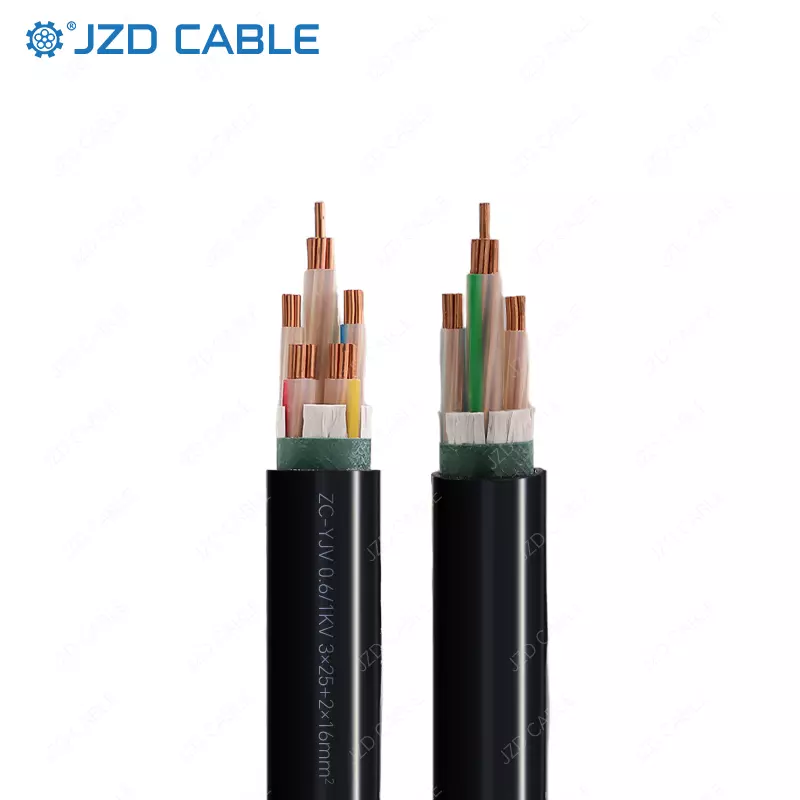



In modular construction, factory prefabrication creates an irreversible constraint: once wall panels are sealed, internal cables cannot be maintained. Initial selection is therefore critical for lifecycle reliability. This guide addresses four core wiring challenges: prefab limitations, cross-module stress, confined space safety, and export compliance.
In-Wall Prefab Wiring and Module Cross-Connections
On the factory assembly line, cables must be routed into narrow sandwich wall cavities made of EPS or XPS insulation before the panels are sealed. They must also withstand the mechanical stress of transport and hoisting.
1. Physical Advantages of Flat Structures
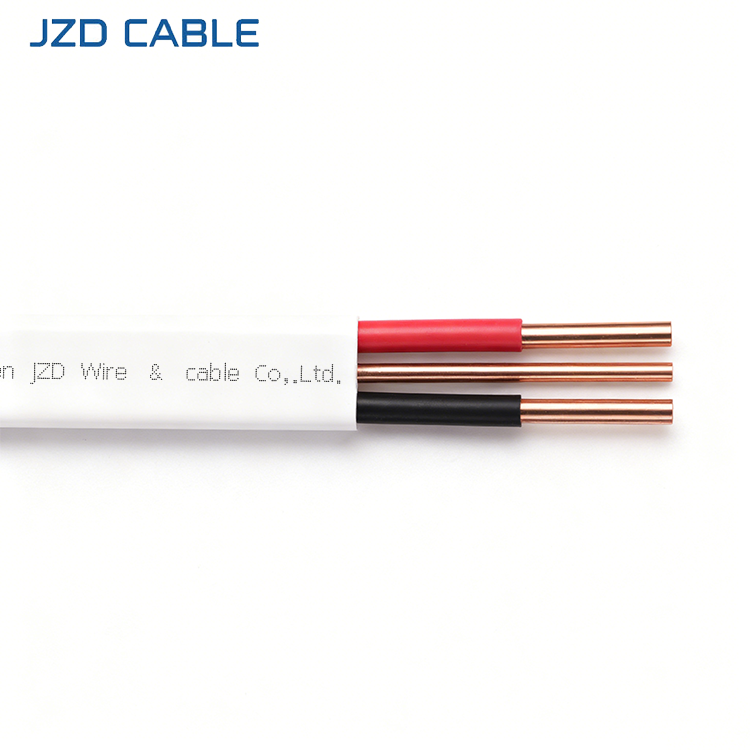
Traditional round cables create high friction in sandwich panel cavities, easily causing wall bulging. For markets like Australia, the industry typically uses flat TPS cables compliant with the AS/NZS 5000.2 standard. Their ultra-thin flat profile drastically improves factory routing efficiency and prevents damage to the insulation layer.
2. The Hidden Threat of “Plasticizer Migration”
The most concealed hazard in prefab walls is material compatibility. The plasticizers in standard PVC sheaths will diffuse into the adjacent polystyrene insulation material over time. This causes the foam to swell and degrade, while the cable sheath—having lost its plasticizers—rapidly becomes brittle and cracks, eventually exposing the conductors. To prevent this, non-migratory TPS cables must be used for internal wall wiring. Their specialized sheath formulation blocks chemical migration at the molecular level, ensuring long-term insulation stability.
3. Stress Absorption at Module Connections
During truck transport and on-site hoisting, cables at the connection points endure significant pulling and vibration. Highly flexible control cables, such as UL 2464 multi-core cables, effectively absorb this mechanical stress. Leaving a service loop at the module junction prevents internal conductor fatigue and breakage.
Related reading: UL2464 Wiring Guide: Modular & Prefab Buildings
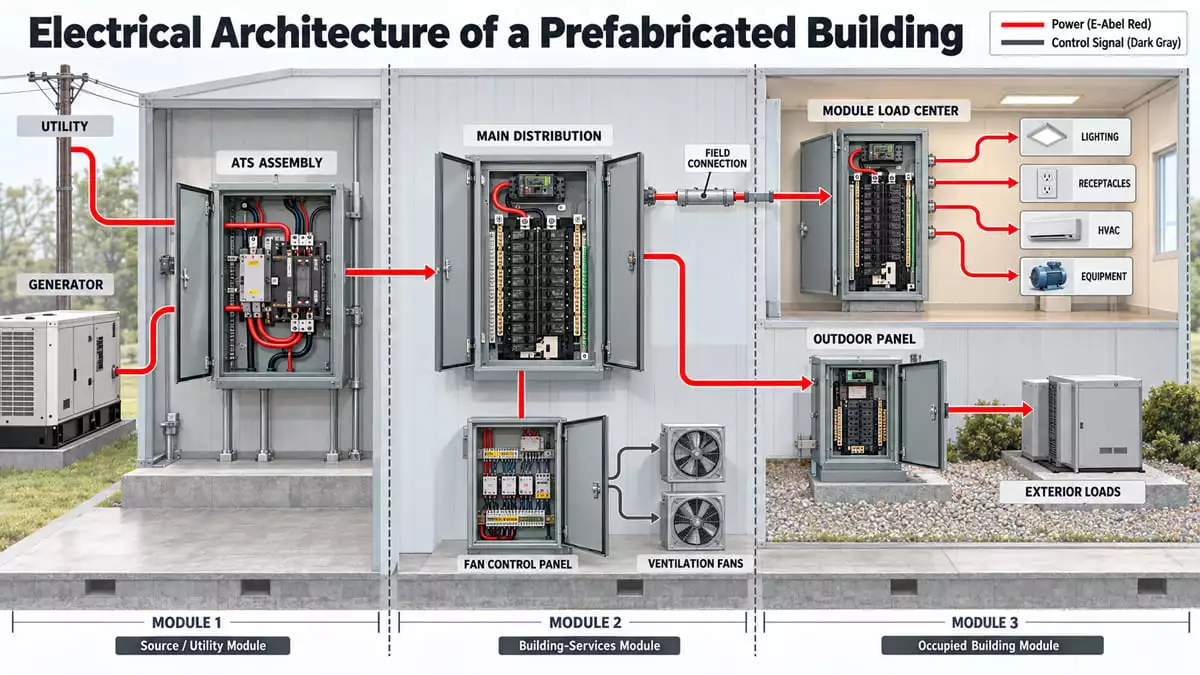
Pre-wired Distribution Boxes
The pre-wired miniature distribution box is the electrical heart of a modular house. Its internal space is extremely compact, and it operates in a sealed environment.
1. Heat Accumulation in Tight Spaces
With densely packed circuit breakers, the terminal temperatures rise significantly under full load. If the internal jumper wires lack sufficient temperature ratings, thermal aging and breakdown can occur. Therefore, UL 1015 hook-up wire is typically specified for internal wiring. Its 105°C temperature rating and 600V withstand capability effectively manage heat accumulation inside the compact enclosure, ensuring safe internal connections.
2. Vibration and Termination Standards
For control circuits (such as HVAC and security systems), UL 2464 flexible multi-core cables are highly recommended. Strict craftsmanship must be enforced: stranded wires must be terminated using cold-pressed ferrules. This prevents wire strands from loosening due to transport vibration. For power branch circuits facing similar transit stress, MC cable can be utilized; its armored metallic sheath shields the conductors against physical impact, ensuring the pre-wired connections remain intact.
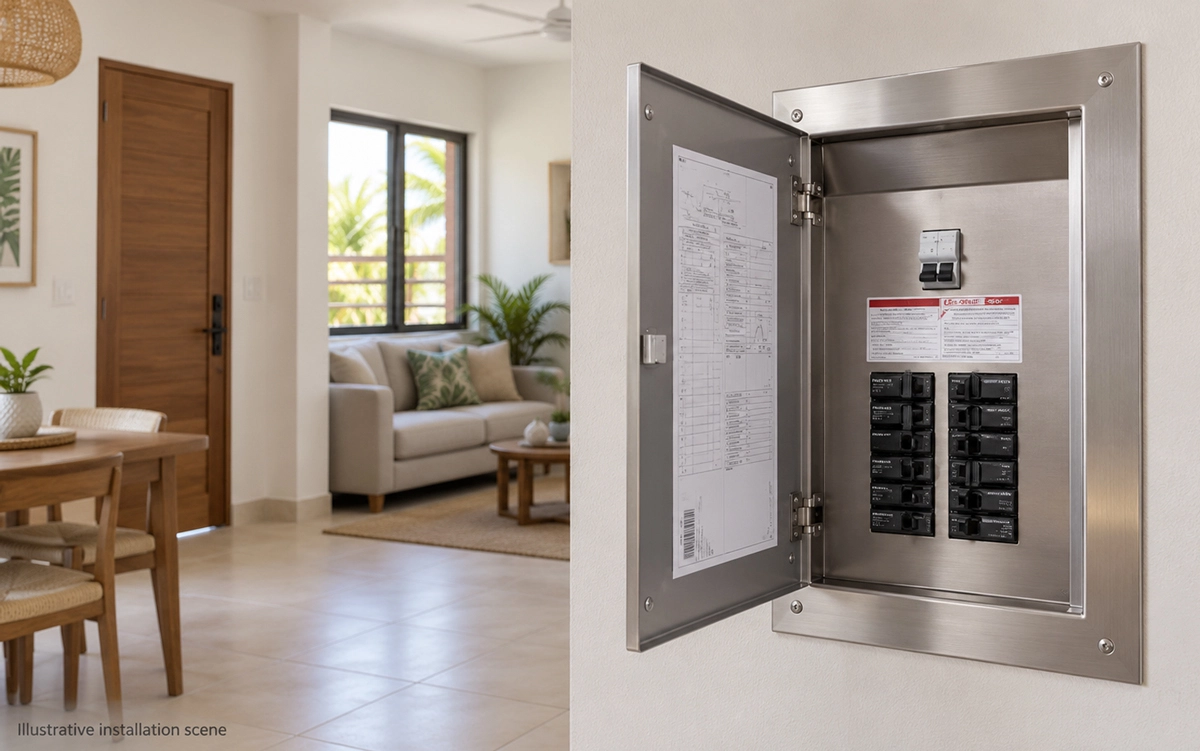
North American NEC-Compliant Integration
While AWM components handle internal logic, North American modular projects require NEC-listed building wires for branch circuits. Eabel provides US-standard prefab distribution boxes engineered for this exact challenge. Their UL-listed 8–42-way load centers feature pre-punched entries and flush mounting for seamless integration. Because sealed walls cannot be reopened for maintenance, Eabel pre-matches panel configuration, cable entry, and termination before sealing—keeping the factory-pre-wired assembly strictly on the NEC/UL compliance path for North American exports.
1. Pre-wired 8–42-Way Load Centers
Inside these densely packed, sealed enclosures, internal jumpers and branch-circuit terminations face significant heat accumulation. UL 83 THHN/THWN-2 single conductors are the ideal match, providing a 90°C dry/wet rating and an abrasion-resistant nylon jacket to ensure the thermal and mechanical margin required by these pre-wired load centers.
2. Flush-Mounted Residential Distribution Boxes
For residential modular units, flush-mounted boxes neatly terminate standard residential wiring. NM-B cable routes efficiently through dry interior wall cavities, connecting directly to the enclosure. This pairing offers a cost-effective, familiar wiring method for bedroom and kitchen circuits while maintaining factory assembly efficiency.
3. High-Capacity Commercial & Industrial Panels
For commercial pods or industrial modules with heavier loads, higher-capacity panels (up to 42 ways) require multi-core solutions. UL 2586 tray cables can be factory-routed into these enclosures to serve large-scale loads. Pre-matching the tray cable routing and termination ensures a streamlined, code-compliant installation for industrial modular projects.
The Baseline of Electrical Safety
Modular cabins have limited space and extremely short evacuation paths. In such confined scenarios, the secondary disasters of an electrical fire—toxic gases and dense smoke—are often more destructive than the flames themselves.
Standard PVC cables release large amounts of light-blocking black smoke and corrosive halogen acid gas when burned. For prefab units with high occupancy or limited egress, the material system should be upgraded to Low Smoke Zero Halogen (LSZH). In the event of a fire, LSZH cables maintain high visibility and release no halogen acid gas, buying precious time for evacuation while protecting valuable electronic assets from corrosion.

Export Compliance and Quality Verification
Modular buildings are global products, manufactured in Asia and assembled worldwide. If the correct certifications are not selected before leaving the factory, the entire module risks rejection at customs or on-site inspection.
1. Mandatory Matching of Regional Standards
- Oceania Market: Must use TPS cables compliant with AS/NZS 5000.2 and SAA certified (e.g., 450/750V, -30°C to +90°C).
- North American Market: Must comply with NEC and UL. Distribution box wiring: UL Style 1015 AWM; control cables: UL Style 2464 AWM. Both are AWM styles under UL 758 (cUL certified), not cable listings. AWM is a Recognized Component, not a standalone NEC field-wiring method unless permitted by the AHJ.
- Europe & Middle East: Requires CE certification and corresponding IEC standard test reports.
2. Quality Verification Beyond the Label
Since cables cannot be replaced after sealing, underlying parameters must be verified before shipment to avoid purchasing a “blind box”:
- No Shrinkage (Conductor): Must use high-purity annealed copper to avoid excessive resistance and abnormal heating caused by impurities.
- No Eccentricity (Insulation): Eccentric insulation in thin-walled flat TPS cables is prone to breakdown under overvoltage. The consistency of the factory’s extrusion process must be verified.
- Full Test Reports (Certification): If claiming LSZH, third-party lab test data for IEC 61034 (smoke density) and IEC 60754 (halogen acid gas) must be provided. A simple certificate of conformity is not enough.
Conclusion
Electrical selection for modular buildings is a search for the optimal balance among factory assembly efficiency, confined space safety, multinational standard compliance, and maintenance-free lifecycle. From non-migratory flat TPS cables and heat-resistant UL 1015 to vibration-resistant UL 2464 compliant with North American standards, every choice directly maps to the building’s long-term reliability.
For specifications and certification documents for non-migratory flat TPS cables, UL 1015 hook-up wire, or UL 2464 multi-core control cables dedicated to modular houses, please contact us.