

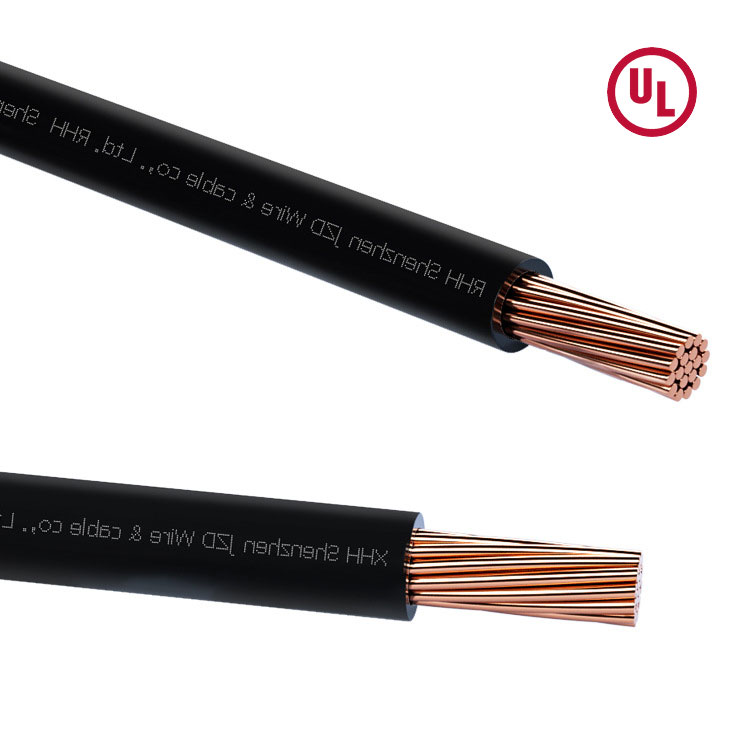
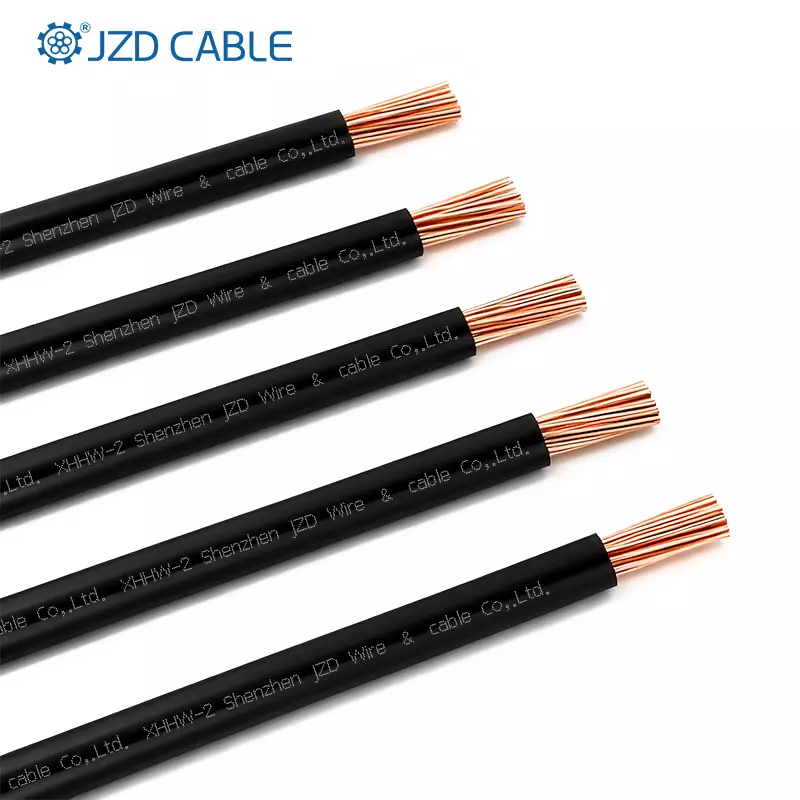
XHHW and XHHW-2 are often treated as interchangeable—both are XLPE-insulated, 600V, UL 44 listed. But the difference matters: it affects ampacity, derating, and wet-location compliance.
For feeders in underground conduit, outdoor raceways, or damp spaces, the wrong temperature rating forces either conductor upsizing or excessive operating temperatures. This article covers temperature ratings, ampacity and voltage drop, insulation aging, derating, and verification.
Core Difference: Wet-Location Temperature Rating
Rating Differences Between XHHW and XHHW-2
XHHW is rated 90°C in dry locations but only 75°C in wet locations. The insulation formulation limits the wet rating to 75°C, which means that in any wet location, the 75°C column of NEC Table 310.16 must be used for load calculations.
XHHW-2 is rated 90°C in both dry and wet locations. The “-2” suffix indicates that the insulation has been tested and listed for 90°C wet operation, allowing the 90°C ampacity column to be used in wet environments as well.
The table below summarizes the key differences:
| Item | XHHW | XHHW-2 |
| Dry-location rating | 90°C | 90°C |
| Wet-location rating | 75°C | 90°C |
| NEC ampacity column | 75°C column | 90°C column |
In NEC Table 310.16, XHHW appears in the 75°C column, while XHHW-2 appears in the 90°C column. This means XHHW-2 has a higher allowable ampacity than XHHW under both dry and wet conditions.
Practical Impact on Ampacity and Voltage Drop
1. Ampacity Difference and Conductor Sizing
To understand the practical impact, consider a 2/0 AWG copper conductor. At 90°C in a dry location, its allowable ampacity is 195A. At 75°C, it drops to 175A. If the conductor is installed in a wet location, using XHHW would limit the design to 175A, while XHHW-2 would allow the full 195A.
For a feeder circuit required to carry 180A, XHHW would need to be upsized to 3/0 AWG, while XHHW-2 could remain at 2/0 AWG. Upsizing increases material cost, conduit fill, and installation labor.
2. Voltage Drop Effects
Increasing conductor size not only affects material cost but also changes voltage drop calculations. NEC limits voltage drop to 3% for branch circuits and 5% combined for feeders and branch circuits. In long feeder runs, if a conductor must be upsized because of an insufficient temperature rating, voltage drop will decrease—but material cost and installation difficulty will rise. Conversely, if XHHW-2 allows a smaller conductor size to be maintained, voltage drop must still be checked to ensure it meets the limit.
Take a 200 ft, 200A feeder as an example: 4/0 AWG copper has a voltage drop of approximately 2.1%, within the 3% limit. If XHHW forces an upsize to 250 kcmil, voltage drop falls to approximately 1.7%, but conductor cost increases significantly. The value of XHHW-2 is not only meeting ampacity requirements but also achieving a more economical balance between conductor size and voltage drop.
XLPE Insulation Aging and Long-Term Reliability
1. Thermal Aging Performance
XHHW-2 uses thermoset XLPE insulation, which is the core difference from thermoplastic PVC insulation such as THHN/THWN-2.
XLPE forms a three-dimensional network through chemical cross-linking and does not rely on plasticizers for flexibility. Under long-term heat exposure, XLPE does not soften or re-flow, and its thermal aging resistance is superior to PVC. This is especially important in data center UPS feeders and main distribution circuits—these circuits operate continuously at high current, and the insulation must remain stable under sustained thermal stress.
2. Moisture Penetration and Water Treeing
In wet environments, XLPE’s advantage is more pronounced. Under equivalent test conditions, XLPE cable insulation resistance is typically one to two orders of magnitude higher than PVC cable. This means that under long-term moisture exposure, XLPE has much lower leakage current and its insulation performance degrades more slowly.
Another engineering fact worth noting: XLPE insulation in wet environments can experience “water treeing”—moisture gradually penetrates the insulation under the influence of an electric field, forming tree-like microchannels that reduce dielectric strength. However, UL 44’s long-term insulation resistance test for thermoset insulation (insulation resistance greater than 10 MΩ/kft after immersion in 90°C water) is specifically designed to evaluate this performance. XHHW-2’s UL 44 listing means it has been designed with moisture penetration effects on insulation resistance in mind.
3. Short-Circuit Withstand and Low-Temperature Performance
XHHW-2 also carries a 130°C emergency overload rating and a 250°C short-circuit rating. In high-density AI data center racks, available fault current is elevated. The 250°C short-circuit withstand means the cable can survive fault current until the protective device operates, without insulation breakdown causing a secondary incident.
XHHW-2 remains flexible at -40°C, while PVC insulation can become brittle at low temperatures. This has practical significance for outdoor installations in cold climates or wiring near cold storage areas.
Beyond the aging behavior of the insulation material itself, actual allowable ampacity is also constrained by ambient temperature and installation method.
Ambient Temperature Correction and Bundled Conductor Derating
1. Ambient Temperature Correction Factors
XHHW-2’s 90°C rating provides greater thermal margin, but in actual projects, ampacity must still be corrected for ambient temperature and installation conditions.
According to NEC Table 310.15(B)(1), the correction factors for 90°C-rated insulation at different ambient temperatures are as follows: 0.96 for 31–35°C, 0.91 for 36–40°C, 0.87 for 41–45°C, and 0.82 for 46–50°C. In high-temperature workshops, boiler rooms, or rooftop exposed installations, when ambient temperature exceeds 40°C, the correction factor for XHHW-2 is approximately 0.91; for 75°C-rated insulation under the same ambient conditions, the factor is 0.88. The difference affects conductor selection when approaching design limits.
2. Bundled Conductor Derating and Termination Temperature Limits
Bundled conductor derating: When more than three current-carrying conductors are in a conduit or tray, derate per NEC Table 310.15(C)(1). The correction factors are 0.80 for 4–6 conductors, 0.70 for 7–9, and 0.50 for 10–20. In data centers, cables are often densely installed in trays, making bundled derating a routine consideration.
Termination temperature limitation: NEC 110.14(C) states that conductor ampacity cannot exceed the value corresponding to the termination temperature rating. Most standard circuit breakers and distribution equipment have terminations rated 60°C or 75°C. Even if XHHW-2 itself is rated 90°C, when connected to a 75°C termination, the actual selection must still be based on the 75°C column. This is the most common source of derating for 90°C-rated wire in real projects.
Based on the ampacity correction and insulation performance factors above, the following items should be verified during selection.
XHHW-2 Selection Verification Points
When specifying XHHW-2 for a project, confirm the following:
- UL 44 listing for thermoset-insulated wire, covering both 600V and 1000V ratings
- Wet/dry temperature rating of 90°C in both conditions, ensuring wet-location compliance
- Conductor material: 99.9% pure electrolytic copper, meeting ASTM B3 (solid) or B8 (stranded)
- Sunlight-resistant (SR) rating for outdoor exposed installations
- RoHS compliance and zero halogen emissions for projects with environmental requirements
- Compact stranding for easier pulling through rigid and EMT conduits
- Batch consistency in insulation thickness, conductor stranding, and marking
Some XHHW-2 products offer dual 600V/1000V ratings in sizes 8 AWG and larger, providing flexibility for projects that may require future voltage upgrades. Certain constructions in 1/0 AWG and larger are tested to IEEE 1202/FT4 for tray installation.
Conclusion
XHHW and XHHW-2 are not interchangeable in wet locations. XHHW-2’s 90°C wet-location rating provides higher ampacity, reduces the need for conductor upsizing, and offers better long-term reliability in moisture-exposed environments. XLPE insulation has better dielectric strength and insulation resistance retention than PVC, and it degrades more slowly under continuous full load and wet conditions.
For commercial and industrial projects where feeders run through underground conduit, outdoor raceways, or damp spaces, XHHW-2 is the technically sound choice. Selecting the correct temperature rating at the design stage avoids costly redesign and helps ensure the installation passes inspection.
For UL 44 listed XHHW-2 copper conduit wire specifications or certification documents, please contact us.