

In North America, Latin America, Africa, and the Middle East, extending electrical grids to rural and remote communities presents engineering challenges that are fundamentally different from urban distribution networks. Long distances, difficult terrain, limited infrastructure access, and tight budgets combine to create unique constraints for rural power distribution.
Why Aluminum Is Preferred for Rural Distribution
ABC cables can be manufactured with copper or aluminum conductors, but aluminum is the absolute mainstream for rural overhead distribution. This is not because aluminum is “better”—it is because aluminum performs better under the engineering constraints of rural distribution. The advantages of aluminum wiring in rural overhead applications manifest in three specific ways:
-
Simplified pole design. Aluminum wire weighs approximately 30-40% of copper for equivalent ampacity. Lighter conductors mean lower vertical loads on poles, simpler cross-arm and insulator requirements, and shallower foundations in soft soil areas. This difference is especially critical in swampy, frozen, or otherwise weak soil conditions—where pole foundation costs often exceed the cost of the pole itself.
-
Increased span capability. Conductor weight directly determines sag and tension. Rural distribution economics require minimizing pole count by maximizing span length. Aluminum wiring achieves longer spans at the same tension, or lower pole strength requirements at the same span, compared to copper. This means fewer poles for the same project.
-
Reduced logistics and installation costs. In remote areas, road conditions and transport distances often make logistics a major budget item. Lighter aluminum wire reduces shipping costs and is easier to string on-site, requiring less heavy lifting equipment—in roadless mountain areas, this advantage can determine whether a project is even feasible.
ABC Cable vs. Bare Conductors: How to Choose the Right Aluminum Wire
The selection between ABC and bare conductors is not about which is “better” in absolute terms—it is about which solution delivers the best balance of reliability, safety, and life-cycle cost under the specific conditions of each rural distribution project. The following comparison provides the engineering basis for that decision.
1. Bare Conductor Types: AAC, AAAC, and ACSR
In rural overhead distribution, bare conductors fall into three main types, each suited to different engineering scenarios:
| Type | Full Name | Construction | Characteristics | Typical Application |
| AAC | All Aluminum Conductor | Single aluminum alloy wires stranded | Best conductivity, lowest strength | Urban short spans, dense pole support |
| AAAC | All Aluminum Alloy Conductor | Aluminum alloy wires stranded | Higher strength than AAC, better corrosion resistance | Longer spans, coastal areas |
| ACSR | Aluminum Conductor Steel Reinforced | Steel core + aluminum conductor | Highest strength, longest spans | Long-distance transmission, river crossings |
2. Fault Rate Differences Between ABC and Bare Conductors
In rural distribution, bare conductors experience four main fault types, with approximate percentages:
- Tree contact (~40-50%): Branches touching exposed conductors causing phase-to-phase faults
- Wind-induced conductor clashing (~20-30%): Conductors swinging together under strong winds
- Wildlife contact (~10-15%): Birds or animals touching two phases simultaneously
- Lightning flashover (~10-15%): Insulator flashover caused by lightning strikes
ABC’s fully insulated construction reduces the probability of all four fault types to near zero. Field data shows that ABC networks experience 5 to 10 times fewer fault incidents than bare conductor lines. This difference is decisive in forested rural areas (such as Africa, Latin America, and the western United States).
3. Comprehensive Engineering Performance Comparison
| Comparison Dimension | Bare Conductors (AAC/AAAC/ACSR) | ABC Cable |
| Insulation | None—relies on air gap clearance | XLPE fully insulated—phases can contact each other |
| Phase-to-phase faults | High risk—wind, vegetation, wildlife | Zero risk—insulation isolates phases |
| Right-of-way width | Wide—requires phase spacing | Narrow—compact bundled design |
| Pole loading (vertical) | Moderate | Slightly higher (due to insulation weight) |
| Pole loading (horizontal/tension) | High—conductor carries tension | Low—messenger wire carries tension |
| Tree trimming maintenance | High frequency—1-2 times per year | Low frequency—once every 2-3 years |
| Fault rate | Baseline | 5-10 times lower |
| Service life | ~5 years (environmental degradation) | 15+ years |
| Initial material cost | Low | Moderate to high |
| 30-year TCO | High (maintenance + faults + losses) | Significantly lower |
4. Span Capability Comparison: ABC vs. AAC, AAAC, and ACSR
Among all performance dimensions, span capability is often the deciding factor in rural distribution economics—fewer poles mean lower project costs. The following comparison shows how each conductor type performs on this critical parameter.
| Conductor Type | Typical Maximum Span | Tension Carried By | Limiting Factor |
| AAC | 80-120 meters | Conductor itself | Conductor breaking strength |
| AAAC | 100-150 meters | Conductor itself | Conductor breaking strength |
| ACSR | 150-300 meters | Steel core | Steel core breaking strength |
| ABC | 100-300 meters | Messenger wire | Messenger breaking strength |
At the low-voltage distribution level, ABC achieves span capability comparable to ACSR through its messenger wire design, while providing the fully insulated safety that ACSR lacks.
ABC Cable Construction: Aluminum Wire, XLPE Insulation, and Messenger Wire
Understanding how ABC cable is constructed—from conductor material to insulation to messenger wire—is essential for making informed design and procurement decisions. Each component affects the cable’s performance, longevity, and cost.
1. Conductor: 1350-H19 Aluminum Wire for Overhead ABC Cable
ABC conductors use aluminum wire (1350-H19), fully hard-drawn to maximize tensile strength. This aluminum wiring meets ASTM B230 (Aluminum Wire for Electrical Purposes) and ASTM B231 (Concentric-Lay-Stranded Aluminum Conductors) standards. Material characteristics:
- Purity ≥99.7%
- Compact stranded construction for a smoother surface and more reliable terminations
2. Insulation: XLPE Temperature Range and Weather Resistance
ABC uses XLPE (cross-linked polyethylene) insulation, with engineering advantages including:
- Continuous operating temperature -40°C to +90°C, covering all global climates
- UV resistance does not degrade under prolonged outdoor exposure
- High dielectric strength can withstand 3× rated voltage
- Fully insulated—eliminates phase-to-phase faults and shock hazards
3. Messenger Wire: Span Capability and Tension Design
The messenger wire distinguishes ABC from ordinary insulated cables. Its function is to carry the cable’s self-weight, wind loads, and ice loads. The messenger’s breaking strength directly determines the achievable span length and is the most critical sizing parameter in engineering design.
| Messenger Material | Typical Breaking Strength | Suitable Span | Application |
| Galvanized steel (high-strength) | High | 150-300 meters | Long spans, heavy ice loading |
| Galvanized steel (standard) | Medium | 100-200 meters | Standard rural distribution |
| Aluminum alloy | Lower | 80-150 meters | Medium spans, coastal areas |
Messenger selection logic:
- Span ≥150 meters or design ice thickness ≥10mm → Choose high-strength galvanized steel messenger
- Coastal/corrosive environments → Choose aluminum alloy messenger (superior corrosion resistance)
- Standard rural distribution → Standard galvanized steel messenger is sufficient
Overhead Distribution Design: Span, Tension, and Climatic Loads
1. Span and Tension Calculation: Sag Design Guide
ABC cables in rural distribution must meet specific mechanical design requirements. The core parameters are the balance among span, tension, and sag:
1. Span
Span length determines pole count and total project cost. In rural distribution, cost-driven design maximizes span to reduce pole count. Typical span ranges:
- Urban distribution: 60-120 meters
- Rural distribution: 100-250 meters
- Long-span design: Up to 300+ meters (requires special messenger specification)
2. Tension
The messenger’s tension capacity determines achievable span length. Rural distribution ABC messenger wires typically use galvanized steel or aluminum alloy, with allowable tension generally 30-40% of breaking strength.
Design principle: Increasing tension reduces sag but increases pole lateral loading and foundation requirements.
3. Sag
Excessive sag results in inadequate ground clearance; insufficient sag means excessive tension. Standard requirements:
- Maximum sag typically 2-4% of span length
- Under extreme temperature conditions, sag variation must remain within acceptable limits
2. Climatic Load Corrections: Ice, Wind, and Temperature
Climatic conditions directly affect ABC cable engineering parameters:
| Climatic Load | Effect on ABC Cable | Design Response |
| Ice accumulation | Increases total cable weight, sag, and tension | Use higher-strength messenger, shorten spans |
| High wind | Increases lateral loading, cable sway | Tighten sag design, reduce sag |
| High temperature | Conductor expansion increases sag | Allow sag margin for high temperatures |
| Low temperature | Conductor contraction increases tension | Limit maximum tension at low temperatures |
Overhead vs. Underground: Why ABC Wins for Rural Distribution
| Comparison Dimension | Underground Cable | ABC Cable |
| Installation environment | Underground | Overhead |
| Terrain limitations | Difficult in rock, permafrost, swamp | Deployable in all terrain types |
| Installation cost | High—excavation, backfill, restoration | Low—overhead stringing, no excavation |
| Repair difficulty | High—requires excavation to locate faults | Low—visual inspection of overhead line |
| External influence | Low (but vulnerable to third-party damage) | Medium (affected by fallen trees, ice) |
| Best suited for | Urban cores, road crossings, high aesthetic areas | Rural, mountainous, forested, coastal areas where excavation is difficult |
In rural distribution, ABC cable is superior to underground cable in most scenarios due to its overhead installation, low-cost deployment, and terrain flexibility.
Aluminum Wire Selection Guide: ABC vs. Bare Conductors
| Project Conditions | Recommended Solution | Engineering Rationale |
| Long-distance HV transmission (>110kV) | ACSR bare conductor | Steel core reinforcement for ultra-long spans; insulation cost would be prohibitive |
| MV distribution (6-33kV), forest/mountain | ABC cable | Fully insulated eliminates tree contact faults; suitable for complex terrain |
| LV distribution (0.6/1kV), rural residential | ABC cable | Safe, low fault rate, easy installation |
| Coastal/corrosive environments | ABC cable or AAAC | Full insulation protection or aluminum alloy corrosion resistance |
| Extreme long spans (>300 meters) | ACSR bare conductor | Steel core provides maximum tensile strength |
| Urban core, high aesthetic requirements | Underground cable | No overhead visual impact |
| Extremely tight budget, no vegetation risk | AAC/AAAC bare conductor | Lowest initial investment |
Selection essence:
- Rural LV distribution (0.6/1kV) → ABC cable is the engineering-optimal solution
- MV distribution, densely vegetated areas → ABC cable significantly reduces tree-trimming maintenance costs (5-10× lower fault rate)
- Ultra-long spans, HV transmission (>110kV) → ACSR bare conductor remains irreplaceable
- High aesthetic requirements in urban areas → Underground cable is an option
International Standards for Aluminum ABC Cable
ABC cables are manufactured to multiple international standards. Each standard has differences in insulation thickness, conductor specifications, and testing requirements, with the following impacts on procurement decisions:
| Standard | Primary Markets | Key Differences from IEC | Procurement Impact |
| IEC 60502 | Middle East, Africa, Latin America (mainstream) | Baseline standard | Widest applicability, shortest lead time |
| AS/NZS 3560.1 | Australia, New Zealand, Pacific Islands | Thicker insulation requirements | Separate stock required; not interchangeable with IEC |
| ANSI/ICEA S-76-474 | North America (U.S., Canada) | Conductor sizes in AWG/kcmil | Must be manufactured to imperial sizes; not interchangeable with metric |
| BS 7870 | UK, former Commonwealth countries | Some stricter test requirements | Requires additional testing/certification |
| NFC 33-310 | France, parts of French-speaking Africa | Different insulation material and thickness requirements | Requires separate certification |
ASTM B230 specifically covers aluminum wire (1350-H19) for electrical purposes—the material used in ABC cable conductors. ASTM B231 covers concentric-lay-stranded aluminum conductors.
Actual impact on procurement decisions:
- IEC standard products can be used across most projects in the Middle East, Africa, and Latin America
- North American projects must use ICEA standard products (AWG sizes + UL certification)
- Australian/New Zealand projects must meet AS/NZS standards (thicker insulation requirements)
- For projects spanning multiple standard regions, separate procurement is recommended—a single product cannot simultaneously meet all standard requirements
JZD’s ABC cables can be manufactured to any of the above standards, ensuring compliance with local regulatory requirements.
JZD ABC Cable Solutions: Aluminum Wire Manufacturer for Global Rural Electrification
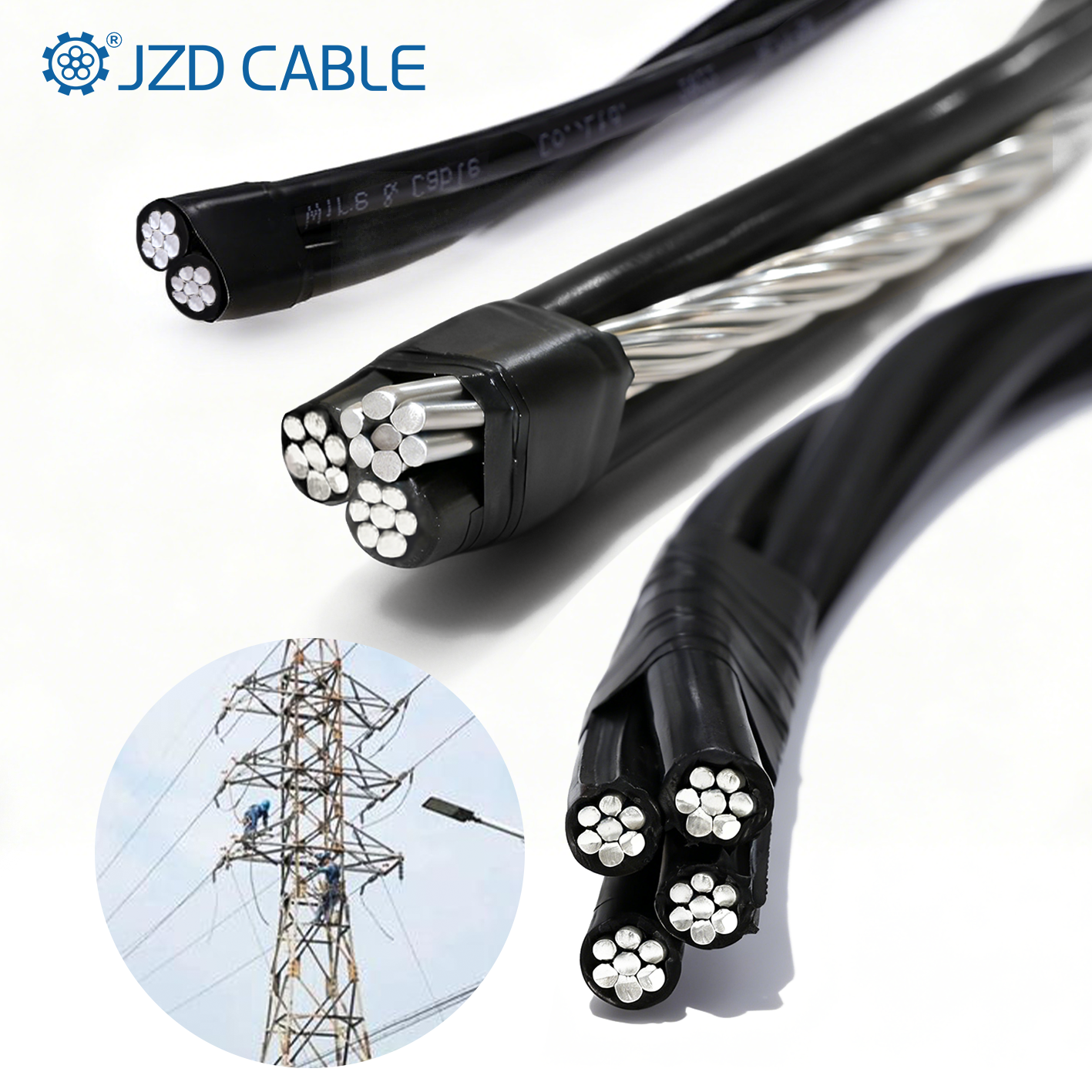
JZD Cable manufactures a comprehensive range of Aerial Bundled Cables for overhead power distribution, serving markets across North America, Latin America, Africa, and the Middle East.
1. Product Specifications
| Parameter | Specification |
| Standard | AS/NZS 3560.1, IEC 60502, ASTM (per customer requirements) |
| Voltage | 0.6/1kV (LV); 6.35/11kV and 19/33kV (MV options available) |
| Conductor | Aluminum 1350-H19, compact stranded |
| Insulation | XLPE with UV stabilizers |
| Temperature range | -40°C to +90°C |
| Messenger wire | Galvanized steel or aluminum alloy (sized per span requirements) |
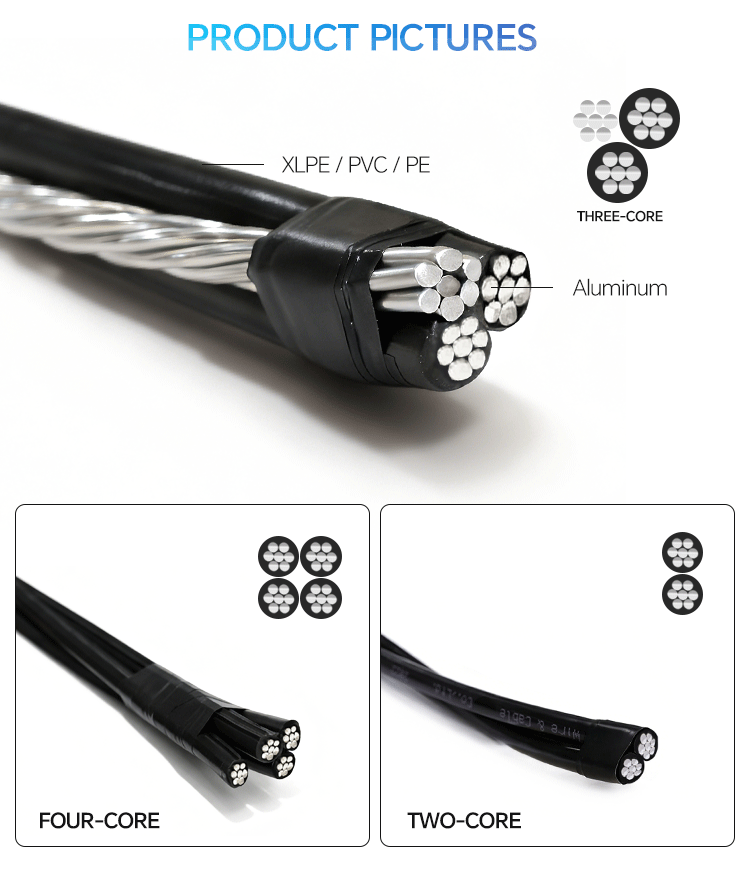
| Configurations | 2-core, 3-core, 4-core |
| Conductor size range | 16mm² – 150mm² (LV) |
2. Key Features
- Fully insulated conductors eliminate tree contact and phase-to-phase faults
- XLPE insulation provides -40°C to +90°C wide temperature range and UV resistance
- Compact bundled design requires narrower rights-of-way, suitable for densely vegetated areas
- Messenger wire support enables long spans, reducing pole count
- Corrosion-resistant materials suitable for coastal and industrial pollution areas
- Multi-core configurations (2-core, 3-core, 4-core) cover all distribution needs
- Multi-standard production capability: can manufacture to IEC, AS/NZS, ICEA, BS, and other standards
3. Global Reach
With over 25 years of manufacturing experience and exports to more than 100 countries, JZD Cable provides reliable, code-compliant ABC cable solutions for overhead power distribution projects worldwide.
Conclusion: Why Aluminum ABC Cable Is the Engineered Solution for Rural Power Distribution
For rural and remote distribution projects, aluminum ABC cable delivers the optimal balance of performance, durability, and cost-effectiveness.
The aluminum wiring advantage:
- Material cost approximately one-third that of copper at equivalent ampacity
- Weight approximately 40% of copper, reducing pole loads and increasing span capability
- Tangible benefits in pole design, span capability, and logistics cost
The ABC value proposition:
- Fully insulated construction reduces fault rates to one-fifth to one-tenth of bare conductors
- Messenger wire carries mechanical loads, enabling long spans while keeping conductors stress-free
- XLPE insulation provides wide temperature range, UV resistance, and 30+ year service life
- In complex terrain—rural, mountainous, forested, coastal—ABC’s engineering adaptability is unmatched
For utilities, contractors, and project developers working on overhead distribution in rural and remote areas, aluminum ABC cable is the key tool that transforms the engineering constraints of rural electrification into feasible solutions.
Need ABC cable for your overhead distribution project? Contact JZD for technical specifications, sizing assistance, and certified cable solutions.