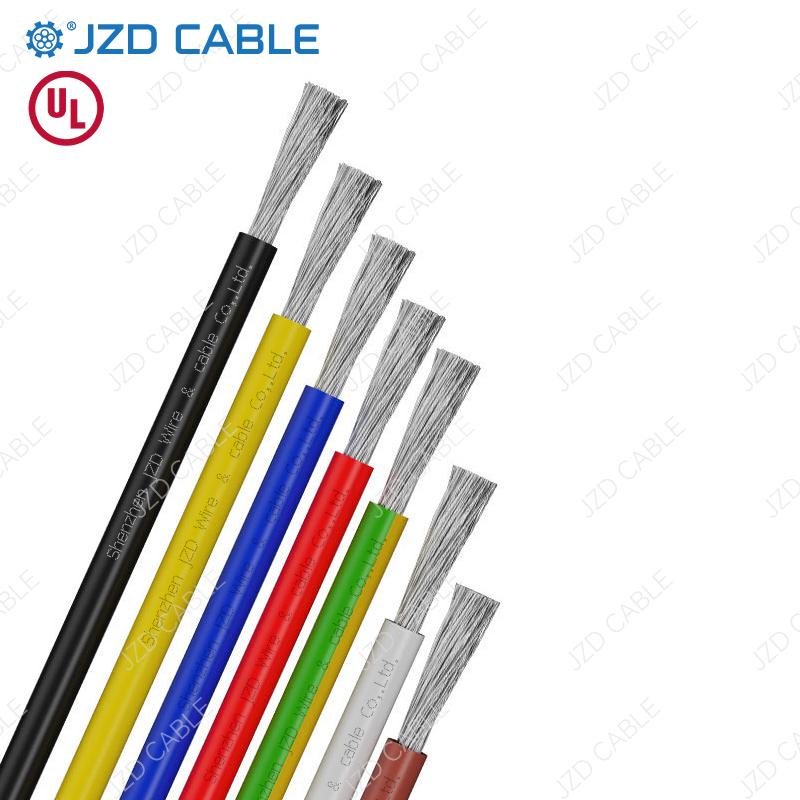


On Australian job sites, electricians often wire split-system air conditioners by matching terminal colors—black to black, white to white, red to red. The problem: black is active, white is neutral, red is communication. Connecting by color rather than function is wrong.
Energy Safe Victoria issued an alert on this. The wiring must comply with AS/NZS 3000 Table 3.4. Wrong connections mean immediate rectification.
If you’re looking for SAA-certified blue TPS cable that meets AS/NZS 5000.2 for air conditioning installations, the blue sheath is your visual assurance—it tells the installer this cable is for HVAC and to get the conductor functions right.
What’s Actually Inside a Blue TPS Cable?
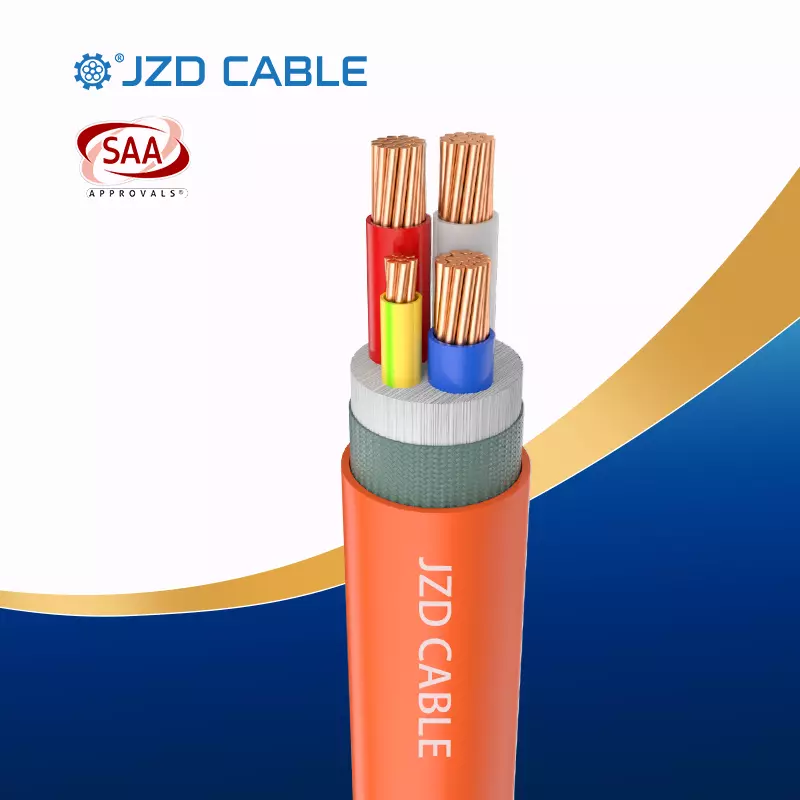
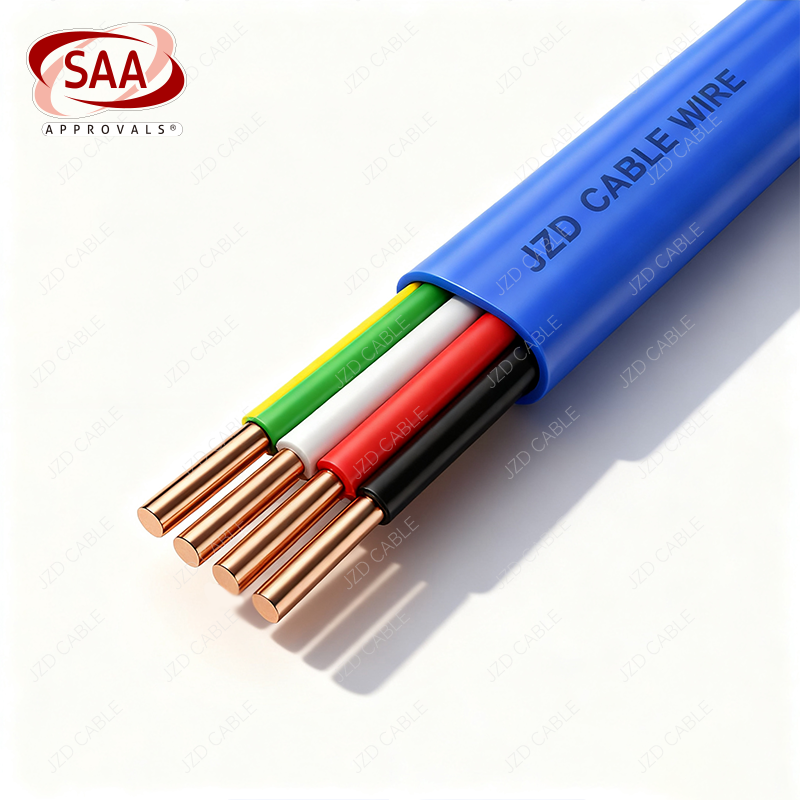
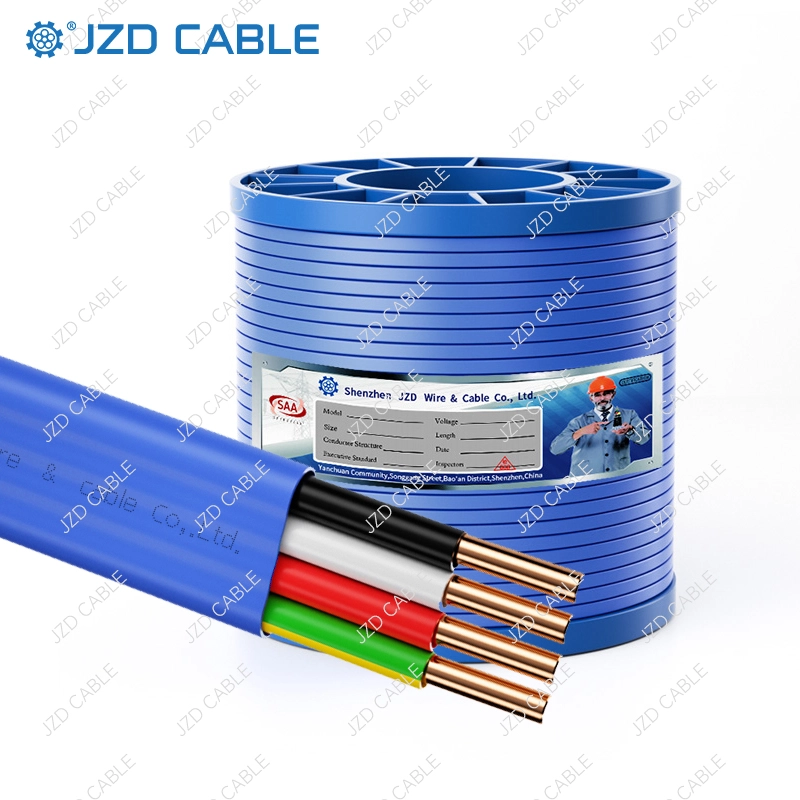
The standard blue TPS cable used for air conditioning is a 3-core + earth (3C+E) configuration, manufactured to AS/NZS 5000.2:
| Component | Color | Function |
| Active | Red | Phase conductor |
| Active | White | Second phase (240V between actives) |
| Neutral | Black | Return path |
| Earth | Green/Yellow | Protective earthing |
This configuration delivers single-phase 240V power—exactly what a standard residential or light commercial air conditioning unit requires.
Clarification: The blue sheath is a product identification color, not a conductor color. Under AS/NZS 3000, neutral conductors are black (or light blue in some cases). The blue outer sheath tells the installer what the cable is for—it doesn’t mean the internal neutral conductor is blue. Inside the cable, core colors follow standard AS/NZS 3000 color coding.
For three-phase HVAC applications, a 4-core blue TPS cable is available, providing three actives plus neutral and earth.
Why Blue? The Logic Behind the Color
The choice of blue isn’t random. In the Australian electrical industry, different sheath colors signal different applications:
| Sheath Color | Industry Association |
| White | General-purpose TPS |
| Purple | Non-migratory sheath (compatible with polystyrene insulation) |
| Blue | Air conditioning and single-phase HVAC |
Multiple manufacturers and suppliers have adopted blue as the standard identifier. Olex-Blu is explicitly described as “a durable and robust 3C+E cable specifically designed for air conditioning and single-phase applications,” with “the added benefit of a blue-colored sheath for easy identification during installation.” Maser Cable lists blue sheath 3C+E cable as “Air Conditioner Cable”.
Prysmian has also publicly acknowledged that customers have been asking for “a simplified circuit identification solution”—which is why they introduced blue-sheathed 3C+E cables for air conditioning and heat pump installations.
The blue sheath allows electricians to visually distinguish HVAC circuits from general power circuits at a glance. On-site, this means:
- Switchboards with multiple circuits can be quickly traced
- Ceiling spaces where cables are bundled together
- Maintenance when technicians need to identify circuits quickly
- Reduced errors—no confusion between circuits
The Installation Problem That Made Blue Sheath Necessary
The Energy Safe Victoria alert highlights the real-world risk. Electricians were incorrectly connecting the wiring between indoor and outdoor units based on terminal color coding. The result? Black became active, white became neutral, and red became communication—exactly the opposite of what’s required under AS/NZS 3000.
This is where the blue sheath adds value. It signals to the installer: this is a dedicated air conditioning cable. The internal conductors follow AS/NZS 3000 standards. Read the conductor colors, not the terminal colors.
Energy Safe Victoria’s message was clear: immediate rectification is required if this error is found. The cost of rectification — not to mention the safety risk—far outweighs any perceived benefit of using generic white TPS cable.
Technical Specifications: AS/NZS 5000.2 Compliance
Blue TPS cable is manufactured to AS/NZS 5000.2, the Australian/New Zealand standard for polymeric-insulated cables up to 450/750V.
| Parameter | Specification |
| Standard | AS/NZS 5000.2 |
| Voltage Rating | 450/750V |
| Insulation | V-90 PVC |
| Sheath | 3V-90 PVC |
| Temperature Rating | 90°C maximum conductor temperature |
| Conductor | Class 2 stranded annealed copper |
| Sheath Color | Blue (industry standard, not standard-mandated) |
Common conductor sizes:
- 1.5 mm²—standard residential split systems (under 3.5 kW)
- 2.5 mm²—large residential / light commercial AC (over 5 kW)
SAA certification confirms compliance with Australian safety and performance requirements.
What AS/NZS 3000 Requires
Installation of blue TPS cable must comply with AS/NZS 3000 (Australian/New Zealand Wiring Rules). Key requirements:
Dedicated Circuit: Air conditioning must be supplied from a dedicated final sub-circuit with appropriately rated overcurrent protection.
Isolator Switch: A local isolator switch must be installed at the outdoor unit location. Note: Some air conditioning models prohibit mounting the isolator switch directly on the unit.
Conductor Identification: The wiring between outdoor and indoor units is classified as installation wiring and must comply with conductor insulation color identification requirements in AS/NZS 3000 Table 3.4.
Conductor Sizing: Minimum conductor size, cable type, and voltage drop must comply with AS/NZS 3000. If the air conditioning manufacturer specifies a larger cable size than the standard, the manufacturer’s higher specification must be followed.
Professional Installation: Air conditioning electrical wiring must be installed by licensed electrical contractors.
Why White TPS Cable Isn’t the Right Substitute
White-sheathed TPS is the general-purpose fixed wiring cable in Australia. But using white TPS as a substitute for blue comes with real drawbacks:
-
On-site identification suffers. In installed switchboards or ceiling spaces, white sheathing doesn’t distinguish air conditioning circuits from lighting, general power, or other circuits. Maintenance personnel facing multiple white cables can only trace or use a multimeter to identify the air conditioning feed.
-
Industry consistency matters. Blue sheathing has become the default visual identifier for air conditioning circuits. Specifying white means electricians, maintenance technicians, and inspectors must take extra steps to verify circuit identity—increasing communication overhead and the risk of errors.
-
AS/NZS 3000 requires clear identification. The Australian wiring rules require clear circuit identification in electrical installations. Blue sheathing is the industry’s standard method of achieving this for air conditioning circuits.
JZD Blue TPS Cable: SAA-Certified for Australian Conditions
JZD Cable offers SAA-certified blue TPS cable manufactured to AS/NZS 5000.2, with SAA certification number SAA-240436-EA.
1. 4-Core – Three-Phase Applications
For commercial HVAC, three-phase equipment, and industrial wiring. The 4-core configuration provides three active conductors plus neutral and earth.
2. Features
- SAA-certified—independent verification for Australian and New Zealand markets
- AS/NZS 5000.2 compliant—meets Australian cable standards
- Blue sheath identification—industry-recognized for air conditioning
- Flat TPS profile—reduces installation space
- 90°C temperature rating—suitable for high-temperature environments
Conclusion
In the Australian electrical industry, blue TPS cable means one thing: air conditioning. The blue sheath is not a conductor color—it’s a product identification system that has become the industry standard for HVAC wiring.
The Energy Safe Victoria alert on split-system wiring errors is a reminder that clear identification matters. The blue sheath helps prevent the kind of misidentification that leads to costly rework and potential safety hazards.
For contractors, this means:
- Faster identification on site
- Reduced errors—no confusion between circuits
- Clearer maintenance—technicians can identify HVAC wiring at a glance
Blue TPS cable is manufactured to AS/NZS 5000.2, carries SAA certification, and delivers reliable power to air conditioning systems across residential, commercial, and industrial applications.
Need blue TPS cable for your HVAC project? Contact JZD Cable for free samples and technical specs.