

Solar panel wiring is often treated as a simple extension of general electrical work. In practice, the DC side of a photovoltaic system operates under conditions that demand a dedicated conductor: continuous UV exposure, wide temperature swings, moisture, and elevated DC voltages. Selecting the wrong cable for exposed array wiring can lead to accelerated insulation aging, code violations, and DC-side faults.
This article focuses on PV wire—the UL 4703 listed single-conductor photovoltaic cable—and covers construction, ratings, ampacity, installation, and selection for commercial and industrial solar projects.
PV Wire Construction and Ratings
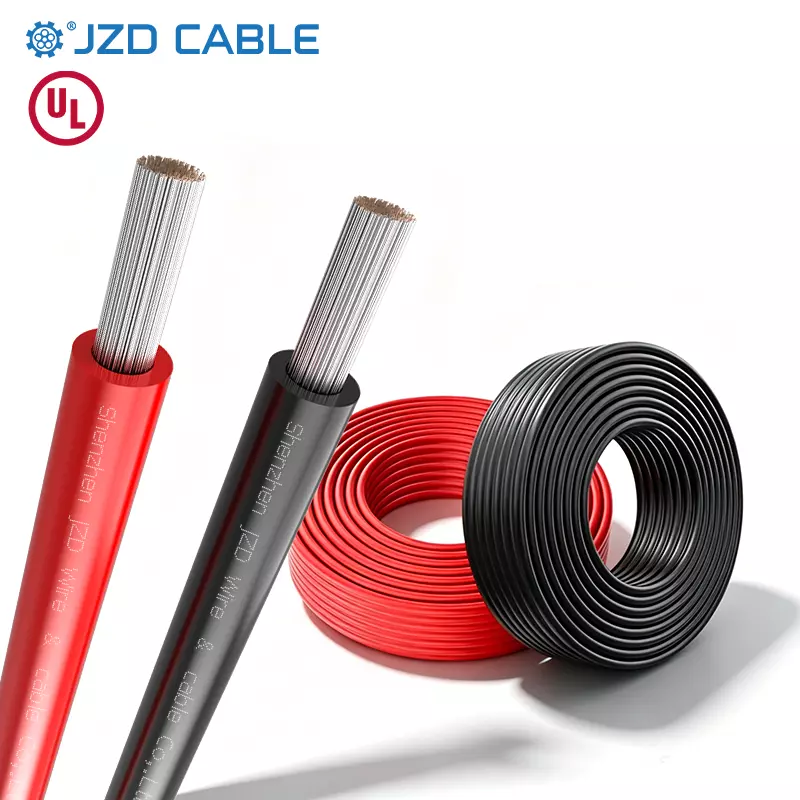
PV wire is a single-conductor, sunlight-resistant photovoltaic cable listed under UL 4703. It is designed for interconnection wiring of grounded and ungrounded photovoltaic power systems as described in NEC Article 690.
PV wire insulation and jacket are typically thicker than general-purpose wiring, providing greater mechanical and environmental protection. The insulation compound resists UV degradation, making it suitable for long-term exposed array wiring.
Key features:
- Sunlight-resistant, suitable for exposed wiring
- 90°C wet rating for outdoor moisture and condensation
- Voltage ratings of 600V, 1000V, and 2000V
- Minimum conductor size down to 18 AWG
- Suitable for grounded and ungrounded PV systems
Understanding the construction helps explain why PV wire is specified for exposed array wiring. The next step is selecting the correct temperature and voltage rating for the system.
Temperature and Voltage Ratings
PV wire temperature ratings vary by product: 90°C, 105°C, 125°C, or 150°C dry, and 90°C wet. For exposed outdoor wiring, the wet rating is the relevant value because moisture and condensation are unavoidable.
Voltage rating should match the system. Residential and light commercial string systems typically use 600V or 1000V PV wire. Commercial and utility-scale projects with higher string voltages require 1000V or 2000V rated cable. Confirm that the cable voltage rating is not lower than the array’s maximum system voltage.
Once temperature and voltage ratings are matched to the system, the next step is to verify ampacity and voltage drop.
Ampacity and Voltage Drop
PV wire ampacity depends on conductor size, insulation temperature rating, and installation conditions. DC PV circuits have specific derating requirements.
For DC circuits, the short-circuit current (Isc) is multiplied by 1.25 for continuous duty sizing. After that, temperature correction factors from NEC 310.16 are applied based on the ambient temperature and the conductor’s insulation rating.
Voltage drop should be verified against project requirements. Common targets are 2% for DC source circuits and 3% for AC output circuits under NEC, or 3% total under IEC 62548.
The DC voltage drop formula is:
Voltage Drop = 2 × Current × Resistance × Length
The factor of 2 accounts for both positive and negative conductors. In long string runs, voltage drop may require a larger conductor than the minimum size determined by ampacity alone.
Once conductor size is determined, connectors and terminations become the next factor affecting installation quality and long-term reliability.
Connectors and Terminations
PV DC connectors typically use a 4 mm contact pin and provide IP67 waterproof sealing for module-to-module and module-to-inverter connections.
Two points matter for projects. First, connectors from different sources may physically mate but are not jointly safety-listed; mixing them creates risk. Second, connector ratings must match the PV wire gauge and current rating. Pre-terminated PV wire can reduce field labor, but the cost trade-off depends on project volume and labor rates.
Beyond connectors, the installation method for exposed wiring also directly affects cable life.
Exposed Array Wiring Installation Notes
PV wire is suitable for module-to-module connections, exposed rooftop surface wiring, and short exposed runs between the array and conduit entry. Once the circuit enters conduit, wet-rated conductors suitable for the location may be used.
Rooftop conduit adds a temperature derating consideration. NEC 310.15(B)(3)(c) adds 22°C to the maximum ambient air temperature for conductors in conduit within 7 inches of the roof surface. This derating applies to PVC and metallic conduit strapped directly to the roof or supported up to 7 inches above it. In hot climates, this can significantly reduce allowable ampacity and should be included in conductor sizing.
Based on the factors discussed above, the following checklist can be used for initial conductor selection.
Selection Checklist
| Project Condition | Recommended Conductor |
| Exposed array wiring, module-to-module | PV wire, 600V or 1000V |
| Exposed array wiring, commercial 1000V system | PV wire, 1000V or 2000V |
| Conduit run, wet location | Wet-rated conductor |
| Conduit run, dry indoor | Dry-rated conductor |
| Ungrounded array, exposed wiring | PV wire |
JZD supplies PV wire and connectors covering 600V, 1000V, and 2000V ratings, with specifications, certification documents, and bulk supply options. For pre-terminated or field-terminated projects, connector matching with wire gauge and current rating can also be confirmed.
FAQ
1. How are wires connected to solar panels?
Solar panels have junction boxes with positive and negative leads. PV wire and solar-specific connectors are used to make connections. Polarity and waterproofing must be observed. Commercial projects often require UL-listed connectors, either pre-terminated or field-crimped.
2. Can I wire a solar panel straight to a battery?
No. Solar panel output varies with sunlight, and direct connection can cause overcharging or over-discharging. A charge controller is required. Commercial systems also need voltage matching and controller capacity checks.
3. Can I connect a solar panel to an electrical outlet?
No. Solar panels produce DC, while outlets supply AC. An inverter is required to convert DC to AC, and the system must comply with grid-tied or off-grid codes. Direct connection can damage equipment and create safety hazards.
If you are sourcing PV wire for commercial or industrial solar projects and need UL 4703 listed product specifications, certification documents, or bulk supply options, contact us for more information.