

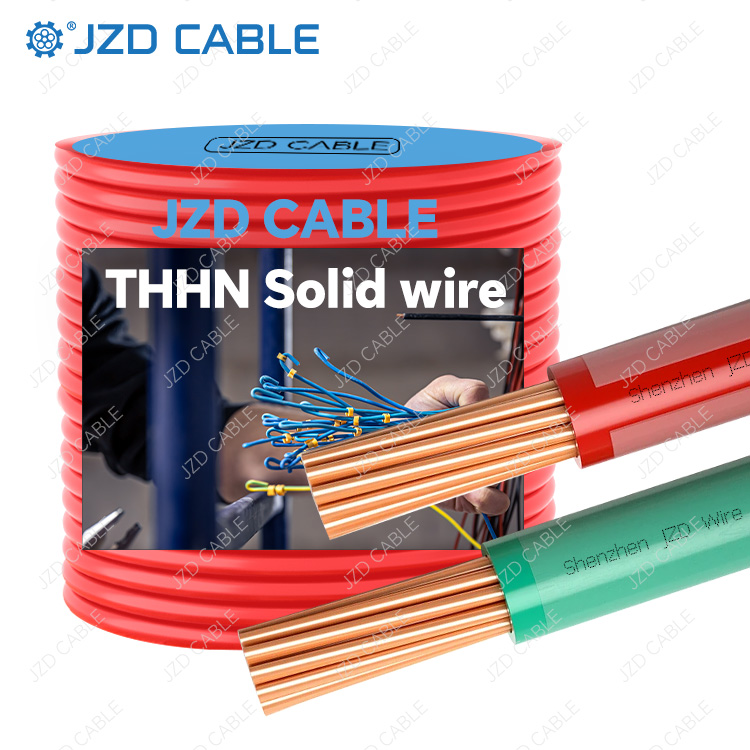
Commercial wiring demands more than a single wire type. Complex circuit loads and harsh installation conditions—such as conduit bundling and environmental extremes—can severely degrade actual ampacity. Selecting the right wire requires dynamically balancing environment, installation, and load. THWN-2 T90 meets this challenge, serving as a North American standard by delivering a proven balance of 90°C rating, dry/wet dual applicability, and installation efficiency.
Why Standard Ampacity Tables Are Not Enough
The current-carrying characteristics of commercial loads vary dramatically, dictating the starting point for wire sizing:
- Lighting Circuits: Current is relatively stable. However, the inrush characteristics of large-scale LED drivers, combined with long routing paths, often make voltage drop the primary constraint on conductor sizing, rather than ampacity.
- Receptacle Circuits: Loads are random and intermittent. Sizing cannot be estimated merely based on average loads; it must consider the coordination between circuit breaker protection characteristics and the thermal time constant of the conductor.
- HVAC Circuits: Continuous high temperatures combined with motor starting inrush currents that are several times the rated load. Furthermore, equipment is often located on rooftops or mechanical floors where ambient temperatures far exceed indoor baselines.
- Distribution Feeders: Face the challenges of short-circuit thermal stability for large conductor sizes and high bundling density in cable trays. Sizing errors can lead to insulation damage or conductor annealing.
The Core Conflict: Ampacity tables in the NEC provide baseline values under “standard conditions,” but actual commercial job sites are almost never standard.
Heat Accumulation and Derating
A 90°C rating is often misunderstood as “unconditional capacity for higher current.” In reality, NEC ampacity tables are based on a baseline of “no more than three current-carrying conductors at 30°C ambient temperature.” In actual engineering, two layers of correction must be applied:
1. Conduit Fill Derating
When a conduit contains four or more current-carrying conductors, mutual heating reduces heat dissipation. Derating must be applied per NEC Table 310.15(C)(1):
- 4-6 conductors: Adjustment factor 80%
- 7-9 conductors: Adjustment factor 70%
- 10-20 conductors: Adjustment factor 50%
2. Ambient Temperature Correction
- Rooftops and ceiling plenums in commercial buildings frequently exceed 40°C. For 36–40°C, the correction factor is approximately 0.91.
- For 46–50°C, the correction factor drops to 0.82.
- For conduits exposed to direct sunlight on rooftops, the NEC requires an additional 33°C temperature adder.
Why THWN-2 instead of standard THWN?
Standard THWN has a temperature rating of only 75°C in wet locations, whereas THWN-2 maintains a 90°C rating in both dry and wet environments. This means that in basements or rooftops where high temperatures and potential condensation coexist, the designer can consistently apply correction factors based on the 90°C column, rather than being forced back to the 75°C column due to “wet” conditions.
Take JZD Cable’s Green THWN-2 T90 as an example. Its product datasheet presents ampacities in three columns: 60°C, 75°C, and 90°C. Using the 6 AWG size as an illustration, its ampacity in the 90°C column is 75A, compared to 65A in the 75°C column—a difference of approximately 15%. This is precisely why THWN-2 provides additional headroom in environments with combined high temperatures and moisture.
What is THHN/THWN-2 Wire?
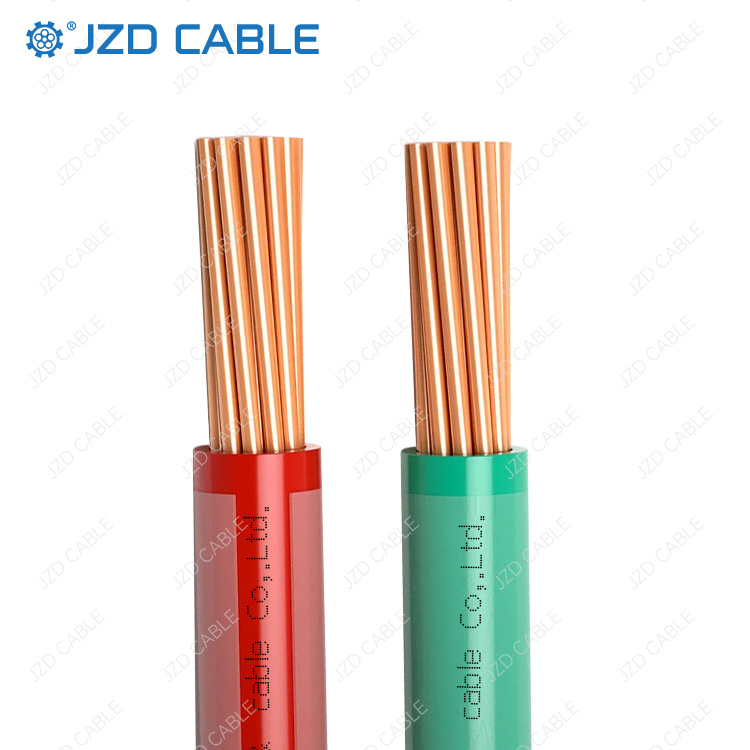
The performance of THHN/THWN-2 stems from its three-layer physical structure. JZD’s product specifications serve as a concrete structural reference:
- Copper Conductor: Provides high conductivity and mechanical strength.
- PVC Insulation: Heat and moisture resistant, forming the basis for the 90°C temperature rating.
- Nylon Jacket: The outermost transparent nylon layer provides physical protection and, with its low friction coefficient, acts as a self-lubricant during conduit pulling.
The Underestimated Engineering Value: The nylon layer significantly reduces drag when pulling multiple conductors simultaneously. In commercial wiring with long runs and multiple bends, this not only reduces the hassle of upsizing conduits due to pulling difficulties but, more importantly, minimizes the risk of mechanical damage to the insulation. Such early damage is often the hidden cause of later ground faults and leakage.
An easily overlooked detail is color. JZD’s product features a green jacket, specified for grounding, bonding, or applications requiring color identification to support hazard prevention. In commercial buildings, the color coding of green wire for grounding/bonding circuits is itself a selection constraint—it is not merely “aesthetic” but part of the code identification system.
What is THHN/THWN-2 wire used for?
THHN/THWN-2 is designed for 600V and below indoor conduit or cable tray wiring, serving as a standard for feeders, branch circuits, and control circuits in both dry and wet locations.
Recommended Scenarios:
- Dry/Wet Indoor Circuits: Lighting and receptacles in standard dry areas or condensation-prone spaces (basements, rooftops) using the wet 90°C rating.
- Feeders & Cable Trays: Bundled floor distribution lines in metal trays and vertical shafts.
- Long Runs: Leveraging the nylon jacket’s self-lubrication for easier pulling through multiple bends.
- Grounding/Bonding: Using color-coded options (e.g., JZD Green THWN-2 T90) for hazard prevention.
Application Limits:
- Direct Burial / Physical Damage: Requires armored cable instead.
- Oil/Coolant Exposure: Rating drops to 75°C; using the 90°C column here poses overheating risks.
- Direct Sunlight: While 8 AWG+ is generally sunlight-resistant, XHHW-2 is a safer choice for high-heat rooftops due to its sunlight temperature adder exemption.
Ultimately, THHN/THWN-2 balances cost and installation efficiency for standard indoor wiring—provided the selector accurately applies these technical parameters to the actual installation conditions.
Selection and Implementation Checklist: Four Dimensions
Whether you are an electrical engineer or project coordinator, technical specifications and commercial conditions must be aligned before placing an order. Focus on verifying these four dimensions:
- Material and Lifecycle Cost. Copper conductors offer good conductivity and low maintenance; aluminum conductors have a lower initial cost but carry risks of oxidation and loosening under thermal cycling. Purchase, installation, energy loss, and maintenance costs must be evaluated within the same framework.
- “Conditional” Review of Ampacity. Require suppliers to provide ampacity values corrected for the project’s actual installation conditions (conduit fill, temperature, dry/wet state), rather than static catalog values. The 90°C ampacity on the datasheet is the starting point for calculation, not the final answer.
- Certification and Compliance. Basic safety must meet UL 83 (Standard for 600V single-conductor thermoplastic-insulated wire); if the project involves the Canadian market or dual North American standards, CSA C22.2 No. 75 is the parallel baseline. Environmental reviews require RoHS; green building projects require confirmation of LEED material contribution declarations. VW-1/FT-1 flame retardant ratings are essential. Taking JZD Green THWN-2 T90 as an example, its dual UL83 and CSA22.2 No.75 certifications are precisely the type of standardized documentation required during the acceptance phase of commercial projects.
- Installation Compatibility. Verify conduit fill ratios and bending radii to avoid “good wire, wrong conduit” scenarios that lead to pulling difficulties or insulation damage.
Conclusion
Commercial wire selection is about bridging standard code conditions with actual operating environments. THWN-2 T90 offers a proven baseline for ampacity, efficiency, and compliance, provided that heat accumulation, ambient temperature, and oil exposure are factored into the derating chain. Products like JZD’s Green THWN-2 T90 succeed by translating these project conditions into verifiable parameters—making the final selection a simple matter of aligning project needs with product specifications.
Contact us to obtain the JZD THWN-2 datasheet, UL/CSA certifications, and project-specific pricing.