

Across the United States and Canada, new residential and commercial developments increasingly rely on underground power distribution, eliminating weather-related outages and improving aesthetics. For developers, contractors, and utility engineers, URD cable selection directly impacts project cost, code compliance, and long-term reliability.
URD cables must meet four criteria: direct burial (no conduit), long-term moisture resistance, economical transmission over hundreds of feet, and coverage from transformer to service entrance. Three main configurations serve different positions in the distribution chain: single-conductor for primary distribution, 3-conductor (Triplex) for 120/240V single-family service, and 4-conductor (Quadruplex) for three-phase commercial and large residential projects.
Engineering Advantages of Aluminum Conductors in URD Cable
URD cables can be manufactured with copper or aluminum conductors, but aluminum is the overwhelming mainstream choice for North American underground residential distribution. This is not because aluminum is “better” in absolute terms—it is because aluminum performs better under the specific engineering constraints of URD applications:
Material cost: Copper prices are roughly 3 to 4 times higher than aluminum. At equivalent ampacity, aluminum material costs approximately one-third that of copper. For underground runs of hundreds or thousands of feet, this difference directly determines project feasibility.
Weight and handling: Aluminum weighs approximately 30-40% of copper for equivalent ampacity. Lighter cables mean lower shipping costs, reduced labor requirements, and easier handling in constrained work spaces.
Corrosion resistance: Modern AA-8000 series aluminum alloys offer excellent corrosion resistance, making them particularly suitable for underground moisture environments.
URD vs. Other Cable Types
1. Copper vs. Aluminum: Cost vs. Performance
Copper conductors offer superior conductivity—at the same AWG size, copper carries roughly 40% more current than aluminum. However, this advantage is significantly diluted in URD applications:
| Comparison Dimension | Copper Cable | Aluminum URD Cable |
| Material cost | Baseline | ~1/3 to 1/4 |
| Weight | Baseline | ~30-40% |
| Underground suitability | Suitable | Designed for underground |
| Termination | Standard lugs | AL/CU dual-rated lugs |
At 2026 commodity prices, aluminum cables in sizes above 50mm² deliver 40–55% material cost savings compared to copper at equivalent ampacity.
2. USE-2: System vs. Component
| Comparison Dimension | URD Cable | USE-2 Cable |
| Nature | Application/structure category (complete system) | Specific model and UL listing (single component) |
| Typical construction | Multi-conductor (single/3/4-core), with integrated neutral | Single-conductor, no neutral |
| Neutral | Integrated into the cable | None—must be installed separately |
| Installation efficiency | One reel, one pull—complete circuit | Requires field assembly, separate pulling and termination |
| Primary application | Distribution backbone: transformer to neighborhood | Service drop: connection point to meter |
3. SER: Underground vs. Above-Ground
| Comparison Dimension | URD Cable | SER Cable |
| Primary application | Direct burial (underground) | Aerial, exposed, conduit (above-ground) |
| Direct burial rating | Yes (core purpose) | No (NEC prohibits) |
| Neutral/ground design | Concentric neutral (bare neutral conductors surrounding the insulated phase conductors) | Separate insulated neutral + bare ground |
| Jacket | XLPE serves as jacket | Gray sunlight-resistant PVC jacket |
Critical principle: URD does not have a sunlight-resistant jacket—using it above-ground will cause rapid degradation. SER’s PVC jacket is not formulated for long-term soil contact. The two are not interchangeable.
3. UF: Distribution vs. Branch Circuit
| Comparison Dimension | UF Cable | URD Cable |
| Primary use | Branch circuit (single load) | Distribution backbone (multiple loads) |
| Typical application | Backyard to detached garage, pump house | Transformer to entire neighborhood/subdivision |
| Voltage rating | Typically 120/240V | 600V and medium voltage (5-35kV) |
| Ampacity | Lower | Higher (larger cross-sections) |
Single vs. Multi-Conductor URD Selection
Once the decision to use URD is made, the engineering decision becomes selecting between single-conductor, 3-conductor (Triplex), and 4-conductor (Quadruplex) configurations—based on distribution position, voltage system, and project type.
1. Configuration Overview
| Configuration | Construction | Position in Distribution Chain | Typical Application |
| Single | 1 phase + concentric neutral | Upstream—transformer to neighborhood tap | Primary distribution, long-distance large cross-sections |
| Triplex | 2 phases + 1 neutral | Downstream—to user | 120/240V single-family residential standard |
| Quadruplex | 3-phase + 1 neutral | Downstream—to user | Three-phase commercial/large project standard |
2. Single-Conductor URD—The Standard for Primary Distribution
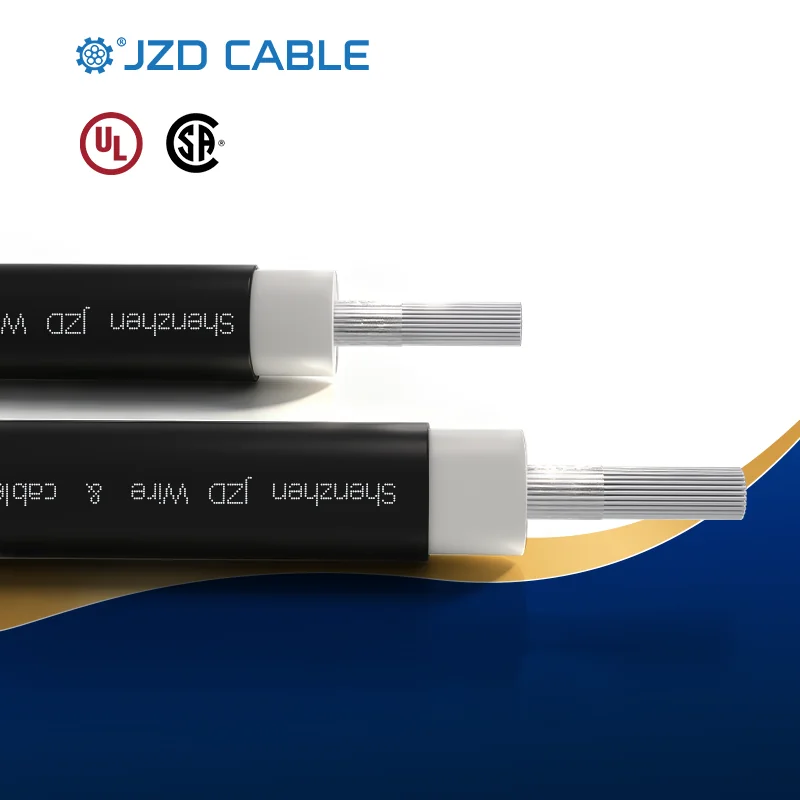
Construction: Single insulated conductor + concentric stranded aluminum neutral. Single-conductor URD is typically installed in groups for primary transmission.
Core advantages:
- Customizable layout: Allows flexible phasing arrangements to adapt to site conditions
- Independent replacement: Only the damaged conductor needs replacement, not the entire cable
- Long-distance conduit installation: Lower jamming risk than bundled multi-conductor cables
- Large cross-section flexibility: Suitable for long-distance primary lines requiring large conductors
Typical applications:
- Transformer to neighborhood tap primary lines
- Large commercial and industrial service entrances
- Projects requiring custom phasing arrangements
- Long-distance underground transmission (over 500 feet)
3. Triplex URD—The Standard for Single-Family Residential Service
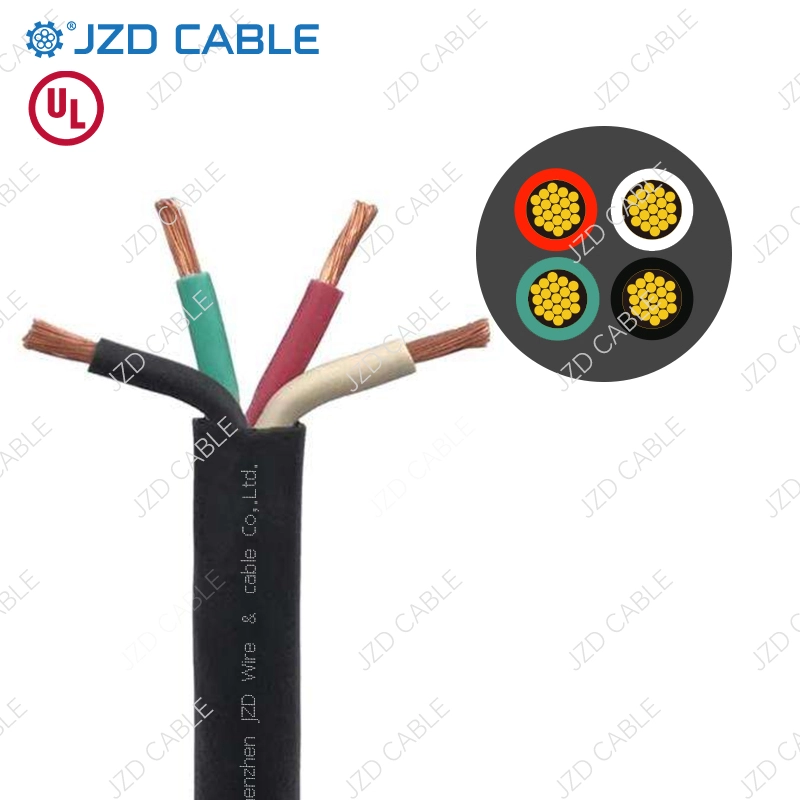
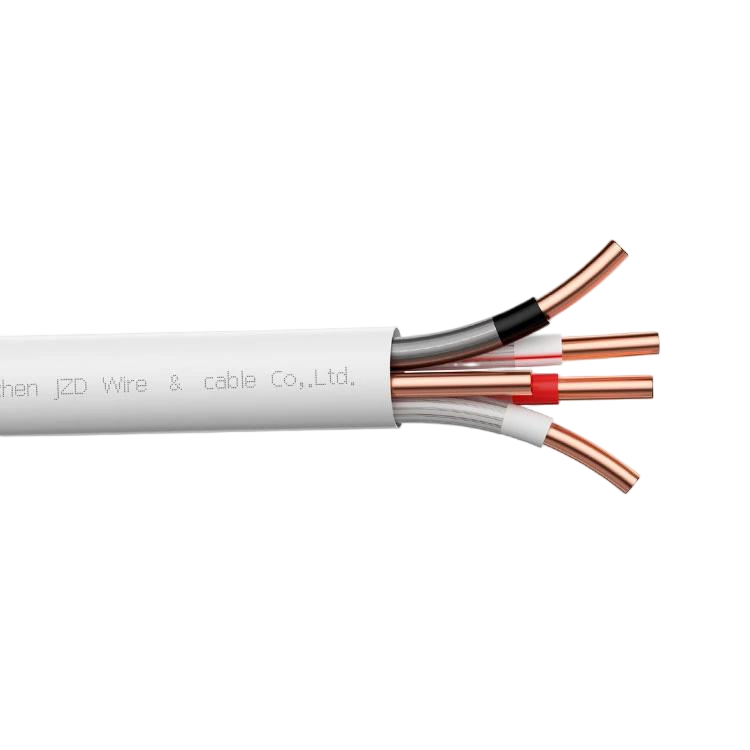
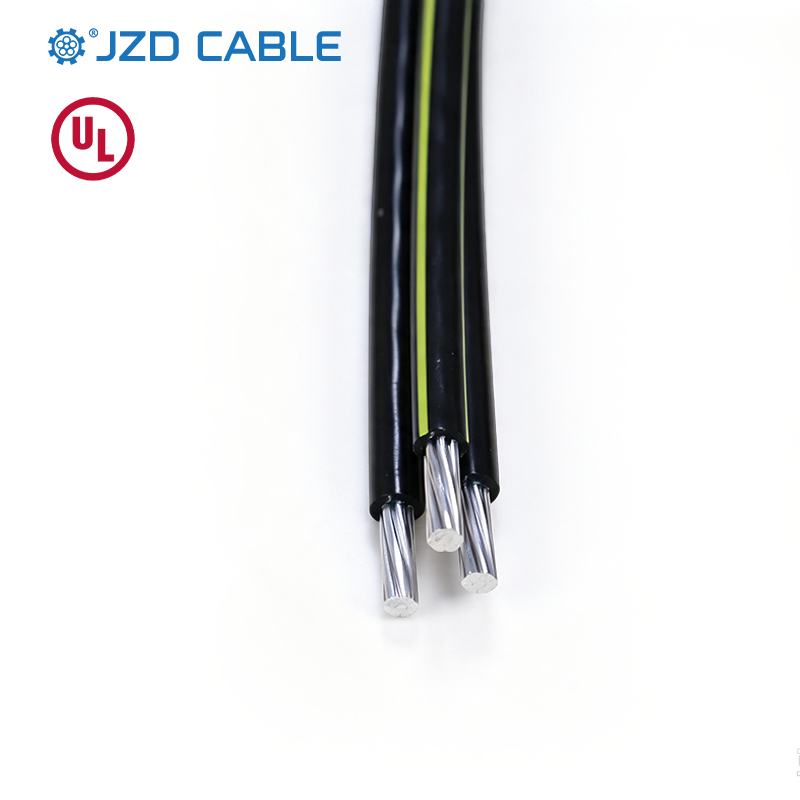
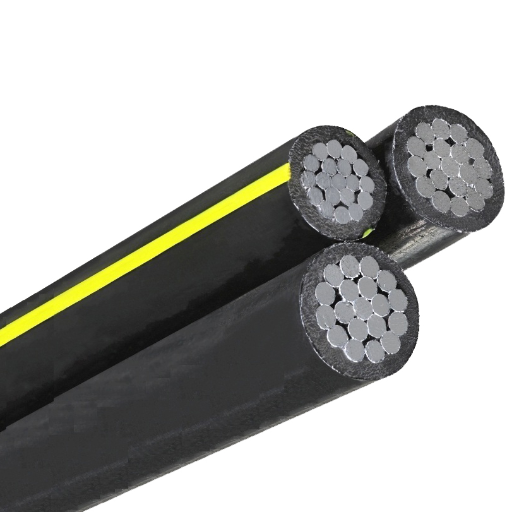
Construction: Two insulated phase conductors + one bare concentric neutral, helically twisted together. Carries 120/240V split-phase power—240V between the two phase conductors, 120V from each phase conductor to neutral. This is the standard U.S. residential voltage configuration.
Typical applications:
- The workhorse of residential underground distribution—connecting neighborhood tap to meter base
- Feeder taps serving multiple homes
- Overhead-to-underground conversion projects
4. Quadruplex URD—The Standard for Three-Phase Service
Construction: Three insulated phase conductors + one bare concentric neutral, helically twisted together. Carries three-phase power—providing 120/208V or 277/480V between phase conductors. This is the standard configuration for commercial buildings and large projects.
Typical applications:
- Commercial building three-phase service
- Large residential development primary feeders
- Industrial facilities requiring three-phase power
5. Single vs. 3-Core/4-Core: Selection Decision Matrix
| Consideration | Single Conductor | 3-Conductor (Triplex) | 4-Conductor (Quadruplex) |
| Distribution position | Primary (upstream) | Service entrance (downstream) | Service entrance (downstream) |
| Voltage system | Single or three-phase primary | 120/240V split-phase | 120/208V or 277/480V three-phase |
| Typical project | Transformer to neighborhood | Single-family home | Commercial, large residential development |
| Conductor configuration | 1 phase + neutral | 2 phase + 1 neutral | 3 phase + 1 neutral |
| Installation method | Grouped pulling | One reel, one pull | One reel, one pull |
| Replacement ease | High (single conductor) | Low (entire cable) | Low (entire cable) |
| Long-distance conduit | Superior (lower jamming risk) | Bundled | Bundled |
Selection principle: Choose single-conductor for primary distribution (transformer to neighborhood, long-distance, large cross-sections—offering flexibility, independent replacement, and lower long-distance jamming risk). Choose 3-conductor or 4-conductor for service entrance (one reel, one pull, complete circuit, higher installation efficiency).
Direct Burial Depth Requirements: NEC Table 300.5
Underground cable burial depth is governed by NEC (National Electrical Code) Table 300. 5. For URD direct burial cables, minimum cover depth depends on the installation location:
| Location | Minimum Cover Depth (inches) |
| Residential general areas (non-driveway) | 24 inches |
| Under residential driveway | 18 inches |
| Under street/public roadway | 24 inches |
For a typical single-family residential backyard installation, URD cable must be buried 24 inches (approximately 61 cm) below grade.
1. Exceptions
For residential branch circuits rated 120V or less with maximum 20A overcurrent protection and GFCI protection, NEC allows minimum cover depth reduction to 12 inches. This exception typically applies to outdoor receptacles, landscape lighting, and other low-voltage branch circuits—it does not apply to main service feeders.
2. Protection for Cables Emerging from Grade
NEC 300.5 also requires that direct-buried cables emerging from grade be protected by enclosures or raceways extending from the minimum cover depth to at least 8 feet above finished grade, preventing damage from lawnmowers, gardening tools, or accidental contact.
3. Frost Protection
In cold regions, direct-buried conductors and underground raceways may be subject to movement from frost action. NEC 300.5(J) requires protection measures. “S” loop service loops at transitions typically absorb frost heave displacement effectively.
4. CEC Burial Depth Requirements
The Canadian Electrical Code (CEC) requires a minimum of 600 mm (approximately 24 inches) for direct-buried cable without conduit. In regions with deep frost lines, experienced electricians often exceed this minimum to 750 mm to 900 mm (30 to 36 inches).
XLPE Insulation: The Key to Underground Reliability
URD cable is designed for direct burial, with long-term exposure to soil moisture, chemicals, and microbial environments. Ordinary indoor cable would fail within months—moisture penetrates the insulation, insulation resistance drops, and ground faults or short circuits result.
URD cable uses XLPE (cross-linked polyethylene) insulation. Its molecular chains form a three-dimensional network through chemical cross-linking, providing moisture resistance that ordinary thermoplastic materials cannot match.
1. 90°C Wet Location Rating
URD cable is rated for continuous 90°C operation in both wet and dry locations. Whether buried in moist soil or installed in water-filled conduit, cable ampacity is not compromised—this rating is codified in UL 854 and ICEA S-105-692 standards.
2. Superior Moisture Resistance
XLPE’s cross-linked structure gives it extremely low moisture absorption. Field data confirms XLPE-insulated cables in direct burial service reliably operate for 25+ years. The cross-linked structure provides excellent chemical stability in moist environments, maintaining insulation integrity for 30-50 years of direct burial service.
3. Chemical and Thermal Aging Resistance
XLPE resists acids, alkalis, salts, and microbial attack, ensuring stable insulation performance throughout long-term burial. As a thermoset material, XLPE does not undergo repeated softening-hardening cycles under temperature fluctuations—avoiding the accelerated aging seen in thermoplastics.
JZD URD Aluminum Cable: Complete Underground Distribution Solution
JZD Cable manufactures aluminum URD cables covering the complete underground distribution chain from primary lines to service entrance, designed for North American direct burial and conduit installations.
1. Product Specifications
| Parameter | Single-Conductor URD | Triplex URD | Quadruplex URD |
| Certification | UL 854 | UL 854 | UL 854 |
| Voltage | 600V | 600V | 600V |
| Conductor | AA-8000 series aluminum alloy | AA-8000 series aluminum alloy | AA-8000 series aluminum alloy |
| Insulation | XLPE (cross-linked polyethylene) | XLPE (cross-linked polyethylene) | XLPE (cross-linked polyethylene) |
| Temperature rating | 90°C wet/dry | 90°C wet/dry | 90°C wet/dry |
| Construction | 1 phase + concentric neutral | 2 phases + 1 neutral | 3 phases + 1 neutral |
| Typical application | Primary distribution | Single-family residential | Commercial buildings |
2. Key Certified Features
- UL 854 listed: Complies with North American service entrance cable safety standards
- ICEA S-105-692 compliant: Meets industry standards for underground residential distribution cable
- ASTM B800 compliant: AA-8000 series aluminum alloy material standard
- 90°C wet location rated: Continuous 90°C operation in wet and dry locations
Conclusion: Single vs. 3-Core/4-Core — URD Covers the Complete Distribution Chain
North American underground distribution cable selection centers on understanding three key characteristics of URD cable:
Burial depth is the safety baseline. NEC Table 300.5 requires 24 inches of cover for direct-buried URD in residential general areas—the basic protection against mechanical damage.
XLPE insulation is the reliability guarantee in moisture. URD cable is rated for 90°C continuous operation in wet and dry locations. The cross-linked structure provides superior moisture resistance, ensuring 25+ years of direct burial service.
Single vs. multi-conductor selection covers the full distribution chain. Choose single-conductor for primary distribution (transformer to neighborhood, long-distance, large cross-sections). Choose Triplex for 120/240V single-family residential service. Choose Quadruplex for three-phase commercial and large projects.
| Comparison | URD’s Position Relative to Other Cable Types |
| Copper building wire | Lower cost, lighter weight, designed for underground |
| USE-2 | URD is a complete system; USE-2 is a component |
| SER | URD is underground-specific; SER is above-ground-specific |
| UF | URD is distribution-grade; UF is user-grade |
JZD’s UL 854 certified URD aluminum cable, with AA-8000 series aluminum conductors and XLPE insulation, provides a complete, code-compliant, cost-effective solution for North American underground distribution projects—from primary lines to service entrance.
Need URD aluminum cable for your underground distribution project? Contact JZD for technical specifications, sizing assistance, and certified cable solutions.