

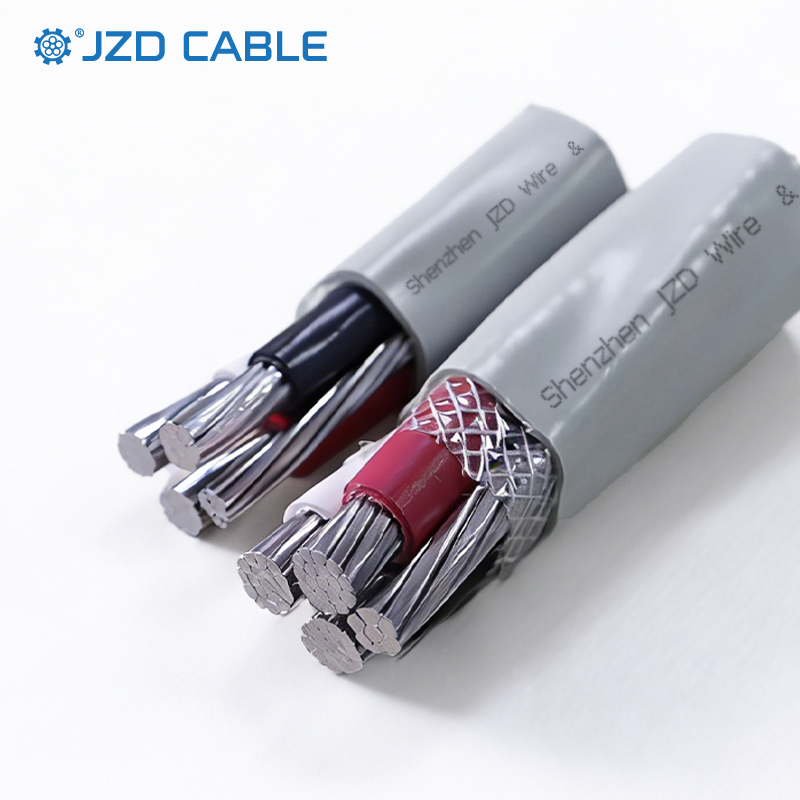
With copper prices remaining elevated in 2026, aluminum conductors offer a practical way to control material costs in large electrical projects.
AA-8000 series aluminum building wire, when properly sized and installed with AL/CU-rated terminations, provides a Code-compliant option for many North American applications.
This guide explains when aluminum makes sense for contractors, developers, and procurement teams, with a focus on NEC ampacity, proper termination, total cost, and application limits.
Aluminum Wire vs Copper Wire: Four Facts to Frame the Decision
Before reviewing technical tables, establish four foundational facts:
Fact 1: Aluminum wire costs 40–60% less than the copper equivalent at the same ampacity. This is the primary economic driver for specifying aluminum in large-scale projects.
Fact 2: Aluminum requires upsizing 1–2 AWG sizes to match copper ampacity. The larger diameter is the engineering trade-off for lower material cost.
Fact 3: Aluminum terminations follow a standard procedure—AL/CU lugs, anti-oxidant compound, and proper torque. These are not “special requirements” but established installation practices.
Fact 4: Aluminum wire is not a universal replacement. It excels in large feeders and service entrances; copper remains the standard for small branch circuits and space-constrained applications.
Aluminum Wire Conductivity and Equivalent Sizing: The Physics of Upsizing
1. Conductivity Comparison
Aluminum has approximately 61% the conductivity of copper (IACS). To carry the same current, the aluminum conductor cross-section must be increased to roughly 1.6× that of copper. In AWG terms, this means upsizing 1–2 sizes.
Equivalent conductor sizing at 75°C (NEC Table 310.15(B)(16)) :
| Ampacity | Copper Conductor | Aluminum Conductor (Equivalent) | Engineering Note |
| 100A | #3 AWG | #1 AWG | Minimum for 100A aluminum feeder |
| 125A | #1 AWG | 2/0 AWG | Recommended for 125A feeder |
| 150A | 1/0 AWG | 3/0 AWG | Recommended for 150A feeder |
| 200A | 3/0 AWG | 250 kcmil | Minimum for 200A aluminum feeder |
2. The Weight Advantage of Aluminum Wire
Aluminum density is 2.7 g/cm³ vs. copper at 8.9 g/cm³. At equivalent ampacity, aluminum weighs approximately 48% of copper—directly reducing shipping costs, installation labor, and support structure requirements.
3. AA-8000 Series Alloy: The Modern Standard for Aluminum Wire
NEC 310.14 requires aluminum building wire to be manufactured from AA-8000 series alloy. This alloy has been the industry standard for over 40 years and is proven reliable across millions of installations.
| Property | AA-8000 Series Performance |
| Creep resistance | Excellent—maintains termination tightness under thermal cycling |
| Thermal expansion | Close to copper—reduces cycling-induced loosening |
| Tensile strength | Meets mechanical stress requirements for installation and service |
| Termination compatibility | Designed specifically for AL/CU dual-rated lugs |
AA-8000 series aluminum building wire is not the same product that caused concerns in the 1960s—that was AA-1350 alloy, which is no longer permitted for building wire applications.
Ampacity Correction for Aluminum Wire: The Engineering Calculation
1. Temperature Rating: Why 90°C Insulation ≠ 90°C Ampacity
NEC Table 310.15(B)(16) provides ampacities at three temperature columns: 60°C, 75°C, and 90°C.
NEC 110.14(C) is the controlling rule: Conductor ampacity must be based on the lowest temperature rating in the circuit—typically the termination.
| Circuit Rating | Applicable Column | Reason |
| 100A and below | 60°C | Default if terminations are not marked otherwise |
| Above 100A | 75°C | Most equipment lugs are rated 75°C |
XHHW-2 insulation is rated 90°C, but in circuits above 100A, ampacity is limited by the 75°C termination rating. In most engineering scenarios, use the 75°C column for sizing.
2. Aluminum Wire Ampacity Table (75°C Column, 30°C Ambient)
| Conductor Size | 60°C | 75°C | 90°C | 75°C Sizing Guide |
| 6 AWG | 55A | 65A | 75A | Suitable for feeders up to 60A |
| 4 AWG | 70A | 85A | 95A | Suitable for feeders up to 80A |
| 2 AWG | 90A | 100A | 115A | Suitable for feeders up to 90A (not 100A) |
| 1/0 AWG | 120A | 135A | 150A | Suitable for feeders up to 125A |
| 2/0 AWG | 135A | 150A | 175A | Suitable for feeders up to 150A |
| 3/0 AWG | 155A | 175A | 200A | Suitable for feeders up to 175A |
| 4/0 AWG | 180A | 205A | 230A | Suitable for feeders up to 200A |
3. Ambient Temperature Correction (NEC Table 310.15(B)(1))
All NEC ampacities are based on 30°C ambient. For ambient temperatures above 30°C, apply correction factors (90°C insulation):
| Ambient Temperature | Correction Factor |
| 31-35°C | 0.96 |
| 36-40°C | 0.91 |
| 41-45°C | 0.87 |
| 46-50°C | 0.82 |
4. Conductor Quantity Correction (NEC Table 310.15(B)(3)(a))
When more than 3 current-carrying conductors are in a conduit, apply additional correction:
| Number of Conductors | Adjustment Factor |
| 6-Apr | 0.8 |
| 9-Jul | 0.7 |
| 20-Oct | 0.5 |
Temperature and quantity corrections apply cumulatively. In multi-circuit conduit banks, calculate both factors and size accordingly.
Voltage Drop in Aluminum Wire: Long-Distance Feeder Calculations
1. The K-Factor Difference
Aluminum has higher resistivity than copper. At 75°C, the K-factor is 21.2 for aluminum vs. 12.9 for copper.
Single-phase voltage drop formula:
VD = (2 × K × I × L) / 1000 (K = 21.2 for aluminum; L = one-way length in feet; I = current in amperes)
2. Engineering Example: 100A Load, 200 ft, 240V
| Conductor | K-Factor | Voltage Drop | Percentage | Verdict |
| #1 AWG Aluminum | 21.2 | 10.1V | 4.20% | Exceeds 3% — upsize required |
| 2/0 AWG Aluminum | 21.2 | 6.4V | 2.70% | Compliant with 3% guidance |
3. When to Prioritize Voltage Drop Calculations
| Distance | Engineering Recommendation |
| Under 100 ft | Size by ampacity; voltage drop rarely governs |
| 100-150 ft | Quick voltage drop check recommended |
| Over 150 ft | Voltage drop governs—calculate first, then size by ampacity |
NEC Informational Notes recommend a maximum voltage drop of 3% for feeders and 5% for feeders plus branch circuits combined. For aluminum feeders over 150 feet, upsizing one additional gauge typically resolves voltage drop concerns.
Aluminum Wire Terminations: The Standard Three-Step Process
1. Step 1: Verify Terminal Marking as AL/CU
NEC 110.14(A) requires terminals used for aluminum conductors to be clearly identified.
| Terminal Marking | Suitability |
| AL/CU or CU/AL | ✅ Acceptable—rated for both copper and aluminum |
| AL9CU | ✅ Acceptable—90°C rated for aluminum and copper |
| CU ONLY | ❌ Not acceptable for aluminum |
2. Step 2: Apply Anti-Oxidant Compound
The NEC does not require anti-oxidant compound at every aluminum termination. However, most terminal manufacturers’ installation instructions require it—and per NEC 110.14(D), manufacturer instructions are mandatory.
Engineering practice: Anti-oxidant compound (Noalox, Ox-Gard, Penetrox) is standard practice for aluminum terminations. It seals out air and moisture, preventing aluminum oxide formation that can increase contact resistance.
Purple twist-on connectors pre-filled with antioxidant compound are UL-listed for aluminum-to-copper connections and comply with NEC Section 110-14(b).
3. Step 3: Torque to Specification
NEC 110.14(D) requires terminations to be tightened to the manufacturer’s specified torque values. Use a torque screwdriver or torque wrench.
| Torque Error | Consequence |
| Under-torqued | High-resistance connection → heating → eventual failure |
| Over-torqued | Damaged threads or conductor → irreversible damage |
Aluminum is softer than copper—over-torquing can permanently damage the conductor. Torque tools are mandatory for proper installation.
Total Cost of Ownership: Aluminum Wire vs Copper Wire
1. Material Cost Comparison
| Comparison | Aluminum vs Copper |
| Price per kg | Approximately 30% of copper (70% cost delta) |
| Equivalent ampacity per meter | Approximately 45-55% of copper |
| Feeder material cost savings | 40-60% lower for equivalent ampacity |
For a 500-foot feeder carrying 100A, the material cost differential between #1 AWG aluminum and #3 AWG copper typically ranges from several thousand to tens of thousands of dollars, depending on commodity prices.
2. Installation Cost
Aluminum at equivalent ampacity weighs approximately 48% of copper, reducing:
- Shipping costs—more cable per truckload
- Pulling and handling labor—fewer workers, less equipment
- Support structure requirements—lower cable tray loading
Total installed cost savings typically range from 30-40% for large feeder applications.
3. Energy Loss (Lifecycle Cost)
Copper’s lower resistance results in 2-5% lower line losses compared to aluminum. Over a 25-30 year service life, the cumulative energy loss penalty for aluminum is quantifiable.
Engineering judgment: In most projects, aluminum’s upfront material savings (40-60%) significantly exceed the 30-year cumulative energy loss penalty. For continuously loaded feeders, a detailed lifecycle cost analysis is recommended—but aluminum typically remains the lower TCO option.
4. TCO Summary
| Cost Factor | Copper Cable | Aluminum Cable (AA-8000) |
| Material cost | Baseline | 40-60% lower |
| Weight | Baseline | ~50% lighter |
| Installation labor | Baseline | Lower |
| Termination materials | Standard lugs | AL/CU lugs (marginal increase) |
| Energy loss (30 yrs) | Baseline | Slightly higher |
| Conduit size | Smaller | Larger |
| Net TCO (large feeders) | Baseline | Significantly lower |
Application Boundaries: Aluminum Wire vs Copper Wire—Where Each Excels
1. Where Aluminum Wire Is the Clear Choice
| Application | Engineering Rationale |
| Large feeders and services (100A and above) | Maximum material cost savings; upsizing is a small relative penalty |
| Residential service entrances (100-200A) | Industry standard practice |
| Commercial and industrial feeders | Proven across millions of installations |
| Cable tray installations | Weight savings reduce loading and support costs |
| New construction projects | Conduit and terminal space can be planned in design phase |
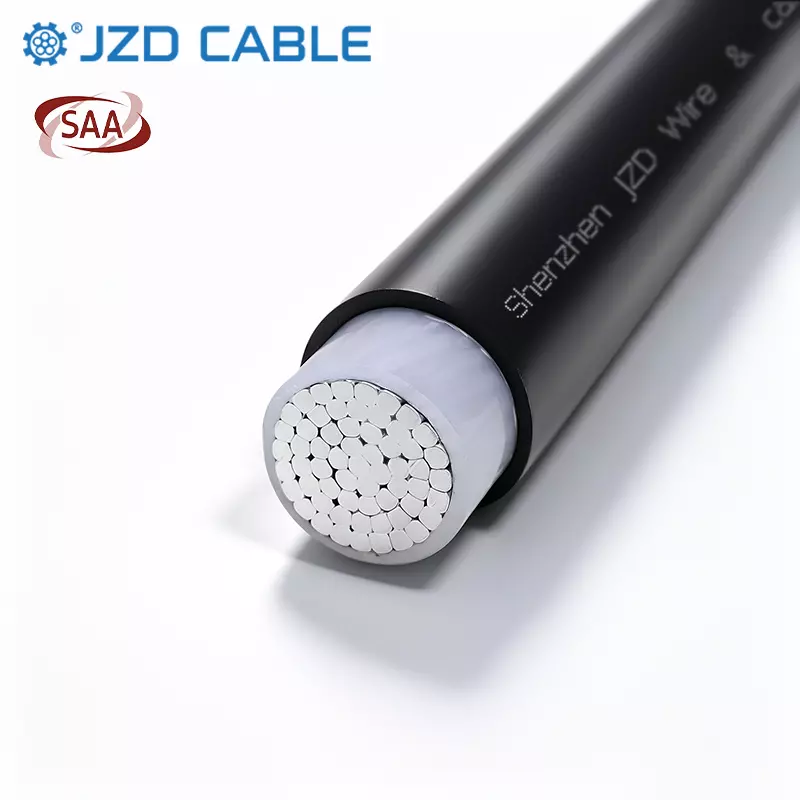
XHHW-2 aluminum building wire (UL 44) is specifically designed for these applications, rated for 600V, 90°C wet/dry, with AA-8000 series conductors and CT rating for cable tray use.
2. Where Copper Wire Remains the Standard
| Application | Engineering Rationale |
| Branch circuits (15-30A) | Small-gauge equipment is predominantly copper-designed |
| Existing conduit retrofits | Avoids upsizing issues with existing conduit fill |
| High-vibration environments | Copper’s superior fatigue resistance |
| Tightly confined spaces | Smaller conductors offer more routing flexibility |
| Critical safety circuits | Evaluated on project-specific reliability requirements |
3. Engineering Decision Principle
- 100A and above: prioritize aluminum and evaluate TCO
- Branch circuits and space-constrained: prioritize copper
- The decision is project-specific—not a blanket “better” or “worse”
JZD Aluminum Wire Product Solutions
JZD Cable provides a complete aluminum conductor product line across three application categories:
1. XHHW-2 Aluminum Building Wire (UL 44)
| Parameter | Specification |
| Voltage | 600V (1000V PV option available) |
| Insulation | XLPE — 90°C wet/dry |
| Conductor | AA-8000 series aluminum alloy |
| Sunlight resistance | Available 8 AWG and larger |
| CT rating | 1/0 AWG and larger |
| Applications | Conduit, cable trays, commercial/industrial building wiring |
Selection Note: Ideal for conduit and cable tray installations in commercial and industrial buildings. Specify XHHW-2 Cable when the job requires CT rating (1/0 AWG and larger) or sunlight-resistant jacketing (8 AWG and larger).
2. URD Aluminum Underground Distribution Cable (UL 854)
| Parameter | Specification |
| Voltage | 600V |
| Insulation | XLPE — 90°C wet/dry |
| Conductor | 1350-H19 or AA-8000 series |
| Direct burial | Yes |
| Configurations | Single, duplex, triplex, quadruplex |
| Applications | Residential underground distribution, multi-family, commercial |
Selection Note: Designed for residential underground distribution, multi-family, and commercial underground feeders. Specify URD Cable when direct burial is required — it can be laid directly into the ground without additional conduit.
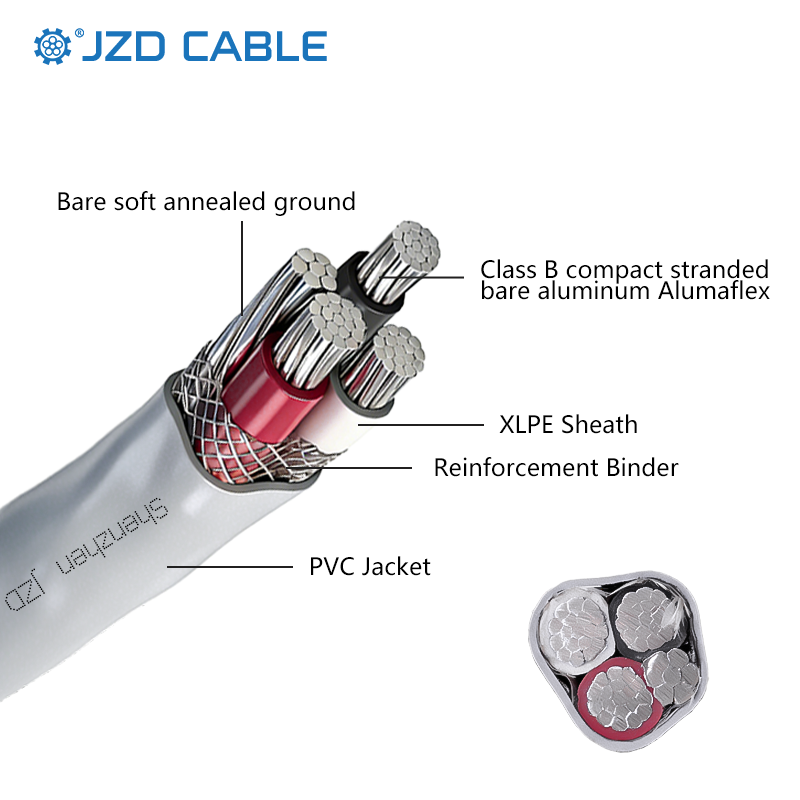
3. SER Aluminum Service Entrance Cable (UL 854)
| Parameter | Specification |
| Voltage | 600V |
| Insulation | XHHW-2 (XLPE) or THHN/THWN |
| Conductor | AA-8000 series aluminum alloy |
| Jacket | Sunlight-resistant gray PVC |
| Construction | Style R (reinforcing tape) + separate bare grounding conductor |
| Applications | Above-ground service entrance, panel feeders, subpanels |
Selection Note: Designed for above-ground service entrance, panel feeders, and subpanels. For new residential or commercial service entrance applications, SER Cable is the standard aluminum choice for replacing copper at the service drop.
Conclusion: Aluminum Wire vs Copper Wire—A Decision Framework
The choice between aluminum and copper is not about which is “better”—it is about which is more suitable for the specific project conditions.
| Dimension | Aluminum Wire | Copper Wire |
| Conductivity | 61% IACS (requires 1.6× upsizing) | 100% IACS |
| Material cost | 40-60% lower | Baseline |
| Weight | ~50% lighter | Baseline |
| Termination | AL/CU lugs + compound + torque | Standard lugs |
| Energy loss | Slightly higher | Baseline |
| Best applications | Large feeders, services, new construction | Branch circuits, confined spaces, high vibration |
For large feeders and services (100A and above), aluminum offers the lowest total cost of ownership in the vast majority of projects. The material cost savings (40-60%) far outweigh the incremental costs of upsizing and slightly higher energy losses.
For branch circuits and space-constrained applications, copper remains the standard. The smaller conductor size and simpler termination make copper the practical choice for these applications.
XHHW-2 aluminum building wire (UL 44) provides 90°C wet/dry XLPE insulation for conduit and cable tray installations. URD aluminum cable (UL 854) offers direct burial capability for underground residential distribution. SER aluminum cable (UL 854) delivers sunlight-resistant jacketing for above-ground service entrance applications.
Need aluminum wire or copper wire selection assistance? Contact JZD for technical specifications, ampacity calculations, and certified cable solutions.