

Water heaters are common, but the cable inside them often goes unnoticed. According to fire safety statistics, electrical wire or cable insulation was the first item ignited in nearly a quarter (24%) of water heater fires. Loose or undersized connections are the most common sources of overheating—and when the wrong cable is used, insulation breakdown is often at the center of the failure.
Inside a water heater, cables face sustained heat from heating elements, self‑heating from high currents, repeated bending during installation and maintenance, and constant moisture. The cable’s temperature rating, flexibility, and insulation stability directly affect equipment safety and service life.
Storage vs. Instantaneous: Two Water Heaters, Two Cable Requirements
Water heaters fall into two main categories—storage and instantaneous (tankless). Their operating principles and conditions differ significantly, and so do their demands on internal cabling.
1. Storage Water Heaters
Storage water heaters use heating elements to raise and maintain the water temperature, typically between 55–75°C (130–170°F). Elements cycle on and off, running for extended periods at relatively steady power.
Operating conditions:
- Heating elements are immersed in water; heat transfers through the metal sheath, with local temperatures reaching 85°C (185°F) or higher
- Prolonged exposure to heat means continuous, gradual thermal aging
- Minimal vibration; lower flex‑fatigue demands
- More internal space for routing
Cable requirements:
Internal wiring insulation must be rated for 90°C or even 105°C service. For immersion heaters, 85°C rubber‑insulated HOFR (heat‑, oil‑, and flame‑resistant) sheathed flexible cable is specified, typically with 1.5 mm² conductors.
2. Instantaneous (Tankless) Water Heaters
Instantaneous water heaters heat water within seconds of flow, with high power, rapid temperature rise, and frequent cycling.
Operating conditions:
- Power ratings typically 6kW to 36kW—currents from 30 A up to 150 A
- Heating element surface temperatures far exceed those of storage heaters, locally exceeding 100°C (212°F)
- Rapid on‑off cycling means cables endure frequent thermal shock
- High currents cause significant conductor self‑heating
- Large units require multiple independent supply circuits (e.g., a 36 kW unit may need 4×40 A breakers with appropriate cable sizing)
Cable requirements:
Tankless water heater installations typically require copper conductors rated at 75°C minimum. With high power and high current, cable gauge must increase accordingly—for example, a 14.6kW unit typically requires a conductor cross‑section of around 10mm² (approximately 6 AWG) with a suitable overcurrent protection device. The cable must not only withstand high temperatures but also maintain low resistance and minimal self‑heating under continuous high‑current load.
Compliance: In most countries, all wiring and circuit protection must comply with applicable national electrical codes. In North America, the U.S. National Electrical Code (NEC) and the Canadian Electrical Code (CEC) apply, with specific requirements for conductor ampacity, voltage drop, and overcurrent protection.
Technical Deep Dive: H07RN‑F vs. PVC – The Material Difference
The performance gap between H07RN‑F and PVC cable in water heater applications comes down to fundamental material science. Understanding these differences is essential for proper cable selection.
1. Temperature Rating: The Critical Differentiator
| Parameter | PVC Cable | H07RN‑F (EPR/Neoprene) |
| Continuous conductor temperature | 70°C | 90°C |
| Short‑circuit temperature (≤5s) | 160°C | 250°C |
| Operating ambient range | −5°C to +70°C | −40°C to +90°C |
| Minimum bending radius (dynamic) | Typically 8–10× OD | 6× OD |
| Flexibility retention | Degrades with heat cycling | Maintains flexibility |
The numbers tell the story clearly. PVC’s 70°C continuous rating means that inside a water heater at 80–100°C ambient, the cable is already operating beyond its design limits. H07RN‑F’s 90°C conductor rating provides a 20°C safety margin—a critical buffer in real‑world applications where temperature spikes are common.
2. Thermal Aging: The Hidden Long‑Term Factor
Cable insulation doesn’t fail overnight. The real risk is accelerated thermal aging—the gradual degradation of material properties under sustained heat.
PVC is a thermoplastic. It softens when heated and hardens when cooled. Each thermal cycle (water heater from ambient to operating temperature and back) represents one “soften‑harden” cycle. Over hundreds of cycles, plasticizers leach out and molecular chains break—the result is brittle, cracked sheathing that compromises both insulation performance and physical protection of the conductors.
EPR is a thermoset. It does not soften or flow when heated. Its cross‑linked structure remains stable at elevated temperatures. For EPR, the same thermal cycle is simply a temperature swing—there is no cumulative soften‑harden fatigue mechanism. This is why H07RN‑F maintains its mechanical integrity long after PVC cables have begun to fail.
A 2022 study on electrical insulating polymer materials confirmed that EPR exhibits increased resistance to ozone compared to rubber and PVC compounds, while rubber and PVC compound did not pass tests under the influence of low and high temperatures and showed “poor” resistance to aggressive environments.
3. Moisture and Humidity Resistance
Water heaters are inherently wet environments. Condensation, steam, and occasional leaks mean cable sheathing must resist moisture ingress.
PVC has a relatively high moisture absorption rate and becomes brittle over time in wet conditions. Neoprene (chloroprene rubber)—the sheath material on H07RN‑F—offers superior moisture resistance. H07RN‑F carries an AD8 rating for water immersion, meaning it can be safely submerged in fresh or sea water up to 100 meters depth.
4. Oil and Chemical Resistance
Water heater environments may expose cables to lubricants, sealants, and cleaning chemicals. PVC is susceptible to oil‑induced swelling and degradation. Neoprene sheathing provides superior resistance to oils, greases, and chemicals—a critical advantage in maintenance‑prone equipment.
5. Flexibility and Mechanical Toughness
PVC cables become stiff and brittle over time—especially after exposure to heat cycling. H07RN‑F’s neoprene sheath maintains flexibility across its entire temperature range, does not become brittle or stiff over time, and offers far superior wear resistance to PVC. This is particularly important during installation, maintenance and in applications where cables may be subject to vibration.

Standards and Manufacturer Specifications
1. IEC 60335 Series: The Safety Framework
Water heater safety is governed by the IEC 60335 series:
- IEC 60335‑2‑21 covers storage water heaters, with specific sections on Internal wiring (clause 23) and Supply connection and external flexible cords (clause 25)
- IEC 60335‑2‑35 covers instantaneous water heaters, with corresponding Internal wiring and Supply connection requirements
These standards specify insulation temperature ratings, mechanical strength, and termination reliability for internal wiring. H07RN‑F’s 90°C EPR insulation and neoprene sheath fully meet these safety requirements.
2. Manufacturer Specifications: H07RN‑F as Standard Equipment
Multiple equipment manufacturers explicitly specify H07RN‑F in their technical documentation:
Unox (commercial kitchen equipment manufacturer) lists H07RN‑F as the power supply cable type for their combi ovens. A 380‑415V three‑phase unit specifies 5G×2.5mm² H07RN‑F; a 220‑240V single‑phase unit specifies 3G×1.5mm² H07RN‑F.
Backer Eltop (industrial immersion heater manufacturer) specifies that electrical cables of type HO5 VV‑F or HO7 RN‑F be used for their immersion heaters, which are designed for heating baths and liquids in industrial pre-treatment and surface treatment applications.
Prysmian notes that H07RN‑F products can safely be immersed in fresh or sea water (AD8 rating) up to 100 meters in depth and for maximum water temperatures of 40°C.
These specifications from leading equipment manufacturers confirm that H07RN‑F is not an “optional upgrade”—it is the recognized standard for demanding heating applications.
How H07RN‑F’s Material Properties Match Water Heater Conditions
1. EPR Insulation: 90°C Continuous Operation
H07RN‑F uses EPR (ethylene‑propylene rubber) insulation, rated for 90°C continuous conductor operating temperature, with a 250°C short‑circuit temperature (for up to 5 seconds).
Inside a water heater at 80–100°C ambient, EPR insulation maintains stable electrical properties—insulation resistance and dielectric strength remain consistent—without the softening or performance degradation seen in PVC at elevated temperatures. For applications involving sustained heat and repeated thermal cycling, EPR’s thermal aging resistance is significantly superior to conventional materials.
2. Neoprene Sheath: Heat, Oil, and Flame Resistance
The neoprene (chloroprene rubber) sheath on H07RN‑F provides multiple layers of protection: heat resistance, oil resistance, and resistance to lubricants. Inside a water heater, where sealants may leach or lubricants may be present, neoprene’s oil resistance prevents chemical attack on the sheath.
H07RN‑F complies with IEC 60332‑1‑2 vertical flame testing—in the event of an electrical fault, the cable resists flame propagation.
3. Class 5 Stranded Conductor: Flex‑Fatigue Resistance
The “F” in H07RN‑F denotes a Class 5 fine‑stranded copper conductor—multiple fine copper strands twisted together. This construction provides excellent flexibility and resistance to bending fatigue. During installation, maintenance, and operation—particularly under water‑hammer vibration in instantaneous heaters—the stranded conductor effectively distributes stress, avoiding the stress concentration and fatigue fracture seen in solid conductors.
4. Rated Voltage and Bending Radius
H07RN‑F is rated at 450/750V (0.6/1kV for fixed installation) and features a minimum bending radius of 6× cable diameter—significantly tighter than many PVC alternatives, enabling easier routing in confined spaces.
Technical Comparison Summary: H07RN‑F vs. PVC in Water Heater Applications
| Performance Parameter | PVC Cable | H07RN‑F | Advantage |
| Max continuous conductor temp | 70°C | 90°C | +20°C margin |
| Short‑circuit temp (5s) | 160°C | 250°C | +90°C margin |
| Operating ambient range | −5°C to +70°C | −40°C to +90°C | Wider by 95°C |
| Thermal cycling fatigue | High (thermoplastic) | Low (thermoset) | No soften‑harden cycle |
| Moisture resistance | Moderate | Excellent (AD8 rated) | Submersible |
| Oil/chemical resistance | Moderate | Superior | Resists degradation |
| Flexibility retention | Degrades with heat | Maintains | Long‑term flexibility |
| Abrasion/wear resistance | Moderate | Far superior | Mechanical durability |
| Flame retardancy | Varies | IEC 60332‑1‑2 | Fire safety |
| Typical service life in water heater | 3–5 years | 10+ years | Long‑term reliability |
Key Technical Points for Water Heater Cabling
1. Termination: Contact Reliability Under Heat
The cable termination point is the most vulnerable part of any water heater wiring system. Under high temperatures, bare copper terminals oxidize, contact resistance increases, heat builds—and a positive feedback loop develops.
Best practice: Use tinned copper lugs with secure crimping. Install a strain relief clamp at the termination point to prevent vibration from transferring to the terminals.
2. Cable Isolation from Heat Sources
Radiant heat from heating elements is the primary driver of cable aging. Cables should be routed away from the direct radiation zone of the heating elements, secured on insulated brackets or within cable channels. Near heating elements, thermal sleeving provides additional protection.
3. Conductor Sizing
For instantaneous water heaters, conductor sizing must satisfy ampacity, voltage drop, and mechanical strength simultaneously. A 14.6kW unit may require a conductor cross‑section of approximately 10mm²; a 36kW unit may require multiple separate circuits with larger conductors. Applicable electrical codes mandate that conductor ampacity and overcurrent device sizing include appropriate safety factors (e.g., 125% continuous‑load factor in North America).
4. Moisture Protection
Water heaters present condensation risk. Cable terminations should use waterproof junction boxes to protect connection points from moisture ingress. H07RN‑F’s neoprene sheath provides AD8 water immersion rating, making it suitable for wet environments.
Water Heater H07RN‑F Selection Quick Reference
| Water Heater Type | Recommended Cable | Recommended Conductor Size | Key Considerations |
| Storage (residential) | H07RN‑F / H05RN‑F | 1.5–4mm² | 90°C rating, long‑term thermal aging |
| Instantaneous (≤8kW) | H07RN‑F | 4–6mm² | High current + thermal cycling, dedicated circuit |
| Instantaneous (8–12kW) | H07RN‑F | 6–10mm² | Multiple supplies, RCD protection |
| Instantaneous (>12kW) | H07RN‑F multi‑core | Per load calculation | Professional design, multiple breakers |
Selection Reference: JZD H07RN‑F Key Parameters
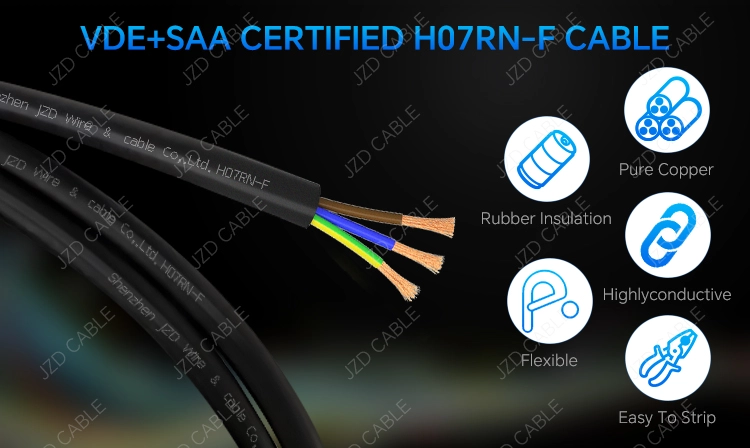
JZD’s H07RN‑F carries VDE, HAR, and CB certifications:
| Parameter | Specification |
| Rated voltage | 450/750V (0.6/1kV fixed) |
| Conductor | Class 5 fine‑stranded annealed copper (IEC 60228) |
| Insulation | EPR (ethylene‑propylene rubber), 90°C continuous |
| Short‑circuit temp | 250°C (≤5s) |
| Sheath | Neoprene (chloroprene rubber, CR) |
| Operating temp (fixed) | −40°C to +90°C |
| Operating temp (flexing) | −25°C to +60°C |
| Minimum bending radius | 6× cable diameter (dynamic) |
| Flame retardancy | IEC 60332‑1‑2 |
| Oil resistance | EN 60811‑404 |
| Water immersion | AD8 rated |
| Certifications | VDE, HAR, CB |
Conclusion
The environment inside a water heater—sustained heat, high currents, thermal cycling, and moisture—places continuous stress on cabling. Industry data shows that electrical wire or cable insulation is the item first ignited in approximately one‑quarter (24%) of water heater fires, making cable selection a critical safety decision.
The technical comparison is clear: PVC’s 70°C continuous rating means it is operating beyond its design limits inside most water heaters. H07RN‑F, with its EPR insulation (90°C continuous, 250°C short‑circuit), Class 5 stranded conductor (flex‑fatigue resistance), and neoprene sheath (oil‑, moisture‑, and flame‑resistant), provides the thermal margin and mechanical durability that water heater applications demand.
IEC 60335‑2‑21 and IEC 60335‑2‑35 set the safety framework for water heater internal wiring. Leading equipment manufacturers—Unox, Backer Eltop, and others—specify H07RN‑F in their technical documentation, confirming its status as the recognized standard for high-temperature heating applications.
foundation for safe, reliable, long‑term equipment operation. Need H07RN‑F for your water heater project? Contact JZD for technical support and certified cable solutions.