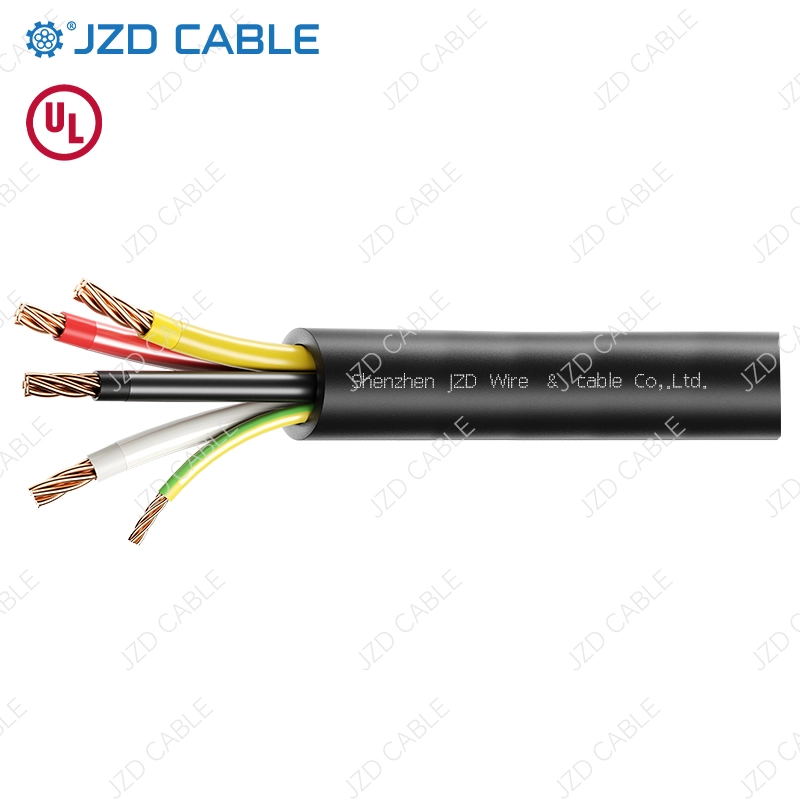


PVC insulated copper cable is widely used in commercial and industrial power distribution. Selection depends not only on gauge and price but also on insulation formulation, UL 83 testing, ampacity correction, and jacket performance. This article covers construction, certification, ampacity correction, and verification.
Material Construction
1. Conductor
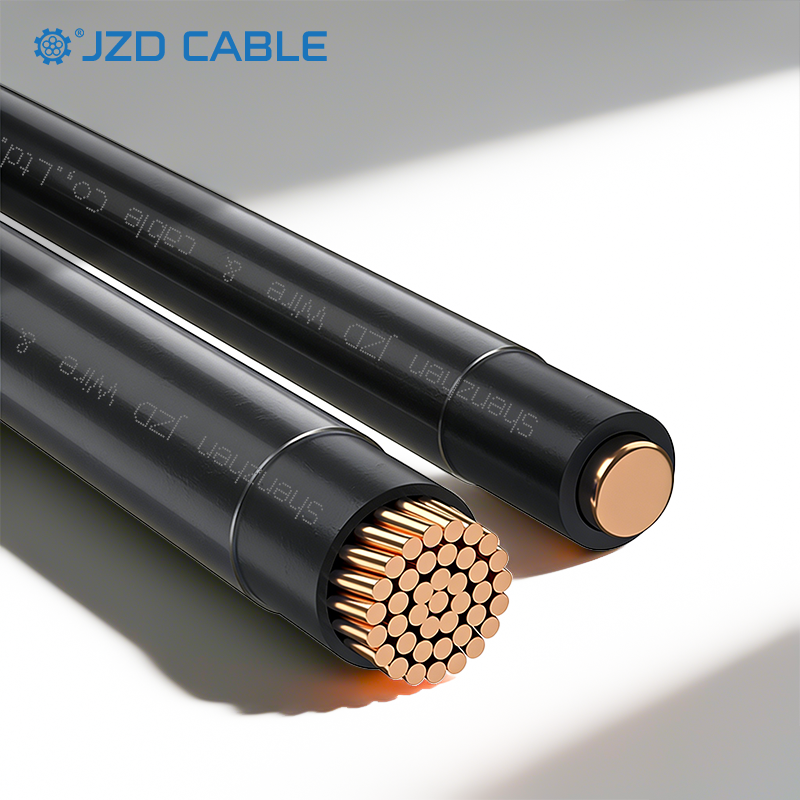
The conductor is annealed copper per ASTM B3 or B8. Sizes range from 14 AWG to 750 kcmil, available in solid or stranded configurations. Stranded conductors are typically Class B concentric stranded, with lay length controlled at 8–16 times the conductor diameter per UL 83. High-conductivity copper purity is typically no less than 99.95%, ensuring DC resistance meets NEC Table 8 requirements.
2. PVC Insulation
PVC insulation is extruded over the conductor, providing electrical insulation and mechanical protection. UL 83 specifies insulation thickness requirements; for example, the average PVC insulation thickness for 14 AWG to 10 AWG single conductors is typically no less than 15 mils (about 0.38 mm), with insulation concentricity deviation typically controlled within ±5%.
The temperature rating of PVC insulation depends on the formulation, with common ratings of 60°C, 75°C, and 90°C. The 90°C grade is the most widely used in commercial and industrial projects because it provides higher ampacity and thermal margin with limited cost increase.
3. Nylon Jacket
For common products such as THHN/THWN-2, a nylon jacket is extruded over the PVC insulation. The nylon jacket provides a low-friction surface for easier pulling, enhances abrasion and chemical resistance, and provides GR II oil and gasoline resistance. Nylon jacket thickness is typically 6–7 mils (about 0.15–0.18 mm), depending on conductor size.
4. Certification Standards
Common UL standards for PVC insulated copper cable include UL 83 (Thermoplastic-Insulated Wires and Cables, covering THHN, THWN, THWN-2, etc.), UL 1063 (Machine Tool Wire, MTW), and UL 758 (Appliance Wiring Material, AWM). UL 83 is the core building wire standard, covering complete requirements for construction, materials, and performance testing.
Understanding the material composition leads to how UL 83 verifies performance under actual operating conditions.
UL 83 Testing Requirements
UL 83 specifies a series of tests to verify the performance of PVC insulated cable under actual operating conditions.
1. Heat Shock Test
The heat shock test places finished cable samples at elevated temperature for a specified period, then examines the insulation for cracking or deformation. For PVC insulation, the test temperature is typically around 121°C. This test simulates short-term thermal exposure in high-temperature environments or overload conditions.
2. Cold Bend Test
The cold bend test cools cable samples at low temperature for a specified period, then bends them around a specified diameter metal mandrel to check for cracking in insulation and jacket. Cables marked “-40°C” must pass -40°C cold bend and cold impact tests. This test evaluates the flexibility of PVC insulation under low-temperature installation conditions.
3. Insulation Resistance Test
The insulation resistance test is conducted after the dielectric withstand test, with cable samples immersed in room-temperature (15.6°C) tap water. This test evaluates the insulation’s ability to retain resistance under wet conditions, directly related to long-term leakage current levels.
4. Vertical Flame Test
The VW-1 vertical flame test evaluates flame resistance under fire conditions. PVC insulation itself is flame-retardant and self-extinguishing after flame removal. The nylon jacket further enhances this performance. For commercial and industrial projects, VW-1 is a basic requirement for fire inspection approval.
Passing tests is only the baseline. Actual selection also requires matching temperature, wet location, and oil resistance requirements.
Performance Characteristics and Applications
1. Temperature and Wet Location Ratings
THHN/THWN-2 is the most common dual-rated product among PVC insulated copper cables. Dry location rating is 90°C, and wet location rating is 90°C. Note that pure THHN is suitable only for dry locations; older THWN is rated 75°C in wet locations; THWN-2 has a 90°C wet location rating. For products marked only THWN (without “2”), ampacity in wet locations must be based on the 75°C column, not the 90°C column. This distinction is often overlooked during selection, leading to ampacity calculation errors.
XHHW-2 also provides a 90°C wet location rating but uses thermoset XLPE insulation and is not in the PVC cable category. The core difference between PVC and XLPE is: PVC is thermoplastic, its flexibility depends on plasticizers, and long-term heat exposure and oil contact may cause plasticizer migration; XLPE is thermoset, forming a three-dimensional network through chemical cross-linking, and does not rely on plasticizers for flexibility.
2. Flame Resistance and Chemical Resistance
PVC insulated copper cable passes the VW-1 vertical flame test. The nylon jacket of THHN/THWN-2 also provides GR II oil resistance, suitable for industrial environments with oil, gasoline, or grease exposure. The nylon jacket’s resistance to gasoline and oil is something PVC insulation alone does not provide.
3. Sunlight Resistance
Black PVC insulation typically carries a sunlight-resistant (SR) rating. For outdoor conduit installation, sunlight resistance is a necessary condition. However, if used for exposed installation rather than in conduit, products such as TC-ER that are permitted for exposed installation should be selected.
4. Typical Applications
| Application | Suitable Product | Notes |
| Building branch circuits | THHN/THWN-2 | Lighting, receptacle circuits, conduit installation |
| Control panel internal wiring | THHN/THWN-2, MTW | Distribution panels, relay panels |
| Industrial equipment wiring | THHN/THWN-2, MTW | Machine tools, motor control circuits |
| Wet or outdoor conduit | THWN-2 | Pump rooms, outdoor distribution |
| Tray wiring | TC-ER (with PVC insulation) | Tray-to-equipment transitions |
| Oil-exposed environments | THHN/THWN-2 (nylon jacket) | GR II oil resistance |
Once the application is determined, conductor size must be determined through ampacity correction.
Ampacity Values and Correction
1. Starting from the 90°C Column
Ampacity for PVC insulated copper cable is based on NEC Table 310.16. For 90°C-rated products, values from the 90°C column require three correction steps. Table 310.16 is based on 30°C ambient temperature and applies to no more than three current-carrying conductors.
2. Termination Temperature Limitation
NEC 110.14(C) states that conductor ampacity cannot exceed the termination temperature rating. Most circuit breaker terminations are rated 60°C or 75°C. Even if the cable is rated 90°C, actual selection is typically based on the 75°C column. This is the most common source of derating for 90°C-rated cable in real projects.
3. Ambient Temperature Correction
Table 310.16 is based on 30°C ambient. In high-temperature workshops or rooftop exposed installations, when ambient temperature exceeds 40°C, the correction factor for 90°C insulation is approximately 0.91.
4. Bundled Conductor Derating
When more than three current-carrying conductors are in a conduit or tray, derate per NEC Table 310.15(C)(1). Correction factors are 0.80 for 4–6 conductors, 0.70 for 7–9, and 0.50 for 10–20.
5. Worked Example
For 12 AWG copper THHN/THWN-2, the 90°C column base ampacity is 30A. Correction steps and results are as follows:
| Step | Correction | Result |
| Start | 90°C column base value | 30A |
| Step 1 | 75°C termination limit | 25A |
| Step 2 | 40°C ambient ×0.91 | ~22.8A |
| Step 3 | 6 current-carrying conductors bundled × 0.80 | ~18.2A |
Final allowable ampacity is approximately 18.2 A. If the 90°C column value of 30A is used directly, the conductor may be undersized and operating temperature may exceed limits.
The corrected allowable ampacity determines conductor size. During selection, the following product documentation should also be verified.
Selection Verification Points
1. Core Verification Items
When specifying PVC insulated copper cable, confirm the following:
- UL 83 listing covering complete THHN/THWN-2 test requirements, not just UL recognition
- Conductor material: annealed copper per ASTM B3 or B8, purity no less than 99.95%
- Temperature and wet location rating: confirm product is marked THHN/THWN-2, 90°C dry/wet
- Jacket type: confirm whether nylon jacket is included; nylon jacket provides pulling lubrication and GR II oil resistance
- Flame test: confirm VW-1 vertical flame test compliance
- Sunlight resistance: confirm SR rating for outdoor conduit use
- Batch consistency: confirm insulation thickness, conductor stranding, and marking remain consistent across reels
2. Common Selection Mistakes
Note in particular: pure THHN cannot be used in wet locations; ampacity cannot be taken directly from the 90°C column without considering termination temperature limits; GR II oil resistance from the nylon jacket is not provided by PVC insulation alone, so jacket type should be confirmed for oil-exposed environments.
Conclusion
PVC insulated copper cable selection goes beyond gauge and price. Key factors include conductor purity, insulation temperature rating, nylon jacket oil resistance, and UL 83 testing. THHN handles dry locations; THWN-2 covers wet at 90°C. Ampacity must be corrected for terminations, ambient temperature, and bundled conductors. Verify UL 83 listing, jacket type, and batch consistency.
For UL 83-listed PVC insulated copper cable, contact us for specifications or certification documents.