

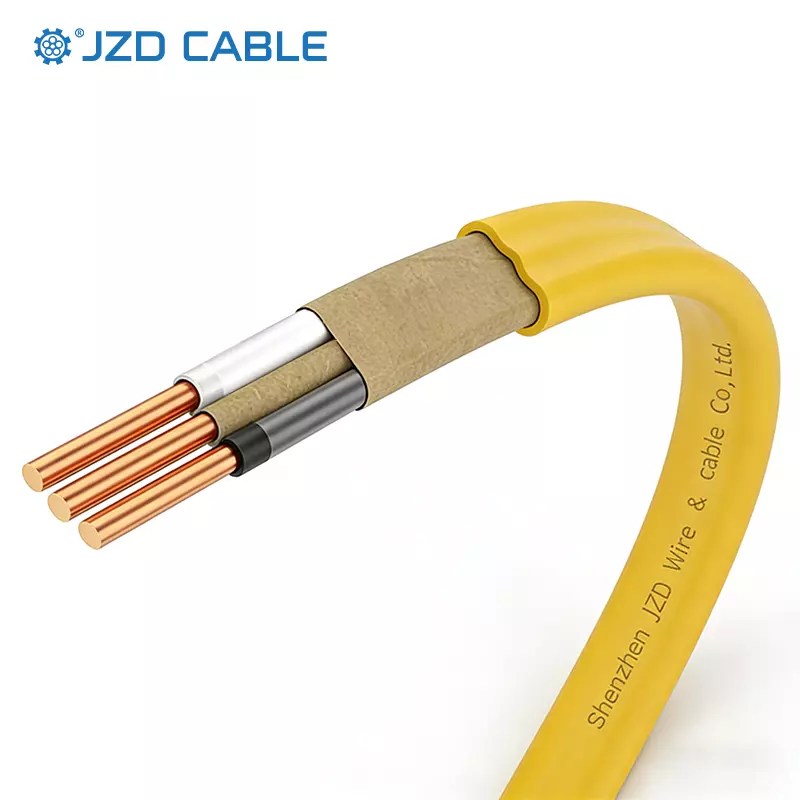
If you’ve ever pulled NM-B (often called “Romex” — though Romex is technically Southwire’s brand name for NM-B ) off a shelf, you may have noticed something curious: some rolls are cylindrical, others are flat and ribbon-like. Same printing, same voltage, same color-coded jacket — but a completely different cross-section.
Both are legitimate UL 719 non-metallic-sheathed cables, both comply with NEC Article 334, both carry 600V and 90°C conductor rating for normally dry locations . Yet the choice between round and flat changes everything about how the cable routes through studs, fits in narrow gypsum gaps, survives being dragged across a job site, and handles a 40A air conditioner circuit.
This guide breaks down the structural, mechanical, and practical differences so your next residential BOQ gets the right shape the first time.
What is NM-B Cable?
Per UL 719 and NEC Article 334 :
- Voltage: 600V, for exposed or concealed work in normally dry locations
- Conductor insulation: PVC + nylon (THHN-equivalent), rated 90°C in dry locations
- Ampacity limit: Determined using the 60°C column of NEC Table 310.16 (14 AWG = 15A, 12 AWG = 20A, 10 AWG = 30A, 8 AWG = 40A, 6 AWG = 55A)
- Construction: 2–4 circuit conductors + bare copper ground, PVC outer jacket
- Allowed: One- and two-family dwellings, Type III/IV/V multifamily, concealed in walls/floors/ceilings, fished in masonry block air voids
- Prohibited: Wet/damp locations, direct burial, embedding in poured concrete, commercial buildings exceeding 3 floors, exposed to physical damage
💡 Both round and flat NM-B meet this exact same specification. The only difference is internal conductor arrangement and external shape.
Decoding the Shape
|
Feature
|
Round NM-B
|
Flat NM-B
|
|---|---|---|
|
Core arrangement
|
Conductors stranded/twisted into a cylindrical profile; ground sits among them
|
Conductors laid parallel, side-by-side, non-separated; ground (with kraft paper wrap) between or beside them
|
|
External shape
|
Cylindrical
|
Flat, oval, or ribbon-like
|
|
Typical core counts
|
2-core, 3-core, 4-core — full range from 14 AWG to 2 AWG
|
Primarily 2-core in 14 AWG and 12 AWG; 14/2, 12/2, 14/3, 12/3 are the most common flat variants
|
|
Jacket
|
PVC, flame-retardant, moisture-resistant
|
Same PVC compound, but formed into a flat profile
|
|
Common color coding
|
White (14 AWG), Yellow (12 AWG), Orange (10 AWG), Black (8–6 AWG)
|
Identical gauge-to-color mapping
|
📌 In practice, 2-conductor grounded NM-B (e.g., 12/2, 14/2, 10/2) is typically flat, while 3-conductor grounded NM-B (e.g., 6/3, 10/3, 12/3) is typically round . But this is a manufacturing convention, not a code requirement — both shapes can theoretically be built in any configuration, though flat is rarely produced above 12 AWG.
Full Side-by-Side Comparison
|
Comparison Dimension
|
Round NM-B
|
Flat NM-B
|
|---|---|---|
|
Internal structure
|
Cores twisted/stranded cylindrically
|
Cores parallel, flat side-by-side
|
|
Outer profile
|
Cylindrical
|
Flat, thin, ribbon-like
|
|
Space in walls/drilling
|
Larger hole diameter required for piercing
|
Ultra-thin — fits gypsum gaps, narrow seams, decorative grooves
|
|
Bending behavior
|
Uniform bending in all directions; radius ≈ 4–6× OD; multi-angle turns don’t crush conductors
|
Bends only along its flat plane; bending “the wrong way” crushes the flat face, damages insulation; requires larger bend radius
|
|
Tensile / abrasion
|
Round sheath distributes force evenly; resistant to pulling, corner friction, and drag
|
Flat sides have thinner wall; dragging and friction easily cut the jacket; weaker crush resistance
|
|
Jacket stripping
|
Round profile — stripping requires more effort
|
Thin flat side — knife slit strips quickly, faster termination at outlets/panels
|
|
Heat dissipation
|
Air gaps between stranded cores → better convective cooling; full ampacity per NEC 334.80
|
Conductors lie adjacent — slightly poorer dissipation; temperature rise higher in enclosed cavities
|
|
Securing & supporting
|
Universal round clamps/cable staples; stable on any framing face
|
Must be stapled flat against the framing member, never on edge (NEC 334.30) ; needs proper flat cable clips
|
|
Compression resistance
|
Strong — wall pouring, plaster, stacked insulation won’t crush it
|
Weak — side walls thin; concrete pouring or heavy compression deforms the cable
|
|
Size/rating coverage
|
14 AWG – 2 AWG, 2/3/4-core all available
|
Mostly 14/2, 14/3, 12/2, 12/3; no large-gauge flat production
|
|
Cost
|
Mass-produced, lower unit cost
|
Niche product, 10–25% more expensive per foot for equivalent AWG
|
|
Best applications
|
Wall cavities, ceiling/attic runs, long pulls, large-appliance circuits, multi-angle routing, areas subject to compression
|
Narrow gypsum gaps, slim decorative moldings, retrofit without large openings, short fixed runs, high-volume outlet assembly
|
Six Practical Differences That Drive Specification
1. Space Saving — Flat’s Greatest Advantage
Flat NM-B is 30–40% thinner than its round equivalent. A 12/2 flat profile measures roughly 4.9 mm × 10.4 mm (L×H), while round 12/2 occupies a ~10 mm diameter cylinder . That difference means:
- Fits into narrow gypsum board seams where round won’t
- Slides behind furniture, inside decorative trim, through thin partition walls
- Enables retrofit jobs without cutting large access holes
Old-house renovation where you can’t open up walls? Flat NM-B is often the only option.
2. Bending — Round Bends Everywhere, Flat Bends One Way
- Round: Cylindrical geometry bends uniformly in all directions. Route it through a stud bay with multiple twists and turns — no problem.
- Flat: Bends only along its flat plane. Try to fold it “the wrong way” (across the flat face) and you’ll crush the PVC wall, compressing the parallel conductors together. This risks insulation damage and conductor short-circuit.
Rule: If the route has multiple directional changes → round. If it’s a straight, single-plane run in a narrow gap → flat.
3. Mechanical Durability — Round Dominates
On a busy job site:
- Round NM-B is dragged across floors, pulled through bored holes, stepped on, and pushed through crowded stud cavities. Its cylindrical profile distributes tensile and abrasion forces evenly — surviving the abuse.
- Flat NM-B has thinner side walls. Dragging it across a concrete floor or pulling it sharply through a tight bore easily scores or tears the jacket.
NEC 334.30 also requires flat NM-B to be stapled flat against the framing — never on edge. Mistakenly securing it on edge is a common inspection failure .
4. Stripping Speed — Flat Wins in Manufacturing
For OEMs or high-volume pre-assembly operations:
- Flat NM-B has a thin side wall — a knife slit strips it in one pass. Termination at panelboards and outlet boxes is significantly faster.
- Round NM-B requires more force and care to remove the cylindrical jacket.
For prefab wall-panel manufacturers or modular home builders doing thousands of terminations, flat NM-B’s strip-and-terminate speed advantage translates into measurable labor savings.
5. Heat Dissipation & Ampacity
Both are legally limited to the 60°C ampacity column per NEC 334.80 . However, thermally:
- Round: Air gaps between twisted cores allow better convective cooling. In enclosed cavities or bundled runs (which require derating per NEC 334.80), round starts from a better thermal baseline.
- Flat: Conductors lie directly adjacent with minimal air gap → slightly higher temperature rise under load.
For hot attic runs or bundled cables through insulated framing where derating calculations kick in, round NM-B gives you more thermal headroom.
6. Gauge Coverage — Round Has No Ceiling
- Round NM-B: Full range from 14 AWG to 2 AWG, including 14/2, 14/3, 12/2, 12/3, 10/2, 10/3, 8/3, 6/3, 4/3, 2/3, etc.
- Flat NM-B: Effectively limited to 14 AWG and 12 AWG in 2-core and 3-core configurations. Above 12 AWG, flat production essentially stops.
Large-appliance circuits (AC, electric range, dryer, EV charger feed) require 10 AWG, 8 AWG, or 6 AWG — these are round-only territory.
NEC Article 334 Rules That Apply to Both
Regardless of shape, NM-B must comply with :
- Support: Within 12 inches of every box entry; supported at intervals ≤ 4.5 ft along the run
- Stapling: Flat cables must be stapled flat against the framing member, never on edge
- Not permitted: Wet/damp locations, direct burial, embedded in poured concrete, exposed to physical damage, buildings over 3 floors, commercial Type I/II construction
- Ampacity: 60°C column of NEC Table 310.16 (14 AWG=15A, 12 AWG=20A, 10 AWG=30A, 8 AWG=40A, 6 AWG=55A)
- Derating: When >2 NM cables with 2+ current-carrying conductors are bundled through the same framed opening and sealed with insulation/caulk, apply Table 310.15(C)(1) adjustment
Application Decision Tree
|
Scenario
|
Recommended
|
Why
|
|---|---|---|
|
14/2 lighting circuit, standard stud wall
|
Round NM-B
|
Versatile, durable, cheapest; the default choice
|
|
12/2 outlet circuit, new construction
|
Round NM-B
|
Full coverage, handles multiple bends
|
|
10/3, 8/3, 6/3 for AC, range, dryer
|
Round NM-B (only option)
|
Flat not produced in these gauges
|
|
Attic run, hot environment, derating needed
|
Round NM-B
|
Better heat dissipation, thermal headroom
|
|
Old-house retrofit, narrow gypsum gaps
|
Flat NM-B
|
Fits where round can’t; minimal opening required
|
|
Decorative molding, furniture cavity wiring
|
Flat NM-B
|
Ultra-thin profile hides easily
|
|
Prefab wall panel, high-volume termination
|
Flat NM-B
|
Fast stripping = lower labor cost
|
|
Long pull through bored studs, multiple bends
|
Round NM-B
|
Bends uniformly; flat would crush on multi-axis turns
|
|
Garage, basement, areas subject to impact
|
Round NM-B
|
Superior crush and abrasion resistance
|
|
Modular/offsite construction, short fixed runs
|
Flat NM-B
|
Space-saving + fast assembly
|
|
Exposed work (allowed by AHJ)
|
Round NM-B
|
NEC 334.30 securement works better with round clamps
|
Frequently Asked Questions
Q: Is flat NM-B as code-compliant as round NM-B?
A: Yes. Both meet UL 719 and NEC Article 334. The shape is a manufacturing choice, not a code distinction. Both carry the same 600V / 90°C conductor / 60°C ampacity rating .
Q: Can I use 14/3 flat NM-B for a 3-way switch?
A: Yes — 14/3 flat is commonly used for 3-way switch loops. The flat profile fits easily into switch boxes and narrow stud bays.
Q: Why don’t they make flat NM-B in 6 AWG or 8 AWG?
A: Large-gauge conductors are stiff regardless of shape. A flat 6 AWG would be impractically wide and wouldn’t bend safely. The flat advantage (space-saving) diminishes as gauge increases, so manufacturers limit flat production to 14 AWG and 12 AWG where flexibility and narrow profile actually matter.
Q: Does flat NM-B cost more?
A: Typically 10–25% more per foot than round for the same AWG . It’s a niche product with lower production volume. The premium is justified in retrofits and prefab where the space-saving and fast-stripping benefits offset the cost.
Q: Is “Romex” the same as NM-B?
A: Romex is a brand name owned by Southwire for their NM-B cable . All Romex is NM-B, but not all NM-B is Romex — other manufacturers (including JZD Cable) produce generic NM-B. The terms are used interchangeably on job sites, but NM-B is the correct technical designation.
Q: Can I run flat NM-B through conduit?
A: NEC 334.15 generally prohibits NM-B in conduit as a wiring method, though short riser protection is permitted . If you need conduit, use individual THHN/THWN-2 conductors. Both round and flat NM-B are intended for open stud-cavity routing, not conduit pulls.
Q: Which shape does JZD Cable recommend for typical residential builds?
A: For standard new construction (walls, ceilings, attics, large appliances), round NM-B is the workhorse — cheaper, more durable, full gauge range. For retrofits, old-house renovations, narrow-cavity routing, or prefab modular construction, flat NM-B is the smart choice where space and assembly speed matter.
JZD Cable NM-B Product Range
At JZD Cable, we manufacture both round and flat NM-B to UL 719 / NEC Article 334 compliance:
Round NM-B (Full Range):
- 14/2, 14/3, 12/2, 12/3, 10/2, 10/3, 8/3, 6/3, 4/3, 2/3 (and more)
- Solid copper 14–10 AWG (ASTM B3), stranded copper 8 AWG+ (ASTM B8)
- PVC insulation + nylon jacket (THHN-equivalent), 90°C dry
- PVC outer jacket, flame-retardant, moisture-resistant
- Color-coded by gauge: White (14), Yellow (12), Orange (10), Black (8–6)
- 600V, UL 719 listed
Flat NM-B (Space-Saving):
- 14/2, 14/3, 12/2, 12/3
- Parallel conductor arrangement, flat profile ~30–40% thinner than round equivalent
- Same UL 719 / NEC 334 compliance, same 600V / 90°C / 60°C ampacity
- Same color-coding and construction (PVC + nylon THHN conductors, bare copper ground with kraft paper wrap)
- Ideal for retrofits, narrow cavities, prefab assembly
Both available in 250 ft and 1000 ft reels, with full UL documentation and bilingual (EN/ES) support for North American distribution.
📩 Need help specifying round vs flat NM-B for your residential or modular project?
Contact the JZD team at https://jzdcable.com/contact-us/ — tell us your gauge, core count, run geometry (open stud vs narrow cavity), and whether it’s new construction or retrofit, and we’ll recommend the optimal shape and provide a competitive quote.