


When standard PVC cable contacts polystyrene (EPS or XPS) insulation, the plasticizers that keep the sheath flexible migrate out of the cable and are absorbed by the foam. The cable hardens and cracks. The polystyrene swells and loses its insulating properties. Within years—not decades—the sheath can become brittle enough to expose conductors, creating shock and fire hazards. The Northern Territory Government has issued formal warnings on this issue.
If your project involves polystyrene insulation, embedded wall systems, or modular construction, you need SAA-certified non-migratory TPS cable that prevents plasticizer migration and meets AS/NZS 5000. 2. In these applications, non-migratory cable is the only compliant option for long-term reliability.
Why Do Plasticizers “Migrate”?
1. What Makes PVC Flexible?
PVC (polyvinyl chloride) is inherently rigid at room temperature—unsuitable for cable sheathing in its unmodified state. Manufacturers add plasticizers (typically phthalate esters) to the PVC compound to make it flexible. These molecules sit between the PVC molecular chains, acting as a lubricant that allows the chains to slide past each other, imparting flexibility.
2. The Physical-Chemical Mechanism
The bond between plasticizers and PVC is physical, not chemical. No covalent bonds are formed. The plasticizer molecules are embedded through polar interactions and steric effects, meaning they can—under certain conditions—leave the PVC matrix and diffuse into materials in contact with it.
3. The Driving Force
Migration is driven by concentration gradient diffusion. When PVC contacts polystyrene, plasticizer molecules move from the high-concentration region (inside the sheath) to the low-concentration region (the polystyrene surface). Diffusion continues until concentrations reach equilibrium on both sides.
4. Key Factors That Trigger or Accelerate Migration
| Factor | Effect |
| Contact area | Requires direct physical contact—gaps or separation layers block the path |
| Temperature | Higher temperatures accelerate molecular movement exponentially (common in roof cavities or high-current circuits) |
| Time | Short-term contact shows no effect; prolonged, continuous contact gradually depletes plasticisers until the sheath fails |

AS/NZS 5000.2: Non-Migratory Sheath Is a Compliance Requirement
AS/NZS 5000.2 is the Australian/New Zealand standard for polymeric-insulated fixed wiring cables up to 450/750V. For non-migratory TPS cables, the standard does more than specify electrical and mechanical performance—it explicitly requires that sheath materials must not degrade sensitive materials such as polystyrene on contact.
1. What the Standard Requires
Non-migratory cables under AS/NZS 5000.2 use 3V-90 or 5V-90 PVC sheath compounds verified as non-migratory. These compounds prevent plasticizer migration on contact with polystyrene, acrylic, polycarbonate, and similar materials. The sheath must maintain thermal stability at 90°C and pass accelerated aging tests while in contact with sensitive materials.
2. SAA Certification: Mandatory Market Access
SAA certification is the Standards Australia approval system. It is a mandatory requirement for all electrical products entering the Australian market. The relationship between the two is:
- AS/NZS 5000.2 defines what the cable should achieve technically
- SAA certification verifies that the product actually meets those requirements and authorises legal sale
Obtaining SAA certification means the cable has been independently tested—electrical performance, mechanical strength, environmental resilience, fire resistance—and confirmed to comply with AS/NZS 5000.2 in full.
3. Compliance Pathway for Non-Migratory TPS Cable
| Level | Requirement | Verification |
| Standards | AS/NZS 5000.2 specifications for non-migratory sheaths | Manufacturer designs to standard |
| Certification | SAA certification (mandatory) | Independent testing, factory inspection, annual audits |
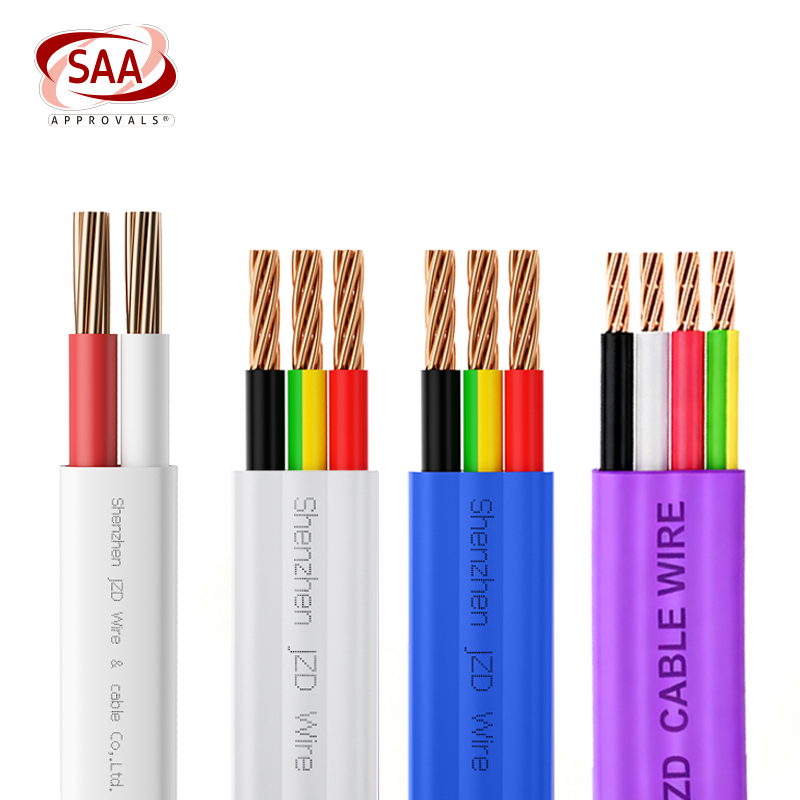
| Identification | Purple sheath (industry standard) | On-site visual identification |
SAA certification is the entry ticket to the Australian and wider Oceanian markets — without it, no legal sale or installation.
What Happens When Migration Occurs?
1. On the Cable Side
As plasticisers deplete, PVC molecular chains lose their lubricant. The material transitions from a flexible rubbery state to a hard, brittle glassy state.
Engineering consequences:
- Loss of flexibility—hardened sheaths cannot accommodate bending or vibration; cracking during installation or service becomes likely
- Degraded insulation—cracks expose the insulation layer to moisture, increasing leakage and short-circuit risks
- Reduced mechanical strength—hardened sheaths have lower impact resistance; even minor physical shock can cause failure
2. On the Polystyrene Side
When polystyrene absorbs plasticiser molecules, its molecular chains are “pried apart,” causing swelling. Macroscopically, the board surface softens, indents, or even appears “melted.” The closed-cell structure is destroyed—thermal resistance drops, and the insulation performance of the building envelope is compromised.
Prysmian’s installation guide explicitly warns: standard PVC-insulated cables must not be installed in direct contact with polystyrene insulation.
The Purple Sheath: Industry Standard Identification
Given the failure risk when standard cables contact sensitive materials, the industry needed a simple, reliable way to distinguish non-migratory cable from standard cable — the purple sheath.
1. What Purple Means
In the Australian cable market, purple sheath is the recognised identifier for non-migratory TPS cable. While white-sheath TPS is the standard choice for general-purpose fixed wiring, purple signals a specific material property:
- Non-migratory PVC compound
- SAA-certified
- AS/NZS 5000.2 compliant
2. Why It Matters on Site
| Benefit | Value |
| Installation efficiency | Electricians can identify non-migratory cable instantly—no need to check technical data for every reel |
| Error prevention | Eliminates the risk of using standard cable where non-migratory is required |
| Inspection acceptance | Electrical inspectors can confirm correct cable type at a glance |
For installers, the rule is simple: if you are unsure whether a circuit will contact sensitive materials, using purple cable is the safest choice.
When Must You Specify Non-Migratory Cable?
1. Scenario 1: Cable in Direct Contact with Polystyrene Insulation
EPS and XPS foam are widely used in Australian buildings—in cavity walls, under slabs, and in roof spaces. Where standard PVC cables directly contact these materials, migration is inevitable. Non-migratory TPS is the only standard wiring solution permitted for direct polystyrene contact.
2. Scenario 2: Embedded Wiring Inside Walls
Modern construction often uses prefabricated panels, composite materials, and multi-layer wall systems. Cables embedded in these structures may be in prolonged contact with acrylic, ABS, or polycarbonate. Once walls are closed, inspection and replacement become extremely difficult—the cost of correcting an error during construction is far higher than the cable itself.
3. Scenario 3: Modular and Prefabricated Construction
All electrical installation in modular buildings is completed in the factory before transport. Vibration during transit can accelerate migration, and cables may later be covered by insulation during on-site installation. Using standard cable means the error is already encapsulated in the wall before it leaves the factory.
4. Scenario 4: Enclosed and Confined Spaces
Switchboards, meter boxes, and cable trenches have limited ventilation, and temperatures can be elevated. These conditions accelerate plasticiser migration. Non-migratory TPS cable provides enhanced long-term reliability in these challenging environments.
JZD Cable: SAA-Certified Non-Migratory Purple TPS Solution
JZD Cable offers SAA-certified purple TPS flat cable manufactured to AS/NZS 5000.2 with non-migratory PVC sheathing available in both 3V-90 and 5V-90 grades.
1. Key Specifications
| Parameter | Specification |
| Certification | SAA Certified (Certificate No. SAA-240436-EA) |
| Standard | AS/NZS 5000.2 |
| Voltage Rating | 450/750V |
| Insulation | V-90 PVC |
| Sheath | 3V-90/5V-90 non-migratory PVC |
| Temperature Range | -30°C to +90°C |
| Conductor | Copper (AS/NZS 1125 compliant) |
| Sheath Colour | Purple (industry standard non-migratory identifier) |
2. Certification & Compliance Advantages
- SAA mandatory certification—meets Australian market access requirements
- AS/NZS 5000.2 compliant—meets Australian cable standards
- Non-migratory sheath—prevents plasticiser migration and protects sensitive materials
- 90°C thermal stability—stable performance in enclosed spaces and high-temperature environments
- Purple identification—rapid on-site visual verification of non-migratory properties
3. Applicable Scenarios
- Modular and prefabricated construction (integrated housing, modular homes, prefabricated pods)
- Embedded wiring in contact with polystyrene (cavity wall systems, roof insulation)
- Closed wall system internal wiring (permanently inaccessible cavities)
- Caravan and RV wiring (long-term reliability in mobile environments)
- Switchboards and meter boxes (high-temperature enclosed spaces)

Conclusion
Non-migratory TPS cable solves a hidden but serious failure mode in modern building wiring—plasticizer migration can destroy cable sheaths and adjacent polystyrene insulation within years, not decades.
AS/NZS 5000.2 provides the technical framework. SAA certification provides independent verification and mandatory market access. The purple sheath provides on-site assurance—a visual identifier that confirms non-migratory properties at a glance.
For any project involving polystyrene insulation, embedded walls, or modular construction, non-migratory TPS cable is not an “option”—it is the engineering choice that ensures long-term reliability.
Want to verify the difference? Contact JZD Cable for free samples and see how the purple sheath non-migratory TPS performs in your application.