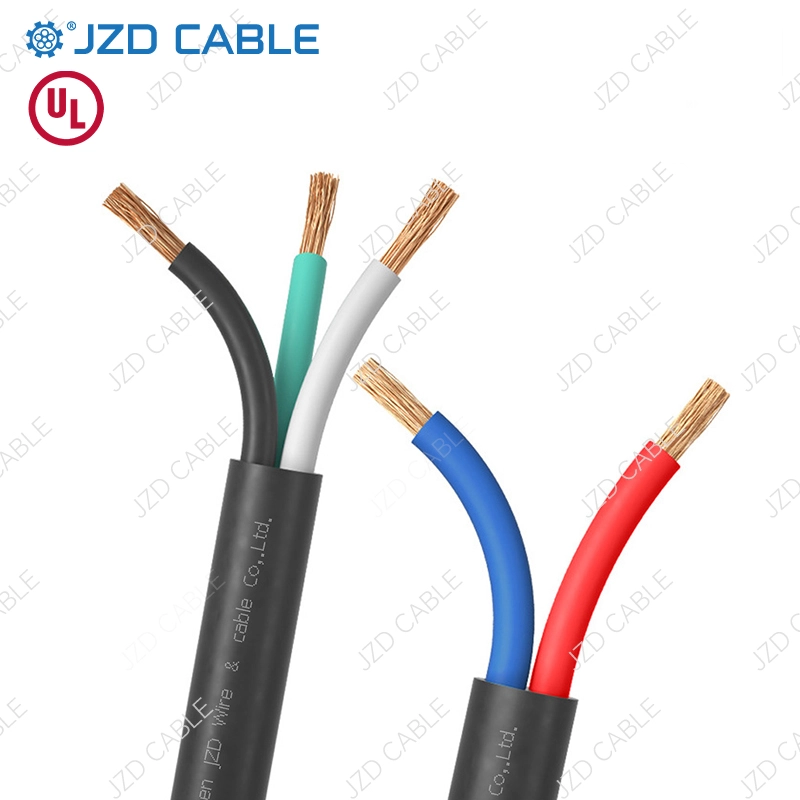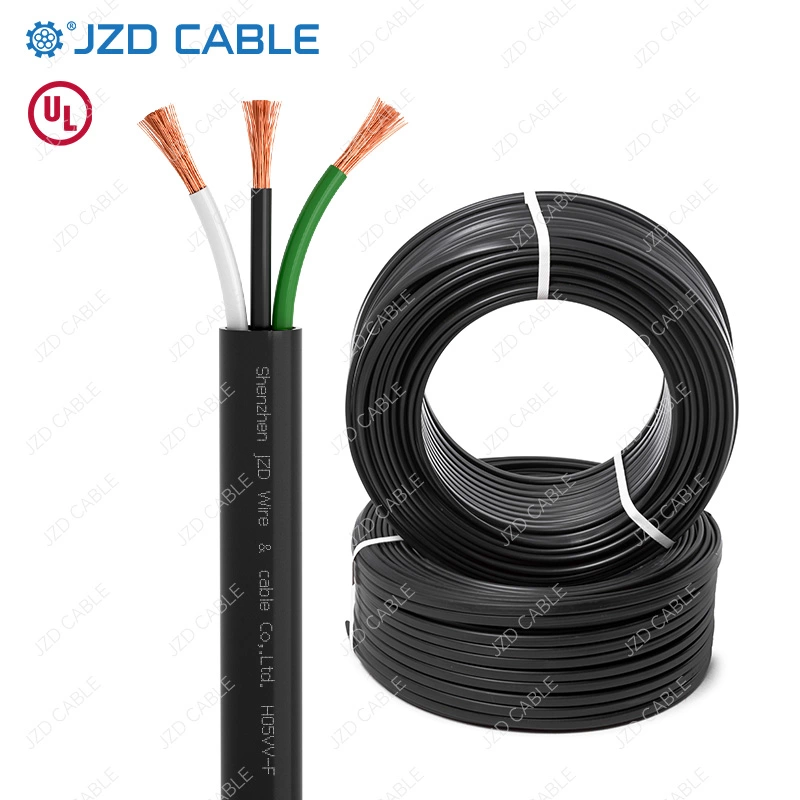


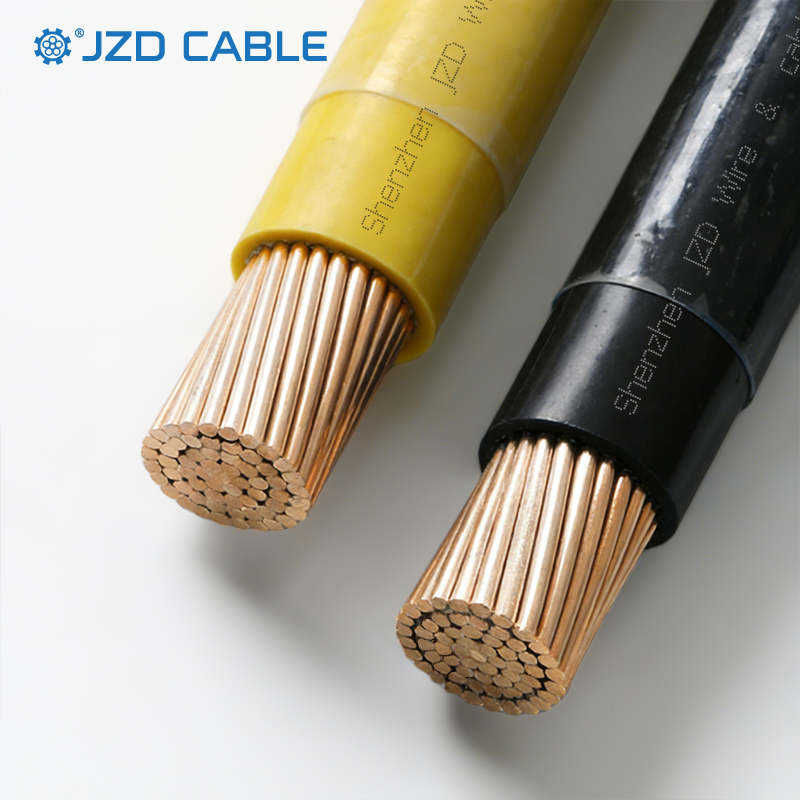
THHN and Romex are both 600V rated but differ in construction, installation, and application. THHN is a single-conductor wire for conduit in commercial and industrial settings; Romex (NM-B) is a multi-conductor sheathed cable for dry indoor residential and light commercial wiring. Selection depends on UL certification, ampacity, environment, code, and total cost—not unit price alone.
Quick Comparison
| Item | THHN / THWN-2 | Romex (NM-B) |
| Construction | Single conductor, PVC insulation with nylon jacket | Multiple insulated conductors plus bare ground, covered by PVC sheath |
| Conductor count | Single conductor | 2–3 insulated conductors plus 1 bare ground |
| Voltage rating | 600V | 600V |
| Temperature and ampacity | Insulation 90°C dry / 75°C wet; ampacity typically based on 75°C column (limited by terminations) | Insulation 90°C; ampacity based on 60°C column |
| Conduit required | Usually yes | Usually no |
| Wet / damp locations | THWN-2 rated for wet / damp locations | Not permitted |
| Typical applications | Commercial and industrial branch circuits, feeders, control panels, raceway systems | Residential and light commercial dry indoor wiring |
Structural Differences Determine Installation Method
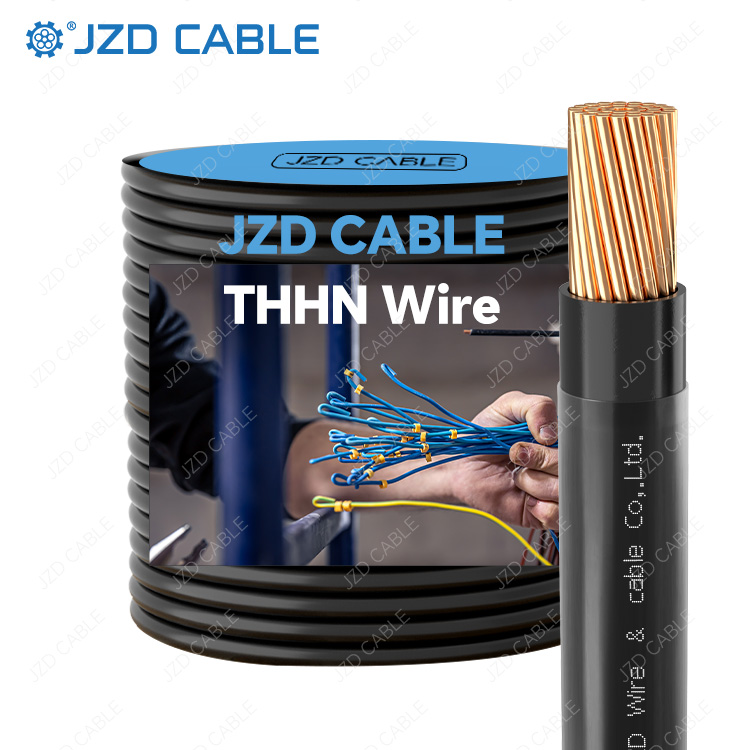
THHN is a single-conductor building wire, consisting of a copper or aluminum conductor, PVC insulation, and a nylon outer jacket. The nylon jacket provides mechanical protection and flame resistance, while the PVC layer provides dielectric strength. This construction makes THHN suitable for pulling through conduit and raceway systems, and it also allows for easier replacement or upsizing later. In practice, THHN is usually installed in EMT, PVC, or metal raceway, where heat dissipation depends on air movement inside the raceway and conduction through the conduit wall.
Romex is a cable assembly. It combines two or three insulated conductors and a bare copper ground wire, all covered by a PVC non-metallic sheath. Because the outer sheath provides a certain level of protection, Romex can usually be installed directly in walls, ceilings, or floors in dry indoor locations without additional conduit. However, its heat dissipation path depends mainly on contact between the sheath surface and surrounding air, and the bundled multi-conductor construction does not dissipate heat as effectively as single conductors in conduit.
These structural differences directly affect ampacity values and suitable applications. The next section looks at the key differences in ampacity calculation.
Ampacity: Insulation Temperature vs. Actual Limits
This is one of the most underestimated differences between THHN and Romex, and it directly affects conductor sizing.
THHN/THWN-2 insulation is typically rated at 90°C, and ampacity calculations can begin from the 90°C column for derating purposes. However, the final allowable ampacity must still be limited by the temperature rating of the terminations. Most standard circuit breaker terminations are rated at 75°C, so practical selection is usually based on the 75°C column. In commercial projects, designers calculate derating based on ambient temperature, the number of current-carrying conductors in the raceway, and other factors before determining conductor size.
Romex (NM-B) works differently. Although its conductor insulation is also rated at 90°C, NEC 334.80 clearly states that the allowable ampacity of NM cable must be based on the 60°C column. The 90°C rating may only be used for derating calculations, and the final result cannot exceed the value in the 60°C column. This means that 14 AWG NM-B cable, with a 60°C ampacity of 15A, can only be used with a 15A circuit breaker. If someone assumes the 90°C rating of 25A can be used and connects 14 AWG to a 20A breaker, it is a code violation.
The cost impact is that, under the same load conditions, Romex often requires a larger conductor size or more circuits. If this difference is not included in the budget during the design stage, later material adjustments may exceed the original cable cost estimate.
Once ampacity is determined, the next question is whether the product is suitable for the specific environment and what code limits apply.
Application Environment and Code Boundaries
THHN and THWN-2 are common in commercial and industrial projects and are suitable for conduit installations. Typical applications include industrial distribution panels, commercial building branch circuits, control panel wiring, outdoor feeders, and underground raceways. The THWN-2 rating allows these wires to be used in wet and damp locations, which makes them common in outdoor or underground projects.
Romex use is clearly limited by NEC 334.12. It is not permitted in wet or damp locations, nor where it is exposed to physical damage. In real projects, physical damage risk is often overlooked more often than moisture. For example, exposed basement walls, garage side walls, and cable routes in equipment rooms that may be struck by carts or materials all fall within the scope of evaluation. If the design drawings require NM-B in these locations, the construction phase may face partial rework or need additional protective measures to pass inspection.
In addition, although the individual conductors inside Romex have insulation marked 90°C, these conductors are not listed as THHN and cannot be pulled out of the cable sheath and installed as individual conductors. If a supplier blurs this boundary in its labeling, it may create unnecessary costs for later installation compliance.
In addition to installation environment and code boundaries, UL certification is a basic condition to confirm during selection.
UL Certification Is the Baseline
For B2B projects, UL certification is a basic requirement. THHN/THWN-2 building wire should comply with UL 83, which covers construction, testing, and performance requirements. The following points should be verified:
- Whether the product has UL 83 listing, not just UL recognition;
- Whether the conductor material meets ASTM B3 or B8;
- Whether it passes the VW-1 vertical wire flame test;
- Whether it has a THHN/THWN-2 dual rating for wet location use;
- Whether each reel or spool maintains consistent specifications in bulk supply and can provide corresponding test documents.
Suppliers with complete certification documents and stable batch quality are better positioned to meet the compliance and consistency requirements of commercial and industrial projects.
After confirming compliance and performance, cost control is another factor affecting the material decision.
Cost Considerations Under Copper Price Volatility
Copper accounts for a high proportion of cable cost, so copper price fluctuations are transmitted fairly directly to cable costs. For projects with long bidding cycles and a time gap between quotation and construction, material costs may already have changed after the quotation is issued.
In this situation, cost control can be approached from several directions. For projects with confirmed quantities and adequate storage conditions, locking in THHN purchase batches in advance can help hedge against short-term price fluctuations. For commercial or industrial projects with large cable volumes and relatively stable specifications, a floating pricing mechanism based on a copper price benchmark may better reflect the actual cost structure than a one-time fixed quotation. In addition, the scrap copper recovery value of THHN after construction is usually higher than that of Romex. For projects with a high material cost proportion, this point is also worth considering during project settlement.
Based on the technical and cost factors above, the following checklist can be used for an initial judgment.
Selection Checklist
The checklist below distinguishes technical selection conditions from cost strategy. The first five rows mainly determine whether the product is suitable. The last row is used to evaluate cost control methods.
| Question | If Yes | If No |
| Is the installation location wet, damp, or underground? | Choose THHN/THWN-2 | Romex may be considered |
| Does the design require conduit or raceway? | Choose THHN single conductors | Romex can be used for direct installation in dry walls |
| Is the project a commercial or industrial building? | THHN is more consistent with code boundaries | Romex may be applicable |
| Is there a risk of physical damage? | Evaluate protective measures or switch to THHN | Romex can be used under protected conditions |
| Is future modification or upsizing expected? | THHN with conduit is more suitable | Romex is acceptable |
| Is the bidding cycle long and copper price volatility significant? | Consider batch locking or floating pricing | Fixed quotation is acceptable |
Conclusion
THHN/THWN-2 and Romex are not interchangeable. THHN/THWN-2 is for commercial, industrial, wet, and conduit use; Romex is for dry indoor residential wiring but limited by 60°C ampacity and NEC 334. 12. Select on environment, code, ampacity, UL certification, and lifecycle cost—not unit price.
If you are looking for UL-certified THHN/THWN-2 wire or NM-B cable, contact us for specifications, certifications, and bulk supply.