
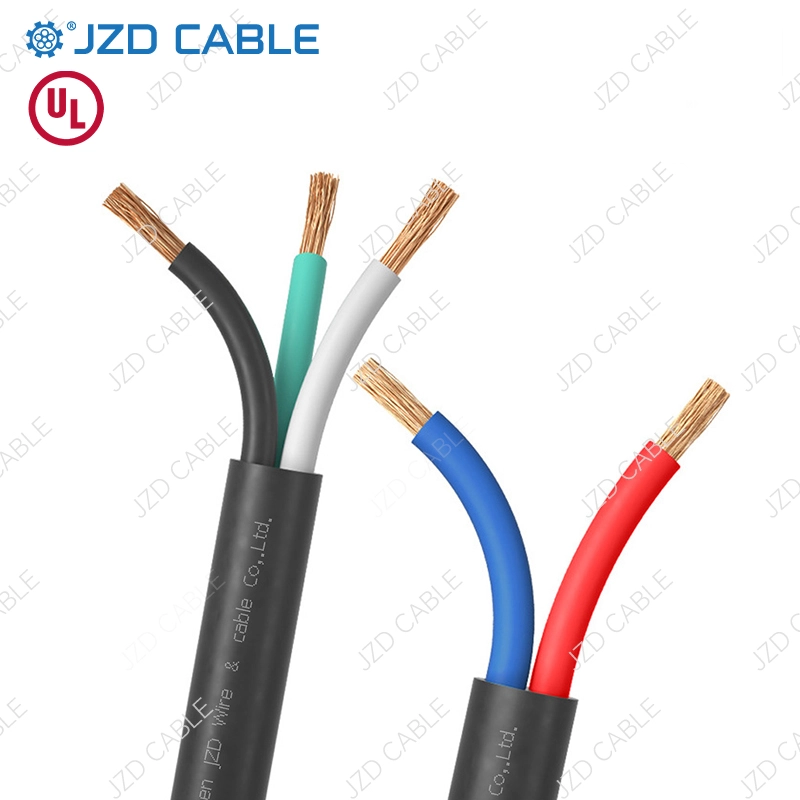
In industrial and construction settings, SOOW and SJOOW differ by a single letter (“J”) but represent vastly different physical boundaries. Misusing SJOOW in 480V/600V circuits risks insulation breakdown, while forcing bulky SOOW into tight spaces causes operator fatigue. To select correctly, we must look at their underlying material DNA.
Thermoset Rubber: The Underlying DNA of Heavy-Duty Portable Cables
Whether SOOW or SJOOW, their insulation and jackets typically utilize an EPR/EPDM insulation + CPE (chlorosulfonated polyethylene) jacket thermoset system.
Unlike standard PVC (thermoplastic), rubber forms a three-dimensional network through chemical cross-linking. This gives them two critical “outdoor survival” capabilities: No Melting/Dripping & Thermal Safety (under short circuit, rubber merely chars rather than melting and dripping like PVC to cause secondary fires), and Extreme Cold Resistance (remains highly flexible at -40°C, whereas standard PVC shatters).
1. What is SOOW Cable?
SOOW stands for Service cord, OO (Oil-resistant insulation & jacket), and W (Weather & water-resistant). It is the standard designation for 600V heavy-duty portable cables. To support high voltage and severe physical dragging, SOOW features exceptionally thick insulation and an outer jacket, capable of resisting crushing, cutting, and oil immersion in extreme environments like mining and ports.
2. What is SJOOW Cable?
The J in SJOOW stands for Junior (medium-duty). It is a 300V medium-duty portable cable. SJOOW has relatively thinner insulation and jacket, which translates to a smaller outer diameter and lighter weight. It is specifically designed for light-to-medium equipment requiring frequent movement in confined spaces (such as handheld drills and portable light towers), making installation easier.
Core Engineering Differences Comparison
| Dimension | SOOW (600V Heavy-Duty) | SJOOW (300V Medium-Duty) |
| Voltage Rating | 600V | 300V |
| Insulation Thickness | Thicker, providing higher voltage margin and thermal buffer | Thinner, meeting 300V system requirements |
| Jacket Mechanical Protection | Extremely thick and hard, resists crushing, cutting, and abrasion | Thinner and flexible, moderate resistance to physical damage |
| Outer Diameter & Weight | Bulky and heavy | Slim and lightweight |
| Min. Bending Radius | Approx. 8-10x OD, stiffer | Approx. 6x OD, highly flexible |
| Typical Environment | Heavy industry, outdoor, oily, extreme cold | Indoor workshops, light-duty equipment, confined spaces |

Application Boundaries in Harsh Scenarios
Combining the parameter differences above, the application boundaries in actual engineering design are very clear:
1. When Must SOOW Be Selected?
When projects involve 480V/600V high-voltage circuits (large three-phase motors, industrial welders), or the cable faces heavy mechanical stress (heavy lifting equipment on construction sites, mobile crushers in mining, shore power connections at ports, long-term oil immersion), SOOW is mandatory. The thicker jacket is the only guarantee for cable survival in extreme physical environments.
2. When is SJOOW More Cost-Effective?
In scenarios where voltage does not exceed 300 V and the space is confined with frequent movement requirements, SJOOW is a wiser choice. Examples include handheld power tools, small water pumps, internal power wiring in automation cabinets, and temporary extension cords for events. SJOOW’s lightweight nature significantly reduces operator fatigue.
Material Verification and Technical Specification Review
When confirming product specifications, focus on the material system and core test data to ensure cable reliability under actual working conditions.
1. Certification and Standard Compliance
Verify that the product is listed in UL 62 and CSA C22.2 No. 49, and confirm its flame rating meets FT2 (Vertical Tray Flame Test) or VW-1 standards.
2. Material System Confirmation
Clearly distinguish between thermoset cross-linked rubber (such as CPE/EPDM) and thermoplastic elastomer (TPE/TPU). Cross-linked rubber offers significantly better aging resistance under long-term oil immersion and high temperatures compared to TPE.
3. Jacket Marking and Identification
Compliant product jackets must clearly print SOOW 600V or SJOOW 300V, along with the continuous operating temperature range (typically -40°C to +90°C).
4. Insulation Concentricity and Craftsmanship
The eccentricity of the insulation layer directly affects voltage withstand performance. High eccentricity creates localized weak points, making the cable more susceptible to breakdown during voltage surges. Evaluate via slice sampling.
5. Jacket Stripping Performance
High-quality cross-linked rubber jackets and inner insulation should have good stripping properties without sticking, ensuring no damage to the inner cores during field termination.
Conclusion
Neither SOOW nor SJOOW is absolutely superior; the key lies in matching the engineering environment. Choose SOOW for heavy high-voltage and harsh outdoor conditions; choose SJOOW for light-duty mobile use and confined spaces. During specification verification, look beyond the generic term “rubber cable” and verify the UL 62 listing, voltage markings, and jacket material system to ensure the long-term safety of the power supply system.
FAQ
1. Can SOOW be used as a downward replacement for SJOOW?
Physically yes (600V can be used in 300V environments), but it is uneconomical and impractical. SOOW is too bulky and stiff, causing wrist fatigue when used on small drills.
2. What does the “W” on SJOOW cable stand for?
It stands for Weather-resistant and Water-resistant, capable of handling outdoor climates. However, its thin jacket is not suited for repeated dragging on rough surfaces.
3. How do both perform in cold storage?
Both remain flexible in extreme cold environments down to -40°C, which standard PVC cables cannot achieve.
For specifications or certification documents for UL 62 listed heavy-duty SOOW (600V) or medium-duty SJOOW (300V) portable rubber cables, please contact us.