

In North American armored cable procurement and engineering applications, the most common source of confusion isn’t technical specifications—it’s the naming itself.
BX, AC Cable, and AC90 are often used interchangeably, but they are not on the same level.
If you’re sourcing CSA-certified armored cable for Canadian or North American projects, understanding the essential differences between AC90, BX, and AC cable—and which standards apply where—is critical to ensuring compliance and avoiding project delays.
Canada: AC90 Is Mandatory
In Canada, the mandatory standard for armored cable is CSA C22.2 No. 51.
AC90 is the common designation for armored cable that complies with CSA C22.2 No. 51. When you see “AC90” on a Canadian electrical drawing or bill of materials, it means:
- Complies with CSA C22.2 No. 51
- CSA certified
- 600V rated
- Suitable for dry indoor building wiring
The Canadian Electrical Code (CEC) requires that all armored cable installed in Canada must bear CSA certification. UL-listed cable cannot be legally installed in Canada — regardless of its technical performance, if it does not meet CSA standards, inspectors will not approve it.
Common Misconception: What Is BX?
In armored cable procurement, “BX” is one of the most misunderstood terms.
Simply put: BX is an industry nickname, not a formal product category or current standard.
- In the U.S., when contractors say “BX,” they typically refer to Type AC Cable (per UL 4 / NEC Article 320)
- In Canada, when contractors say “BX,” they typically refer to AC90 (per CSA C22.2 No. 51)
“BX” has no standard definition. This is why specifying “BX cable” on a purchase order is risky—the supplier may ship to U.S. standards when you need Canadian standards.
Once we understand the nickname status of “BX,” the next question is, what standards do Canada and the U.S. each use to define armored cable, and what are the actual differences?
AC90 vs. Type AC (BX): Core Differences
The table below directly compares key parameters between AC90 (Canada) and Type AC (U.S.):
| Feature | AC90 (Canada) | Type AC / BX (U.S.) |
| Standard | CSA C22.2 No. 51 | UL 4 / NEC Article 320 |
| Certification | CSA (mandatory) | UL (mandatory) |
| Voltage | 600V | 600V |
| Temperature | -40°C to 90°C | 90°C dry |
| Wet locations | AC90 (no); ACWU90 (yes) | No |
| Legal status | CEC-mandated in Canada | NEC-mandated in the U.S. |
Key takeaway: AC90 and Type AC (BX) are not “two “options”—they are legally required standards for two different markets and are not interchangeable.
Grounding: The Most Critical Engineering Difference
The “grounding method” mentioned in the comparison table is the most fundamental engineering difference between AC90 and Type AC, and it deserves further explanation.
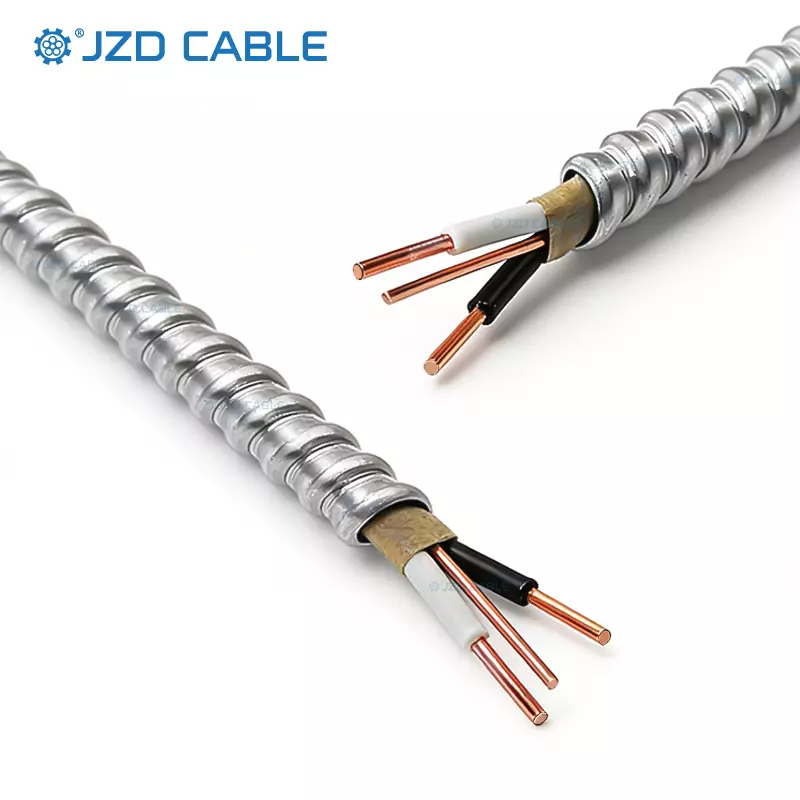
U.S. Type AC (UL 4) relies on an aluminum bonding strip in contact with the armor as the grounding path. The armor itself is the primary grounding conductor, and the reliability of the grounding path depends on the integrity of the armor connections.
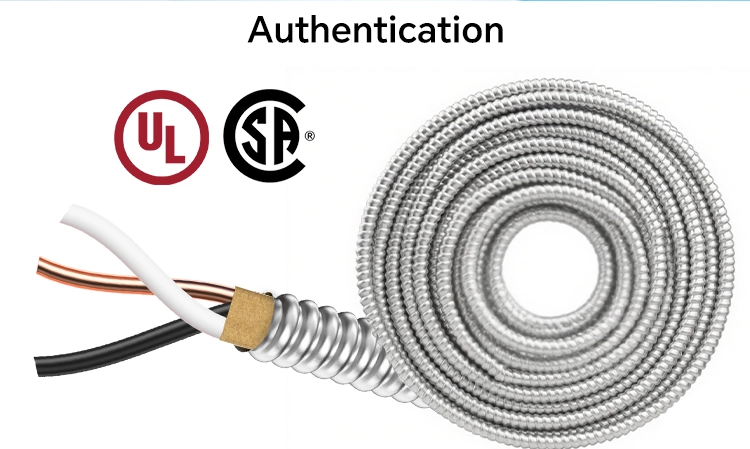
Canadian AC90 (CSA C22.2 No. 51) includes a bare copper bonding conductor running inside the armor, wrapped around the insulated conductors. This provides a dedicated grounding path independent of the armor. The CEC requires the armor and the bonding conductor to work together as the grounding system.
Engineering significance: AC90’s dual grounding system provides a lower-impedance fault current path. At the inspection level, CSA certification requires that the bare copper bonding conductor in AC90 be visible and inspectable at terminations—UL 4 Type AC has no such requirement. In high-density Canadian commercial buildings—
offices, hospitals, schools—this design is considered a fundamental safety requirement.
offices, hospitals, schools—this design is considered a fundamental safety requirement.
Selection Guide: What Should You Specify for a Canadian Project?
| Project Location | Mandatory Standard | Cable Type | Certification |
| Canada | CSA C22.2 No. 51 | AC90 | CSA (mandatory) |
| United States | UL 4 / NEC Article 320 | Type AC | UL |
| Project Requirement | Product to Specify | Standard | Notes |
| Indoor dry location building wiring (Canada) | AC90 | CSA C22.2 No. 51 | Standard armored cable |
| Outdoor / wet locations (Canada) | ACWU90 | CSA C22.2 No. 51 | AC90 with PVC jacket—waterproof and weather-resistant |
| Industrial / harsh environments (Canada) | TECK90 | CSA C22.2 No. 131 | Industrial-grade armored cable for outdoor and mechanical damage risk areas |
Critical rule: Never specify only “BX” on a purchase order. For Canadian projects, specify “AC90 (CSA C22.2 No. 51).” For U.S. projects, specify “Type AC (UL 4 / NEC Article 320).”
JZD AC90 Cable: A CSA-Certified Solution for the Canadian Market
For Canadian projects, the correct choice is AC90 (CSA C22.2 No. 51). JZD Cable offers CSA-certified AC90 cable built to this standard.
Key Specifications
| Parameter | Specification |
| Certification | CSA C22.2 No. 51 |
| Voltage | 600V |
| Conductor | Aluminum (ACM compact or compressed, Class B stranded) |
| Conductor options | Solid (#14-#2 AWG); Stranded (#6-4/0 AWG) |
| Insulation | XLPE (RW90), 90°C |
| Armour | Aluminum Interlocked Armour (AIA) |
| Temperature range | -40°C to +90°C |
Dual-Certification Value
JZD AC90 carries both CSA certification and cUL listing:
- CSA certification: Ensures legal use in the Canadian market, meeting CEC requirements
- UL listing: Provides flexibility for projects that may need U.S. market acceptance
Applications
JZD’s CSA AC90 cable is suitable for fixed wiring in the Canadian market:
- Commercial building power distribution (offices, retail, schools, hospitals)
- Multi-family residential (apartments, condominiums—concealed wiring)
- Industrial facilities (machinery, lighting, control systems)
- Control circuits (motor controls, HVAC controls, automation panels)
- Healthcare facilities (with isolated-ground applications)
Conclusion
The difference between AC90 and BX (AC) cable is not a matter of technical preference—it’s a matter of standard compliance.
In Canada, the Canadian Electrical Code mandates CSA C22.2 No. 51 for armored cable installations. AC90 is the product that meets this requirement. In the United States, UL 4 and NEC Article 320 govern Type AC cable. One is not “better” than the other—they are simply designed for different markets.
When specifying cable, “BX” is not a clear spec. It is an old trade name that means different things to different people. To avoid costly mistakes, be specific: “CSA C22.2 No. 51 AC90” for Canada, “UL 4 Type AC” for the U.S.
Getting the cable right from the start means fewer surprises at inspection, less rework on site, and projects that stay on track.
Need CSA-certified AC90 cable for your Canadian project? Contact JZD Cable for technical specifications and free samples.