

In Canadian residential and light commercial wiring, NMD90 is the default non-metallic-sheathed cable. Rated 300V with a 90°C dry conductor temperature, FT1 flame retardant, and CSA C22.2 No.48 compliant, it’s the go-to for branch circuits, home runs, and light commercial feeders from coast to coast.
But NMD90 comes in two conductor flavours: copper (CU NMD90) and aluminum (AL NMD90, AA8000-series alloy). Both share the same jacket, same XLPE/PVC insulation system, same voltage and temperature ratings — yet the choice between copper and aluminum changes everything about ampacity, weight, termination labor, and long-term reliability.
Get it wrong and you risk overheated lugs, insurance complications, and costly rework. This guide breaks down the two side-by-side so your next Canadian BOQ gets it right.
What is NMD90?
Per CSA C22.2 No.48 (Non-metallic Sheathed Cable) :
- Voltage: 300V
- Conductor temperature: 90°C in dry locations
- Flame rating: FT1 (CSA C22.2 No.2556 vertical flame test)
- Insulation: XLPE (RW90-type) or PVC+nylon (T90-type)
- Jacket: PVC, moisture-resistant, FT1 flame retardant
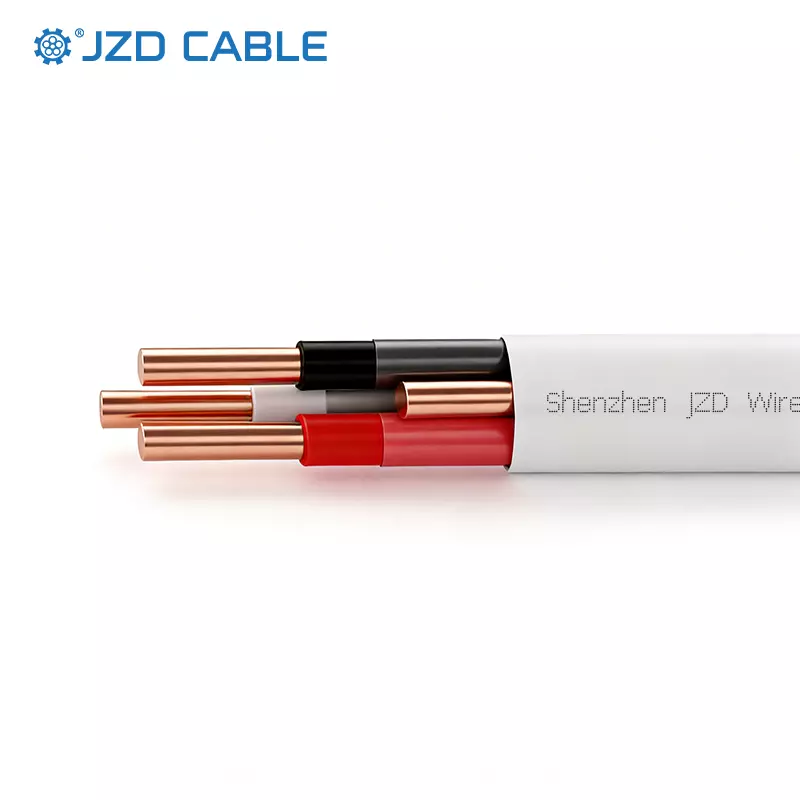
- Colour code: Black, red, white (3-core); black, white (2-core)
- Applications: Exposed and concealed wiring in dry or damp locations, not exposed to mechanical damage
- Prohibited: Direct burial, long-term outdoor sun exposure, embedded in poured concrete, exposed to physical damage
- Compliance: Canadian Electrical Code (CEC) Section 12, Rules 12-552 to 12-576
💡 Both copper and aluminum NMD90 meet this exact same specification. The only difference is the conductor metal.
Decoding the Model Codes
|
Code
|
Meaning
|
|---|---|
|
NMD90
|
Non-Metallic, Dry location, 90°C rated
|
|
CU NMD90
|
Copper conductor version
|
|
AL NMD90
|
Aluminum conductor — AA8000-series alloy (ACM), per ASTM B800/B801
|
Key structural difference: In AL NMD90, all conductors — phase and bonding/ground — are aluminum. There is no copper ground . This is critical for termination planning.
Full Side-by-Side Comparison
|
Comparison Dimension
|
CU NMD90 (Copper)
|
AL NMD90 (Aluminum)
|
|---|---|---|
|
Conductor material
|
Bare copper, solid (14–10 AWG) or stranded (8 AWG+)
|
AA8000-series aluminum alloy (ACM), ASTM B800/B801, compact stranded
|
|
Ground/bonding conductor
|
Bare copper
|
Bare aluminum (all-Al construction)
|
|
Equivalent gauge for same ampacity
|
Baseline
|
Must upsize 1–2 gauges to match copper ampacity
|
|
Resistivity
|
Low — optimal conductivity
|
~1.68× copper; higher resistance per same cross-section
|
|
Voltage drop
|
Minimal — ideal for longer runs
|
Significantly higher per same gauge; upsizing required for distance
|
|
Weight
|
Heavy — 100% baseline
|
~1/3 the weight of copper equivalent
|
|
Cable outer diameter
|
Baseline for given AWG
|
Larger for equivalent ampacity (upsized gauge)
|
|
Short-circuit withstand
|
Excellent (Cu melting point 1083°C)
|
Lower (Al melting point 660°C) — less fault tolerance
|
|
Termination requirements
|
Standard copper lugs, direct crimp
|
Mandatory copper-aluminum transition lugs or Al-specific lugs + antioxidant paste
|
|
Oxidation management
|
Copper oxide still conductive — low risk
|
Aluminum forms insulating oxide film instantly — must abrade + apply No-Ox/Deox
|
|
Galvanic corrosion risk
|
None with copper-to-copper
|
High if Al contacts dissimilar metal (Cu, steel) without proper transition
|
|
Thermal expansion
|
Low
|
Higher — connections can loosen over heating cycles; periodic re-torque needed
|
|
Maintenance interval
|
Long — set-and-forget
|
Shorter — inspection and re-torquing recommended
|
|
Cost (per metre)
|
Higher (copper commodity price)
|
~30–40% lower than copper equivalent
|
|
Common sizes
|
14/2, 14/3, 12/2, 12/3, 10/2, 10/3, 8/3, 6/3, 4/3, 2/3
|
Typically 8 AWG, 6 AWG, 4 AWG, 2 AWG 3-core (larger gauges where Al makes economic sense)
|
|
CEC Table 4 ampacity (sample)
|
12 AWG = 20A, 10 AWG = 30A, 8 AWG = 40A, 6 AWG = 55A, 4 AWG = 70A, 2 AWG = 95A
|
8 AWG Al = 45A, 6 AWG Al = 55A, 4 AWG Al = 75A, 2 AWG Al = 100A
|
|
Best applications
|
Branch circuits (14/2, 12/2), outlets, lighting, small appliances, control wiring, all general residential
|
Larger feeders (#8 to #2 AWG): panel feeders, sub-panel feeds, large 240V circuits, commercial light-commercial mains — where Al’s weight/cost savings offset termination complexity
|
|
Insurance acceptance
|
Standard — all insurers accept
|
Restricted — many home insurers scrutinize Al branch wiring; main feeders more accepted
|
Five Differences That Actually Matter on Site
1. Ampacity & Gauge Upsizing — The Core Trade-off
Aluminum’s higher resistivity means you must upsize to match copper’s current-carrying capacity:
|
Target Load
|
CU NMD90
|
AL NMD90 Equivalent
|
|---|---|---|
|
20A branch
|
12 AWG
|
Not typically done — Al branch circuits rare
|
|
30A (water heater)
|
10 AWG
|
Not typically done
|
|
40A (AC circuit)
|
8 AWG Cu
|
8 AWG Al (45A) — marginal; 6 AWG Al (55A) preferred
|
|
55A
|
6 AWG Cu
|
6 AWG Al (55A) — direct match
|
|
70A
|
4 AWG Cu
|
4 AWG Al (75A) — direct match
|
|
95A
|
2 AWG Cu
|
2 AWG Al (100A) — direct match
|
Reality: AL NMD90 is primarily manufactured in 8 AWG through 2 AWG — the larger gauges where the cost/weight savings justify the more complex termination . You won’t find 14 AWG or 12 AWG aluminum NMD90 on the market; those small branch circuits stay copper.
2. Weight — Aluminum’s Decisive Advantage
Aluminum weighs roughly one-third of copper for the same ampacity . On a long panel feeder run:
- CU NMD90 2 AWG: ~475 kg/km
- AL NMD90 2 AWG: ~145 kg/km
That 330 kg/km difference transforms:
- Handling and pulling effort
- Support/strap spacing requirements
- Structural load on framing
- Shipping and freight costs
For multi-unit residential buildings, long condo corridor runs, or commercial feed systems, AL NMD90’s weight advantage is a game-changer.
3. Termination Complexity — Where Copper Wins Hands-Down
This is aluminum’s Achilles’ heel:
CU NMD90:
- Strip jacket → strip insulation → crimp standard copper lug → done
- Copper oxide is still conductive — minor oxidation doesn’t compromise the joint
- Set-and-forget: joints remain stable for decades
AL NMD90:
- Strip jacket → mechanically abrade each conductor to remove insulating oxide film → apply antioxidant paste (No-Ox, Deox, Penetrox) → crimp bi-metal (Al-Cu) transition lug or aluminum-specific lug → torque to spec
- Never allow direct aluminum-to-copper contact — galvanic corrosion will destroy the joint within months
- Thermal cycling loosens connections over time — periodic re-inspection and re-torquing required
- Inspector scrutiny: many jurisdictions require documented anti-oxidation procedure compliance
⚠️ The historical baggage: Aluminum branch wiring in the 1960s–70s (with inferior alloys and improper termination) caused numerous fires. Modern AA8000 alloy + proper bi-metal lugs + antioxidant paste is code-compliant and safe — but the insurance and inspection overhead remains higher than copper.
4. Cost — Aluminum’s Apparent Win Is Context-Dependent
At the cable level, AL NMD90 costs 30–40% less per metre than CU NMD90 for equivalent gauge . However, factor in:
- Bi-metal lugs: 2–5eachvs0.50 for copper lugs — multiplied across dozens of termination points
- Antioxidant paste: Per-joint consumable cost + labor
- Upsizing: If you must jump from 4 AWG Cu to 2 AWG Al to hit 95A, the material saving shrinks
- Labor: Aluminum termination takes 2–3× longer per joint
- Insurance: Some insurers charge higher premiums or require inspections for aluminum feeders
Net result: For large feeders (#4 AWG and up), AL NMD90 typically delivers 15–25% total project savings. For small branch circuits, copper is cheaper once you add termination overhead.
5. Code Compliance & Insurance — Read the Fine Print
- CEC Rules 12-552 to 12-576 govern NMD90 installation — both copper and aluminum versions comply equally
- Many Canadian home insurers have restrictive policies on aluminum branch-circuit wiring (14/2, 12/2 ranges). They generally accept aluminum for main feeders (#4 AWG and larger) where proper bi-metal terminations are used
- AHJ inspection: Aluminum NMD90 terminations receive closer scrutiny — inspectors verify antioxidant paste usage and bi-metal lug specification
📌 Practical guidance: Copper for branch circuits and general residential wiring. Aluminum for large feeders, sub-panels, and light-commercial mains where the gauge is #4 AWG or larger.
Application Decision Tree
|
Scenario
|
Recommended
|
Why
|
|---|---|---|
|
14/2, 12/2 branch circuits (outlets, lighting)
|
CU NMD90
|
Al not available in these gauges; Cu is code-simple and insurer-friendly
|
|
10/3 for electric dryer, 8/3 for AC
|
CU NMD90
|
Branch-circuit range where Cu is standard; Al termination overhead not worth it
|
|
4 AWG feeder to sub-panel (70A)
|
Either — Cu simpler, Al 30% cheaper
|
Al savings meaningful at this gauge; proper termination adds labor but pays back
|
|
2 AWG feeder to outbuilding (100A)
|
AL NMD90
|
100A Al at #2 is direct CEC Table 4 match; weight + material savings substantial over long runs
|
|
Multi-unit residential, long corridor feeders
|
AL NMD90
|
Weight savings transforms pulling effort; economies of scale offset termination cost
|
|
Commercial light-commercial mains
|
AL NMD90
|
Large gauges — Al’s cost advantage decisive; qualified electricians handle bi-metal terminations routinely
|
|
Insurance-sensitive residential (homeowner policy)
|
CU NMD90 for all circuits
|
Avoids aluminum scrutiny; copper is “invisible” to insurers
|
|
Retrofit/replacement of 1960s–70s aluminum wiring
|
CU NMD90
|
Replace deficient old Al with modern Cu; don’t repeat history
|
|
Short runs (<15m), any gauge
|
CU NMD90
|
Voltage drop not a concern; Cu’s simplicity wins
|
CEC Installation Rules for Both (Key Points)
Per CEC Rules 12-552 to 12-576 , both CU and AL NMD90 must comply with:
- Use: Exposed or concealed wiring in dry or damp locations, not exposed to mechanical damage
- Not permitted: Direct burial, embedding in concrete, long-term outdoor exposure without protection, locations subject to physical damage
- Bending radius: Minimum bend radius per manufacturer spec — aluminum’s stiffness demands careful handling
- Stapling/support: Proper cable staples at code-specified intervals; aluminum’s weight requires adequate support spacing
- Protection: Below 1.5m (5 ft) from floor, NMD90 requires mechanical protection (e.g., PVC conduit sleeve)
- Termination — AL version: Use bi-metal lugs, antioxidant paste, proper torque; periodic inspection recommended
- Box fill: Both comply with standard box-fill rules; aluminum’s larger gauge for equivalent ampacity may require larger boxes
FAQ
Q: Is aluminum NMD90 legal in Canada?
A: Yes — AL NMD90 is fully CSA-compliant to C22.2 No.48 and accepted by the Canadian Electrical Code for feeders and large circuits . The key is proper AA8000 alloy + bi-metal terminations + antioxidant paste.
Q: Why don’t they make 14 AWG or 12 AWG aluminum NMD90?
A: For small branch circuits, aluminum’s termination complexity and insurance scrutiny outweigh the material savings. The market has standardized on copper for 14–10 AWG NMD90. Aluminum NMD90 begins at 8 AWG where the economics favor the alloy .
Q: Can I mix copper and aluminum NMD90 in the same panel?
A: Yes, but never directly. Each aluminum conductor must terminate via a bi-metal (Al-Cu) transition lug — this is non-negotiable. The lug’s aluminum end bonds to the Al conductor (with antioxidant paste); the copper end bonds to the bus bar or Cu conductor. Direct Al-to-Cu contact = galvanic corrosion disaster .
Q: Does AL NMD90 have a bare aluminum ground?
A: Yes — in AL NMD90, all conductors including the bonding/ground are aluminum . This maintains electrical continuity but means the ground also requires proper termination with antioxidant paste and Al-rated lugs.
Q: Is the ampacity of AL NMD90 lower than CU at the same gauge?
A: Yes. Per CEC Table 4: 8 AWG Al = 45A (vs 8 AWG Cu = 40A — interesting exception at this gauge), 6 AWG Al = 55A (vs 6 AWG Cu = 55A), 4 AWG Al = 75A (vs 4 AWG Cu = 70A), 2 AWG Al = 100A (vs 2 AWG Cu = 95A) . At some gauges Al actually edges ahead due to CEC’s generous Al ampacity factors, but the conductor is physically larger.
Q: Will my home insurer accept aluminum NMD90?
A: For main feeders (#4 AWG and larger), generally yes — this is standard practice and widely accepted. For branch circuits (smaller gauges), many insurers either charge higher premiums or require inspection. Always check with your insurer before specifying Al branch circuits.
Q: What’s the minimum installation temperature?
A: Per CEC: –25°C for 3-conductor AL NMD90, with proper handling procedures . Material should be stored above 0°C for 24 hours prior to installation .
Q: How much can I save with AL NMD90 on a 100A sub-panel feeder run?
A: For a 30-metre run of 2 AWG: AL NMD90 cable cost is ~35% less than CU NMD90, weight is ~1/3, and pulling is dramatically easier. After adding bi-metal lugs and antioxidant paste, net project saving is typically 20–25%. Over a multi-unit building with dozens of such runs, the savings become very substantial.
JZD Cable CU NMD90 & AL NMD90 Product Range
At JZD Cable, we manufacture both copper and aluminum NMD90 to full CSA C22.2 No.48 compliance:
CU NMD90 (Copper):
- Sizes: 14/2, 14/3, 12/2, 12/3, 10/2, 10/3, 8/3, 6/3, 4/3, 2/3 (and custom)
- Conductor: Bare copper, solid (14–10 AWG) or stranded (8 AWG+)
- Insulation: XLPE (RW90-type) 90°C, or PVC+nylon (T90-type)
- Jacket: PVC, FT1, moisture-resistant
- Colour code: Black/White (2-core); Black/Red/White (3-core)
- 300V, 90°C dry
AL NMD90 (Aluminum):
- Sizes: 8/3, 6/3, 4/3, 2/3 (3-core with bare Al ground)
- Conductor: AA8000-series aluminum alloy (ACM), ASTM B800/B801, compact stranded
- Bonding conductor: Bare AA8000 aluminum
- Insulation: XLPE (RW90-type) 90°C
- Jacket: PVC, FT1, moisture-resistant
- Colour code: Black/Red/White
- 300V, 90°C dry
- Termination kits available: Bi-metal (Al-Cu) transition lugs + antioxidant paste, per-joint or bulk
Shared compliance for both:
- CSA C22.2 No.48 (Non-metallic Sheathed Cable)
- CSA C22.2 No.38 (Thermoset-insulated wires)
- CSA C22.2 No.2556 (FT1 flame test)
- CEC Section 12, Rules 12-552 to 12-576 compliant
- Reel lengths: 75m, 150m, 250m, or cut-to-length
We serve Canadian electrical distributors, contractors, and residential/MU residential developers with full bilingual (EN/FR) documentation and fast lead times.
📩 Need help deciding between CU and AL NMD90 for your Canadian project?
Contact the JZD team at https://jzdcable.com/contact-us/ — tell us your circuit ampacity, run length, panel location, and whether the AHJ/insurer has aluminum restrictions, and we’ll recommend the optimum conductor and gauge.