

The U.S. prefab construction market is projected to reach USD 162 billion in 2026, driven by persistent housing shortages and labor challenges. Unlike traditional on-site building, prefab houses are assembled on factory lines—modules are pre-wired, transported, then interconnected at the job site.
This creates a problem that most standard building wires can’t solve: factory assembly requires cables that bend easily, pull through tight spaces, and survive repeated handling. Field installation requires cables that withstand sunlight, rain, and temperature extremes. These are fundamentally different demands, but prefab manufacturers need a single cable type that works in both places.
SJT and SJTW portable cords are engineered for exactly this dual role—flexible enough for the factory, tough enough for the field.
SJT vs SJTW: What’s the Difference?
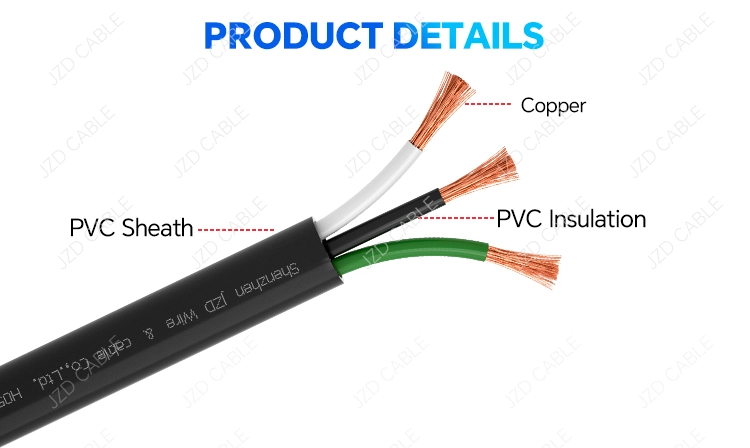
Both SJT and SJTW are UL-listed portable cords under UL 62 (Flexible Cords and Cables) and CSA C22.2 No. 49. They share the same basic construction: stranded bare copper conductors, flexible PVC insulation, and a flexible PVC jacket. Both are rated 300V and available from 18 AWG to 10 AWG.
The only difference is the jacket:
| Feature | SJT | SJTW |
| Jacket material | Standard PVC | Weather-resistant PVC |
| UV resistance | Limited | UV-stabilized |
| Temperature rating | -40°C to +60°C | -40°C to +60°C |
| Moisture resistance | Standard | Enhanced |
| Best for | Indoor use | Indoor and outdoor use |
What “W” actually means in practice. SJTW’s jacket is UV-stabilized to survive direct sunlight—standard PVC degrades and cracks after prolonged UV exposure. It also resists moisture and temperature extremes, rated -40°C to +60°C. UL 62 requires cords with the “W” rating to pass specific weather-resistance tests, including UV exposure and water immersion, to verify jacket durability under prolonged outdoor conditions.
For prefab applications, the choice is straightforward: Use SJT for indoor factory pre-wiring where flexibility is the priority. Use SJTW for outdoor connections, module interconnections, and job-site power where UV and moisture resistance are required.
Why UL Certification Matters
Both cables are UL and cUL certified under UL 62 and CSA C22.2 No. 49. For prefab manufacturers, this certification has three practical benefits:
-
Code compliance. UL-listed portable cords meet the requirements of NEC Article 400, which governs the use of flexible cords in electrical installations. NEC Table 400.4 lists Type SJT as an approved portable power cable. When inspectors see the UL Mark on your cables, they know the product meets NEC requirements—no debates, no delays.
-
Faster inspections. UL certification provides independent, third-party verification that the cable has been tested for safety and durability. For prefab manufacturers, components that carry the UL Mark give code authorities a substantiated basis for acceptance—which means fewer inspection delays and faster project approvals.
-
Reduced liability. Using UL-certified components lowers the risk of electrical failures and fires. This matters for manufacturers delivering complete houses: if a cable fails years later, UL-certified components demonstrate that reasonable care was taken in material selection.
For prefab manufacturers selling across multiple states, UL certification also simplifies market entry—one recognized standard instead of fragmented local approvals.
How SJT/SJTW Solve the Two Prefab Wiring Challenges
1. In the Factory: Flexibility Matters
Inside a prefab factory, electrical installation happens on the production line. Workers pull cables through wall cavities, around corners, and into junction boxes—often in tight spaces. Factory workers handle cables repeatedly during assembly, bending and pulling them into position. A cable that kinks or resists bending slows down production.
SJT/SJTW’s stranded copper conductors and flexible PVC jacket make this easy. Unlike solid-conductor NM cable (Romex), SJT/SJTW bends without kinking and pulls smoothly through conduit and tight spaces. This reduces installation time and minimizes stress on terminations.
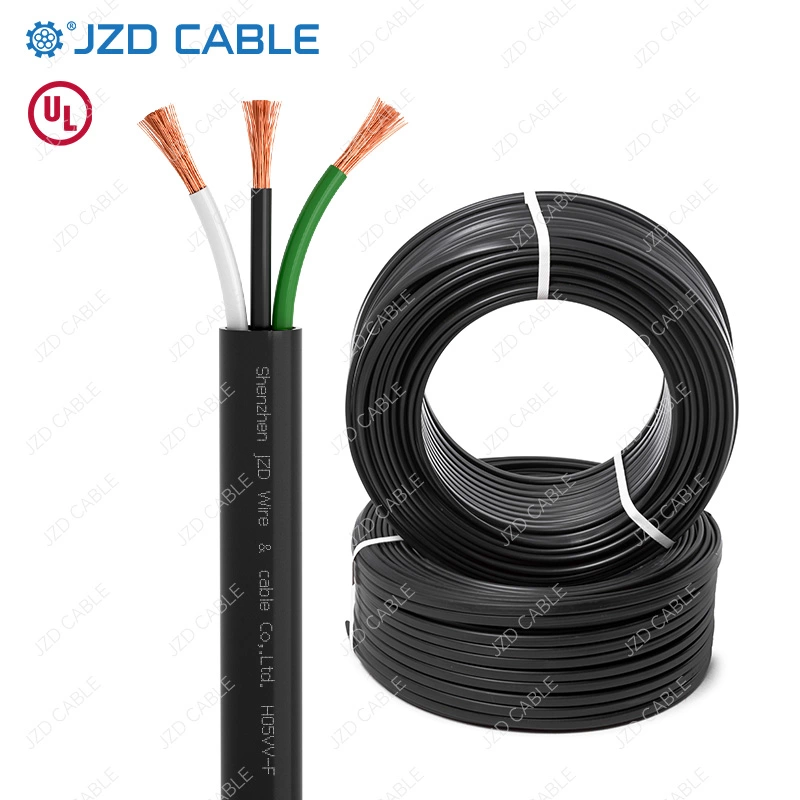
They are also available in 2, 3, or 4 conductors, allowing prefab manufacturers to pull multiple circuits in a single cable. High-visibility jacket options (yellow and orange) make cables easy to see on the factory floor, reducing the risk of damage during subsequent assembly steps. The thermoplastic jacket also resists oil and grease—common in factory environments.
2. At Cable Connections: Reliability Is Critical
Module-to-module connection points—often called “marriage lines”—are the most critical part of any prefab electrical system. These are where factory-installed wiring meets field-installed wiring, and they are a common source of errors during on-site setup.
Cables routed to these interfaces face several specific demands:
- Service loop. They must terminate with enough slack (typically 6–12 inches) to allow for field adjustments during module-to-module interconnection. Insufficient loop length is one of the most common causes of rework on-site—installers find they can’t make the connection and have to pull new cable.
- Color consistency. Conductor colors and numbering must be consistent across all modules so field electricians can identify phase, neutral, and ground connections without guesswork. SJT/SJTW cables with clear color coding (black, white, green—and red for 4-conductor) eliminate that uncertainty.
- Handling durability. Cables at marriage lines may be pulled, twisted, and bent during transport and installation. SJT/SJTW’s flexible jacket resists kinking and maintains cable integrity even after repeated handling.
3. On-Site: SJTW Takes the Weather
Once modules arrive at the job site, the electrical system must be interconnected and brought online. Connections often run across exterior surfaces—exposed to direct sunlight, rain, and temperature swings. Temporary power is also needed during construction: extension cords run across job sites, dragged through mud, and exposed to the elements.
Standard indoor cables are not formulated to survive this. Outdoors, their jackets degrade, crack, and fail—sometimes within months.
SJTW’s weather-resistant jacket solves this. It is UV-stabilized to survive direct sunlight without degrading. It resists moisture and temperature extremes, rated -40°C to +60°C. And it’s durable enough to handle the physical abuse of a construction site—dragging, bending, and occasional crushing.
That is why SJTW is the standard cord type for outdoor extension cords, construction site tools, and temporary power installations.
Need More Power? Consider STW
For smaller to medium-sized prefab houses, SJT and SJTW’s 300V rating is typically sufficient. But when power demands increase—larger homes, commercial modular buildings, or installations with longer cable runs—the 300V rating may be insufficient.
STW (Service Thermoplastic Weather-Resistant) cables offer a 600V rating and larger conductor sizes (down to 6 AWG or larger), making them the right choice for higher-power applications. STW shares the same weather-resistant jacket as SJTW and is rated for heavier service and higher currents. Both SJTW and STW have a temperature range of -40°C to +60°C.
When to consider STW:
- Larger prefab houses with higher power demands
- Commercial modular buildings
- Applications requiring 600V rating
- Longer cable runs with higher current loads
JZD’s STW cables are available alongside SJT and SJTW, providing a complete range of portable cord solutions for prefab manufacturers.
JZD’s SJT, SJTW, and STW – Built for the Job
JZD Cable manufactures UL and cUL-certified SJT, SJTW, and STW portable cords in 2, 3, or 4 conductors, from 18 AWG to 10 AWG (STW down to 6 AWG), rated -40°C to +60°C, with VW-1 flame rating for fire safety. Jacket colors include black, yellow, or orange for high visibility on job sites.
Applications include:
- Factory pre-wiring: Powering heavy-duty motors, conveyors, and assembly line tools in prefab factories
- Construction sites: Running cables to power drills, saws, generators, and temporary lighting
- Outdoor applications: Deploying cables for exterior power distribution and module interconnections
- Commercial/DIY tool power: Extension cords for workshops, garages, and site tools—flexibility prevents kinking during daily use
With over 25 years of experience and exports to 100+ countries, JZD’s portable cords are engineered to meet the mechanical, thermal, and safety demands of prefab house manufacturing and installation.
The Bottom Line
SJT and SJTW portable cords solve the core dilemma of prefab electrical systems: one cable that is flexible enough for factory assembly and tough enough for outdoor installation.
- SJT for indoor factory pre-wiring—flexible, oil-resistant, easy to route
- SJTW for outdoor connections, module interconnections, and job-site power—weather-resistant, UV-protected
- STW for larger projects requiring 600V and higher power capacity
All three are UL-listed, NEC-compliant, and backed by third-party certification—reducing risk, speeding inspections, and simplifying market access for prefab manufacturers.
Need SJT or SJTW for your prefab house project? Contact JZD for technical specifications and certified cable solutions.
FAQ
1. What is the difference between SJT and SJTW cable?
SJTW is SJT with weather resistance added. Both are UL-listed 300V portable cords with stranded copper conductors and PVC jackets. The “W” in SJTW means weather/water resistant—the jacket is UV-stabilized and moisture-resistant for outdoor use. SJT is indoor only; its jacket degrades in sunlight. Both are rated -40°C to +60°C.
2. Is SJTW cord outdoor rated?
Yes. The “W” designation means it is rated for outdoor use—resistant to UV and moisture, with a temperature range of -40°C to +60°C. SJTW is the standard cord type for construction sites, outdoor equipment, and extension cords.
3. What is the difference between SOOW cable and SJTW cable?
| SJTW | SOOW | |
| Voltage | 300V | 600V |
| Temperature rating | -40°C to +60°C | 90°C continuous, 105°C maximum |
| Jacket material | Thermoplastic PVC | Thermoset rubber (neoprene/CPE) |
| Oil resistance | Good | Excellent |
| Best for | General outdoor use, construction sites | Heavy industrial, oil/chemical exposure, high-heat environments |
SOOW is a 600V heavy-duty industrial cord with oil-resistant rubber construction and a higher temperature rating of 90°C continuous (105°C maximum) . SJTW is a 300V weather-resistant cord with a -40°C to +60°C temperature range, suitable for most prefab applications. For factory pre-wiring and job-site power, SJTW is the cost-effective choice; SOOW is over-specified unless continuous oil exposure, 600V, or higher temperature operation (above 60°C) is required.