

When your power cable route involves a high-rise vertical shaft, a river crossing, a mountain-slope underground run, or any scenario where the cable must support its own weight, standard steel-tape armoured cable (YJV22) will fail — literally. Tape armour is built for crush resistance, not tensile load. Hang a 200-metre 11kV feeder in a mine shaft on YJV22 and the tape will split; bury a long-span river crossing and the pull will part the jacket.
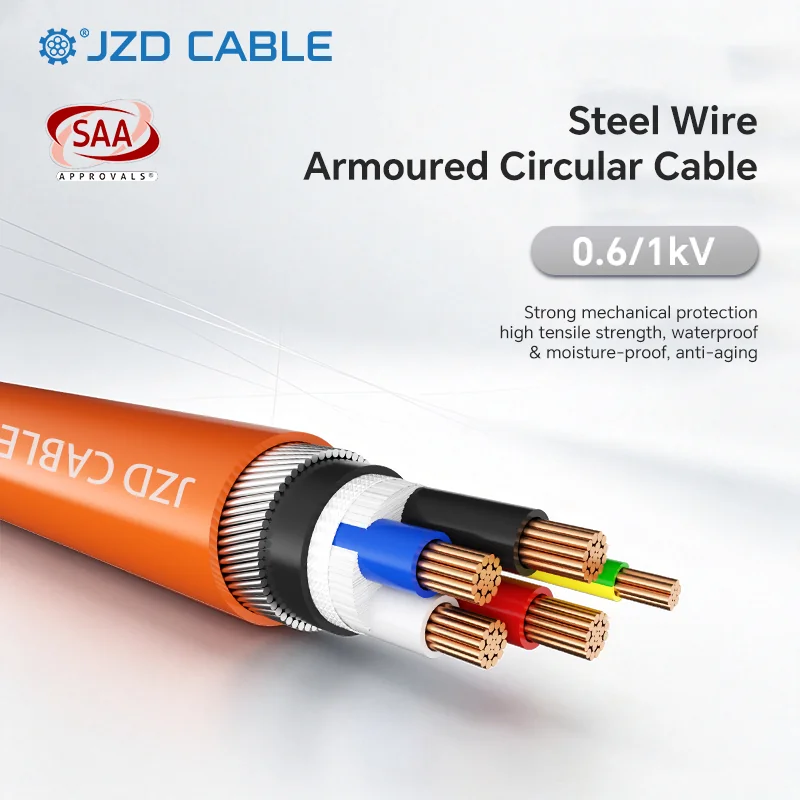
That’s where YJV32 steps in. The “32” suffix means fine round steel wire armour — a helical cage of wires that carries axial tension while also resisting radial crush. Paired with XLPE insulation (90°C) and an optional aluminium core (YJLV32), it’s the go-to for high-drop, underwater, and heavy-traction scenarios where YJV22 taps out.
This guide covers construction, advantages, and where YJV32 earns its keep.
Decoding the Model Code
|
Digit/Letter
|
Meaning
|
|---|---|
|
YJ
|
XLPE (cross-linked polyethylene) insulation — thermoset, 90°C continuous
|
|
V
|
PVC outer sheath
|
|
3
|
Fine round steel wire armour (axial tension + radial crush)
|
|
2
|
PVC outer sheath (the second “2” in 32 refers to the sheath type under/over the armour; the “3” is the armour class)
|
Variants:
- YJV32 = Copper conductor, XLPE, steel wire armour, PVC sheath
- YJLV32 = Aluminum conductor (cost-saving, lighter) — same “32” armour logic
📌 Key contrast: YJV22 = steel tape (crush only, no tension). YJV32 = steel wire (tension + crush). If the cable must hang or be pulled across a span, 22 is wrong — 32 is the answer.
Full Layer Structure (Inside Out)
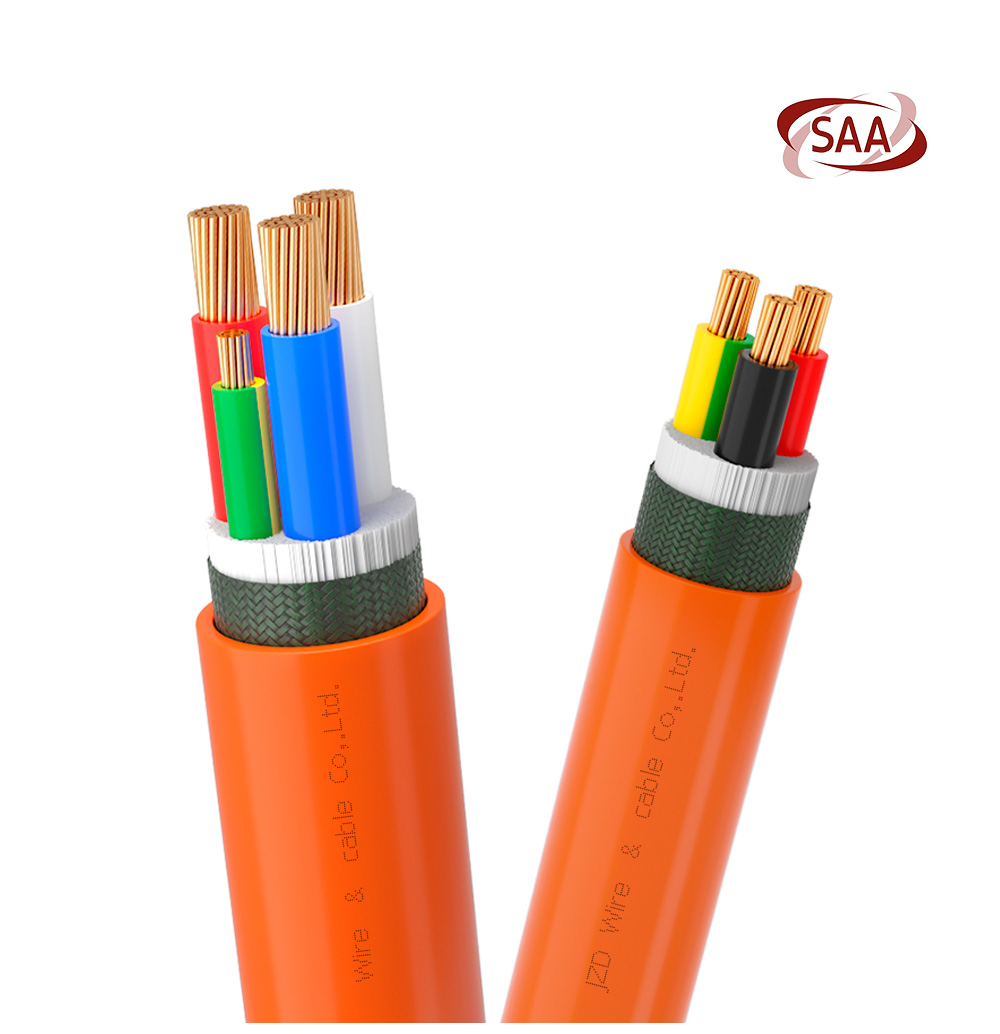
YJV32 is a 6-layer cable (YJLV32 identical except aluminium conductor):
|
Layer
|
Material
|
Function
|
|---|---|---|
|
1. Conductor
|
Compacted aluminium strand (YJLV32) or copper (YJV32). 10–630 mm², 1/2/3/4/3+1 cores.
|
Current path. Compacted Al reduces OD and skin effect.
|
|
2. XLPE insulation
|
Cross-linked polyethylene, 90°C rated, low dielectric loss, moisture/ageing resistant. LV versions have standard wall; MV adds semi-conductor screen layers.
|
Dielectric barrier.
|
|
3. Filler + binder
|
Non-woven tape + filler rope (multi-core only).
|
Roundness, separates insulation from armour.
|
|
4. PVC inner sheath
|
Black PVC.
|
Seals wires from armour, blocks moisture, prevents wire scoring into insulation.
|
|
5. Fine steel wire armour (32)
|
Multiple fine steel wires spiralled helically around inner sheath.
|
The hero layer — carries full cable self-weight tension; also resists radial crush/rolling.
|
|
6. Black PVC outer sheath
|
UV-stable black PVC.
|
Acid/alkali resistance, moisture seal, anti-rodent/anti-ant, outdoor & underground universal.
|
⚠️ Single-core YJV32 critical note: When armouring single-core AC cables, the steel wire must be non-magnetic (e.g., austenitic stainless or galvanized steel with non-magnetic treatment). Magnetic armour around a single-core AC conductor induces eddy currents → heating + loss. Multi-core single-phase triplets don’t have this problem (fields cancel). Always confirm with the manufacturer on single-core 32 orders.
Core Advantages of YJV32
1. Steel Wire Armour = True Tensile Capability
The defining edge over YJV22. Fine wire helix takes the entire longitudinal pull of the cable’s own weight during installation and in service. This is what makes vertical shafts and river crossings possible.
2. XLPE Insulation — 90°C vs VV’s 70°C
Shared with all YJV family — 15–25% higher ampacity vs VV (PVC), 250°C short-circuit vs VV’s 160°C, 20+ year life vs VV’s 8–12. For permanent high-drop installs, YJV32 outlasts VV32 decisively.
3. Aluminium Version (YJLV32) = Cost + Weight Saving
Al conductor is 30%+ cheaper than Cu and lighter per metre — crucial when the cable is hanging hundreds of metres in a shaft or being pulled across a river. For the same ampacity, Al reduces:
- Cable self-weight (less load on the wire armour and suspension)
- Support/racking cost in vertical risers
- Freight cost on long river-crossing reels
4. All-Scenario Protection (vs YJV22’s Limits)
PVC double jacket + steel wire = moisture, crush, abrasion, rodent, mild acid/alkali. Suitable for buried, tunnel, shaft, and riverside exposure.
Where You MUST Pick 32 Over 22
|
Scenario
|
Why 22 Fails
|
Why 32 Works
|
|---|---|---|
|
High-rise vertical shaft (cable riser in high-rise, mine shaft)
|
Tape can’t carry self-weight — cable tears itself apart
|
Wire armour takes full hanging load
|
|
River/underwater crossing
|
Pull tension + water current drag snaps tape
|
Wire armour handles pull + protects against current abrasion
|
|
Mountain slope / long-distance uphill burial
|
Tractive pull during pull-in exceeds tape strength
|
Wire armour rated for axial tension
|
|
Deep mine skip incline
|
Dynamic tension as skip moves
|
Wire armour + flexible build
|
|
Long-span coastal/subsea approach
|
Drag + buoyancy + pull-in tension
|
Wire armour + PVC sheath seal
|
Rule of thumb: If the route has any sustained axial tension — vertical, inclined, or long pull with drag — 32. If it’s purely side-pressure (buried flat, no drop, no pull tension) — 22 is cheaper and sufficient.
YJV32 vs YJV22 vs VV32 — Quick Comparison
|
Parameter
|
YJV32
|
YJV22
|
VV32
|
|---|---|---|---|
|
Insulation
|
XLPE (90°C)
|
XLPE (90°C)
|
PVC (70°C)
|
|
Armour type
|
Fine steel wire (tension + crush)
|
Steel tape (crush only)
|
Fine steel wire (tension + crush)
|
|
Tensile capable
|
✅
|
❌
|
✅
|
|
Crush capable
|
✅
|
✅ (better than wire for point-load)
|
✅
|
|
Life (continuous)
|
20+ yrs
|
20+ yrs
|
8–12 yrs
|
|
Al version
|
YJLV32
|
YJLV22
|
VLV32
|
|
Best for
|
Shaft, river, slope, mine
|
Flat buried, no drop, no tension
|
Budget vertical (shorter life)
|
Typical Applications
1. High-Rise Vertical Shafts (Most Classic Use)
- High-rise building electrical risers (cable hanging from roof down 30+ floors)
- Mine pit vertical feeders (hundreds of metres depth)
- Mountain slope distribution (elevation change 100m+)
2. River / Underwater Crossings
- Riverbed direct burial for township power crossing
- Coastal/beach approach cables (seawater splash + drag)
- Reservoir / dam toe crossings
3. Mountainous & Long-Distance Burial
- Mountain PV farm external feeder (rugged terrain, long pull)
- Rural hill distribution (pull tension on slopes)
4. Heavy Industrial & Mining
- Mine drift mobile drag (combined tension + rolling load)
- Deep-buried plant feeder (trench with cover, vehicle overhead)
- Quarry / pit perimeter mains
⚠️ Where 32 is overkill: Indoor cable trench (covered, no water, no drop) → YJV22 is cheaper. Flat urban direct burial with <5m elevation change → YJV22 is fine. Don’t over-spec 32 on a pancake site — the wire armour costs more and the tensile benefit goes unused.
Frequently Asked Questions
Q: Can single-core YJV32 be used for 3-phase by laying three singles together?
A: Yes, but the armour must be non-magnetic (specify “non-mag 32” when ordering). Alternatively, use a 3-core YJV32 triplet — the magnetic field cancels internally and standard galvanized steel wire is acceptable. Always confirm with the engineer.
Q: YJLV32 vs YJV32 — when to go Al?
A: For large cross-sections (≥95 mm²) on long vertical or river runs, YJLV32 saves 30%+ material cost and reduces self-weight — easier on the pull and on the suspension at the top of the shaft. For small gauges or short runs, Cu (YJV32) is simpler (termination, jointing).
Q: Can YJV32 be direct-buried without sand bedding?
A: Not recommended. Even with wire armour, sharp rocks can score the PVC sheath during pull-in. Use sand bedding or warning tape, especially on river crossings where the cable may shift with current.
Q: What’s the pull tension limit for YJV32?
A: Depends on conductor size, armour wire gauge, and whether it’s Cu or Al. As a rough guide, permissible pull tension is often calculated as motor mass × factor — your cable supplier should provide the rated maximum pulling force (typically 1000–5000 kgf depending on size). Never exceed it — the armour wire can stretch/deform.
Q: Does YJV32 need a separate messenger?
A: No — the wire armour isthe tension member. In a vertical shaft, the cable is typically clamped at each floor/landing, so the armour carries only the weight of the section below each clamp, not the full 200m at once. Design the clamp spacing accordingly.
Why Source YJV32 / YJLV32 from JZD Cable?
At JZD Cable , we manufacture the full YJV / YJLV armour range:
- YJV32 / YJLV32 — Fine round steel wire armour, XLPE 90°C, 10–630 mm²
- Conductor: Cu or compacted Al (YJLV32), single or multi-core
- Inner sheath + steel wire + PVC outer — full 6-layer build
- Non-magnetic armour available for single-core 32 orders
- YJV22 / YJLV22 also stocked (steel tape) for non-tension burial
- Certifications: GB/T 12706, IEC 60502, custom third-party as required
We support high-rise developers, mine operators, hydro/pv farm EPCs, and utility contractors with made-to-length reels and full mill-test packs.
📩 Need a YJV32 quote for your shaft, river, or slope project?
Contact the JZD team at jzdcable.com/contact — send core count, cross-section (Cu/Al), voltage, route profile (drop height / river width / slope length), and we’ll size the armour + recommend 32 vs 22.