

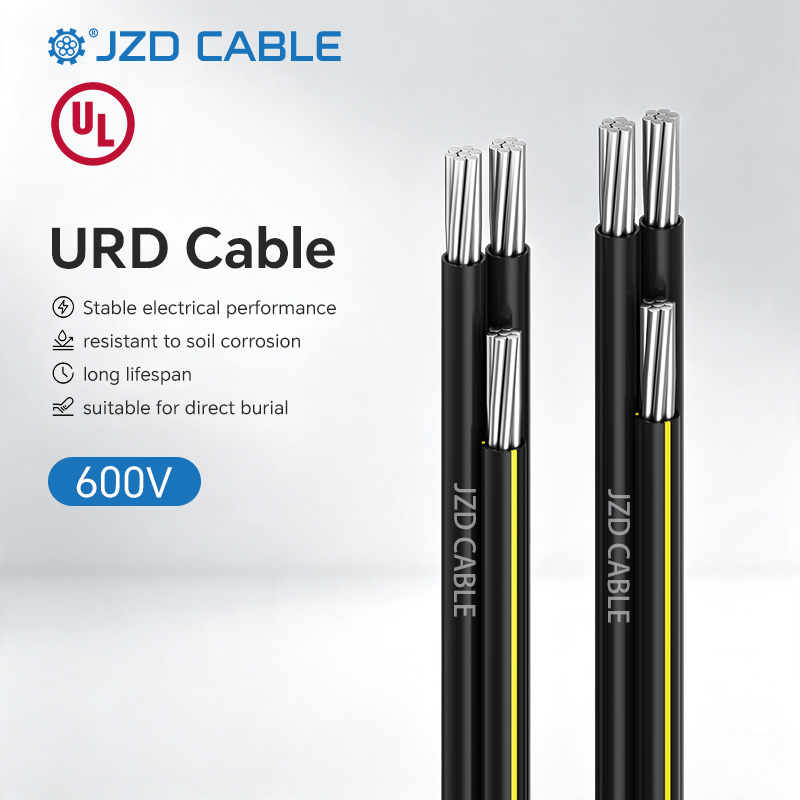
In North American residential distribution, single-family homes typically use a single-phase, three-wire system (120/240V) served by triplex URD. Multi-family, commercial, and industrial projects, however, require three-phase, four-wire systems (120/208 V or 277/480 V)—which demand quadruplex URD.
The difference between triplex and quadruplex is not just one extra conductor. They serve fundamentally different distribution systems, and the choice is not interchangeable. This article explains the three-phase, four-wire system, compares triplex vs. quadruplex URD, and provides clear selection criteria and key installation parameters for contractors and engineers.
When Do You Need Three-Phase, Four-Wire Service?
Single-family homes use single-phase power (120/240V), for which triplex URD is sufficient. The following scenarios require three-phase, four-wire service:
| Project Type | Why Three-Phase Is Needed |
| Apartment buildings, condominiums | Multiple units share a transformer; three-phase balances loads more evenly |
| Buildings with elevators, central HVAC | These are mostly three-phase motors |
| Commercial buildings (retail, office) | Total load exceeds the economic range of single-phase supply |
| EV charging stations | DC fast chargers typically require three-phase input |
| Industrial facilities | Three-phase motors and machinery |
| Solar + storage projects | Inverter AC side output is three-phase |
A quick rule of thumb: If any equipment in the project requires three-phase power, or if the calculated total load exceeds the practical limit of single-phase supply (typically above 200A), you need a three-phase, four-wire system.
Three-Phase, Four-Wire System: Why Four Conductors?
A three-phase, four-wire system consists of three phase conductors (A, B, C) and one neutral conductor (N). The three-phase conductors are electrically separated by 120°, and the neutral provides the return path.
1. Why Is a Separate Neutral Needed?
In a three-phase, four-wire system, the neutral carries the three-phase unbalanced current—not the arithmetic sum of the three phase currents.
Engineering significance:
- When the three phases are balanced, neutral current approaches zero
- When the three phases are unbalanced, neutral current equals the vector sum of the three phase currents
- In real-world projects, three-phase loads are rarely perfectly balanced—a separate insulated neutral is essential to ensure unbalanced current reliably returns to the transformer neutral point
This is the fundamental reason why quadruplex URD requires a separate insulated neutral conductor.
2. Triplex vs. Quadruplex: What’s the Core Difference?
Once you’ve confirmed that your project needs three-phase power, the next step is selecting the correct cable type.
The structural difference between the two cables directly determines their application boundaries:
| Comparison | Triplex URD | Quadruplex URD |
| Phase conductors | 2 | 3 |
| Neutral conductor | 1 | 1 |
| Total conductors | 3 | 4 |
| System served | Single-phase, 3-wire | Three-phase, 4-wire |
| Typical voltage | 120/240V | 120/208V or 277/480V |
| Typical application | Single-family homes | Commercial, multi-family, industrial |
| Installation | One reel, one pull | One reel, one pull |
| Conductors to terminate | 3 | 4 |
Key principle: The two cables are not interchangeable. Use the wrong one, and you’ll either be short a phase and unable to supply power, or you’ll waste money on an extra conductor. Triplex and quadruplex serve different systems—it’s not about which is “better” but which is “correct.”
3. Why You Shouldn’t Replace Triplex with Quadruplex
Some contractors assume “more is better” and use quadruplex URD in place of triplex URD. This is a waste of money.
Quadruplex has one extra phase conductor compared to triplex, meaning
- Higher material cost — the extra phase conductor serves no purpose
- More termination points—more terminations mean longer installation times
- Higher total project cost—using quadruplex cable on a project that doesn’t need three-phase power is unnecessary cost overrun
Color code differences are also a factor to consider. In North America, the typical color code for single-phase systems is black, white, and green; for three-phase systems, it’s black, red, blue, white. When using quadruplex cable for single-phase applications, special attention must be paid to on-site labeling and wiring diagram verification to avoid connection confusion. However, this risk can be mitigated through proper work practices—it adds unnecessary complexity to installation, but it’s not the fundamental reason you can’t use quadruplex for single-phase.
The core principle is simple: if your project doesn’t need three-phase power, don’t use quadruplex cable.
Key Installation and Sizing Parameters
Once the cable type is confirmed, the following parameters need attention in actual engineering:
Burial Depth (NEC Table 300.5)
Quadruplex URD is installed the same way as triplex—one reel, one pull. Residential general areas require 24 inches of burial depth, 18 inches under driveways.
Engineering Standards for Quadruplex URD
Quadruplex URD cable must comply with multiple ASTM and industry standards:
| Standard | Scope |
| ASTM B-230 | Aluminum Wire, 1350-H19 for Electrical Purposes |
| ASTM B-231 | Aluminum 1350 Conductors, Concentric-Lay-Stranded |
| ASTM B-901 | Compressed Round Stranded Aluminum Conductors |
| ICEA S-105-692 | 600V Single Layer Thermoset Insulated Utility Underground Distribution Cables |
| UL 854 (USE-2) | Service Entrance Cable |
Conductor material is 1350-H19 aluminum (high-purity ≥99.7%) or AA-8000 series aluminum alloy. XLPE insulation is rated for 90°C continuous operation, 130°C emergency overload, and 250°C short circuit.
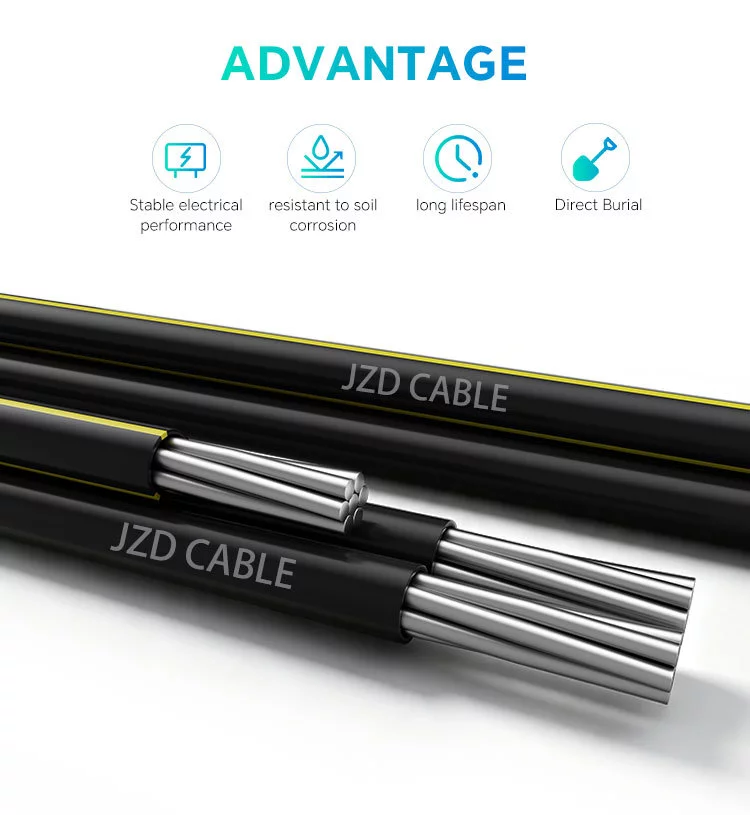
The neutral conductor in North American standards typically has three yellow extruded stripes for identification. Note that color code standards vary by region—IEC standard regions (Latin America, Middle East, etc.) typically use brown, black, and gray for three-phase, different from North America’s black, red, blue. Confirm the color code requirements for your project location when purchasing.
Typical Applications
Quadruplex URD is widely used for:
- Multi-family residential: Underground distribution backbone for apartments, condominiums
- Commercial buildings: Retail plazas, office buildings, shopping centers
- Industrial facilities: Three-phase motors and machinery
- Solar + storage: Inverter AC side three-phase output
- Agricultural irrigation: Linear and center-pivot irrigation systems
JZD Quadruplex URD Aluminum Cable
JZD Cable manufactures UL 854-certified quadruplex URD aluminum cable for 600V three-phase, four-wire secondary distribution, compliant with ICEA S-105-692 standards.
| Parameter | Specification |
| Certification | UL 854 (Type USE-2), ICEA S-105-692 |
| Voltage | 600V |
| Conductor | 1350-H19 or AA-8000 series aluminum |
| Insulation | XLPE – 90°C wet/dry |
| Construction | Quadruplex (3 phase + 1 neutral), left-hand helical lay |
| Direct burial | Yes |
| Temperature rating | 90°C continuous |
Summary
The logic for selecting cable for three-phase, four-wire service entrance is simple:
- Need three-phase power → Quadruplex URD
- Only need single-phase power → Triplex URD
Triplex and quadruplex serve different systems—it’s not about which is “better” but which is “correct.” Choose correctly, and your project runs smoothly. Choose incorrectly, and you’ll either be unable to supply power or waste money.
Need quadruplex URD aluminum cable? Contact JZD for technical specifications and sizing assistance.
FAQ
1. How is the conductor size for quadruplex URD determined?
Conductor size is determined by three factors: calculated load (NEC 220), ampacity (NEC 310.15(B)(16)), and voltage drop (NEC 310.15(A)(1)). Voltage drop is often the deciding factor in long feeder runs — aluminum has higher resistivity than copper, causing greater voltage drop at the same load and distance, which may require upsizing by 1-2 gauges. Always calculate all three factors and select the smallest size that satisfies all conditions.
2. What are the special requirements for terminating quadruplex URD?
Aluminum conductors require AL/CU dual-rated lugs at all terminations, torqued to the manufacturer’s specified values. Under-torquing causes loose connections and heating; over-torquing can damage the lug or conductor. Anti-oxidant compound should be applied where required by manufacturer instructions to prevent aluminum oxide formation and increased contact resistance.
3. What are the emergency overload and short-circuit temperatures for quadruplex URD?
XLPE-insulated quadruplex URD, in addition to its 90°C continuous operating temperature, is rated for 130°C emergency overload (for limited duration) and 250°C short circuit (maximum 5 seconds). These ratings are specified in UL 854 and ICEA S-105-692, providing safety margins under fault or abnormal conditions.
4. How significant is the ampacity difference between direct burial and in-duct installation?
In direct burial, cables dissipate heat through the surrounding soil, typically resulting in higher ampacity than in-duct installations. For example, #2 AWG quadruplex URD has a direct burial ampacity of 153 A versus only 115 A in duct—a difference of approximately 25%. Soil thermal resistivity (RHO) also affects direct burial ampacity—dry sandy soil dissipates heat much less effectively than moist clay. Always consult NEC Table 310.15(B)(16) for actual installation conditions.
5. Can the neutral conductor in quadruplex URD be smaller than the phase conductors?
In a three-phase, four-wire system, the neutral carries only the unbalanced current and can typically be smaller than the phase conductors. However, the neutral may need to be full-sized or larger in the following cases: when significant non-linear loads (VFDs, LED drivers, UPS, etc.) are present, harmonic currents—particularly third harmonics—can add vectorially on the neutral rather than canceling, potentially causing neutral overload. In such cases, calculate the neutral current per engineering requirements and upsize the neutral to match or exceed the phase conductor size as needed.