

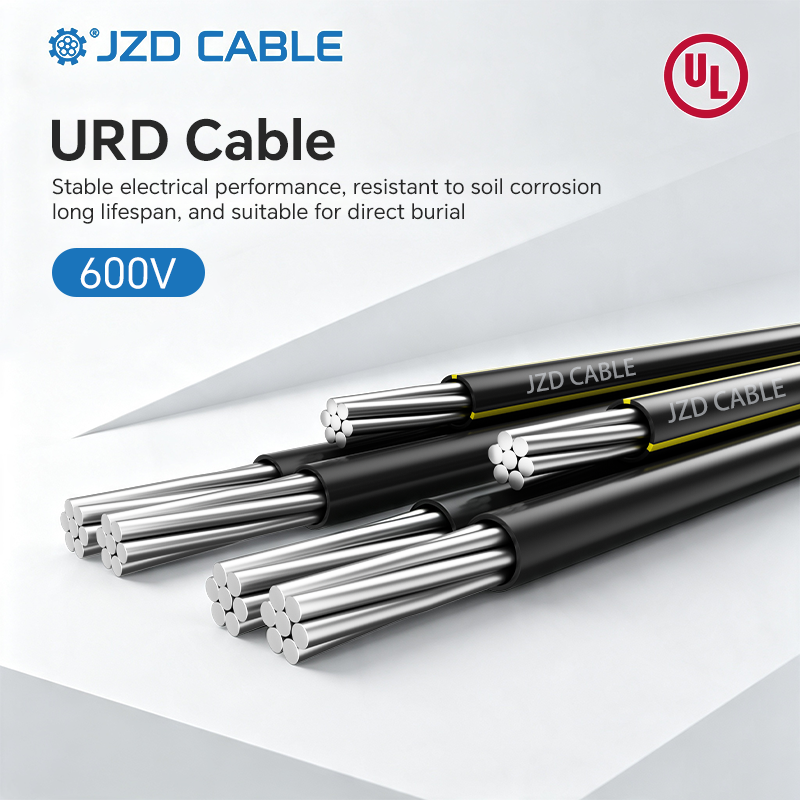
In North and South America, the final link from transformer to meter is a single-phase, three-wire system (120/240V). The standard cable for this service is triplex URD: two insulated phase conductors and one neutral, twisted together.
Triplex URD is designed for 600V secondary distribution. The twisted assembly is not a packaging convenience—it balances electrical performance, installation efficiency, and long-term reliability in direct-burial applications.
Understanding why triplex URD is the standard—and when to choose it over single-conductor or quadruplex—is essential for utilities, contractors, and developers working on underground residential projects.
Three-Phase, Four-Wire Secondary: Where Triplex Fits
Before examining triplex itself, it is worth clarifying the system it serves.
In North American secondary distribution, the most common configurations are:
- Single-phase, three-wire (120/240V)—two phase conductors 180° apart, plus a neutral
- Three-phase, four-wire (120/208V or 277/480V)—three phase conductors 120° apart, plus a neutral
Triplex URD serves the single-phase, three-wire system—by far the most common for residential secondary. It is sometimes confused with “three-phase four-wire,” but triplex has only two phase conductors, not three. The term “three-wire” refers to the total number of conductors (two phases + one neutral), not the number of phases.
For three-phase secondary, the correct cable is quadruplex URD—three phase conductors plus one neutral.
| System Type | Voltage | Conductors | URD Cable |
| Single-phase, three-wire | 120/240V | 2 phase + 1 neutral | Triplex |
| Three-phase, four-wire | 120/208V or 277/480V | 3 phase + 1 neutral | Quadruplex |
Why Triplex: The Engineering Logic
1. Electrical Characteristics of the Twisted Assembly
The helical twist of triplex URD is not merely mechanical—it has direct electrical implications.
Twisting increases mutual inductance between phases. With three conductors spiraled at a fixed lay length, phase-to-phase spacing remains constant, stabilizing mutual inductance values. In a single-phase, three-wire system, this stable mutual inductance helps maintain voltage balance between the two phases. By contrast, three individual single-conductor cables laid in a trench have relative positions that vary with the routing path—mutual inductance fluctuates along the run, potentially causing slight voltage deviations between phases under varying loads. Over long distances, these deviations can accumulate to measurable levels.
Impact on voltage regulation. The twisted construction ensures that the two phase conductors have nearly identical electrical path lengths, guaranteeing symmetrical voltage drop across both phases. This is particularly important in multi-family residential developments, where loads on each phase differ—symmetric voltage drop characteristics ensure that all end-users receive voltage within acceptable limits.
2. Balanced vs. Unbalanced Loads—The Neutral’s Engineering Function
In a three-wire single-phase system, the two phase conductors are 180° out of phase. When loads are perfectly balanced between the two phases, neutral current approaches zero. When loads are unbalanced, the neutral carries only the difference between the two phase currents—typically 10-25% of the system capacity.
Triplex’s role: The twisted construction fixes the relative positions of the three conductors, maintaining consistent distance between the neutral and both phase conductors along the entire cable length. This geometric symmetry keeps neutral impedance uniform regardless of routing path bends or terrain variations, ensuring that unbalanced currents reliably return to the transformer neutral point without being affected by installation geometry. In residential secondary distribution, where phase loads are rarely balanced, triplex construction addresses this challenge by maintaining consistent neutral impedance under all operating conditions.
3. Mechanical Engineering Advantages of the Helical Twist
Mechanical integrity. The twist binds the conductors together, distributing pulling tension evenly across the assembly and preventing individual conductors from separating during installation.
Direct burial compatibility. The compact twisted assembly moves as a single unit during backfilling, reducing the risk of conductor damage compared to separate single conductors.
Ease of termination. The twist allows the cable to be separated at termination points without spring-back, simplifying connection to meter bases and distribution panels.
4. Space and Trench Efficiency
Triplex URD requires significantly less trench space than three individual single-conductor cables.
| Configuration | Trench Width (Typical) | Installation Labor | Long-Distance Pulling Feasibility |
| Triplex URD | 12-18 inches | One reel, one pull | Feasible (bundled construction) |
| Single conductors (3 runs) | 24-36 inches | Three reels, three pulls | Limited (high jamming risk) |
For residential developments with hundreds or thousands of feet of secondary distribution, this trench space and labor difference is substantial. In long-distance conduit pulls, triplex URD’s bundled construction reduces jamming risk through evenly distributed tension, while single conductors are prone to jamming due to conductor tangling or uneven friction.
Triplex vs. Single-Conductor: When to Use Which
| Consideration | Triplex URD | Single-Conductor URD |
| Primary application | Single-phase secondary (120/240V) | Primary distribution, custom phasing |
| Installation | One pull per circuit | Multiple pulls per circuit |
| Trench space | Compact (12-18″) | Wider (24-36″) |
| Phasing flexibility | Fixed (2 phases + neutral) | Flexible (any phase arrangement) |
| Conductor replacement | Entire cable if damaged | Individual conductors can be replaced |
| Cost per circuit | Lower (single cable) | Higher (multiple cables) |
| Best suited for | Residential service entrances | Utility primary, large commercial feeders |
Selection rule: Triplex is the cost-effective choice for single-phase residential secondary. Single conductors are preferred when phasing flexibility is required or when large cross-sections (above 4/0 AWG) are needed for long primary runs.
Triplex vs. Quadruplex: The Phase Count Difference
| Consideration | Triplex URD | Quadruplex URD |
| Conductors | 2 phase + 1 neutral | 3 phase + 1 neutral |
| System served | Single-phase, 3-wire | Three-phase, 4-wire |
| Typical voltage | 120/240V | 120/208V or 277/480V |
| Typical use | Single-family homes | Commercial, industrial, multi-family |
| Neutral function | Unbalanced load return | Unbalanced load return (3-phase) |
| Total conductors | 3 | 4 |
The distinction is not arbitrary. Using triplex in a three-phase application leaves one phase unserved. Using quadruplex for single-phase service creates an unused conductor and unnecessary cost. The selection is driven entirely by the load type:
- Triplex for single-phase loads
- Quadruplex for three-phase loads
Conductors and Insulation: Materials Engineering
1. Aluminum Conductors: 1350-H19 and AA-8000 Series
Triplex URD conductors use compressed stranded aluminum—1350-H19 series or AA-8000 series alloys.
Engineering significance of compressed conductors: Compressed conductors are mechanically rolled to reduce outer diameter, creating a more compact cross-section. The core value of this process: at the same conductor size, compressed conductors have a smaller outer diameter than standard stranded conductors—meaning the overall cable diameter is reduced, allowing larger conductors in the same conduit size, or smaller conduit for the same conductor size. For underground direct burial and conduit installations, this directly impacts constructability and material costs.
1350-H19: High-purity (≥99.7%) aluminum, H19 indicating fully hard-drawn condition—the standard material for electrical-grade aluminum.
AA-8000 series: Aluminum alloy specifically developed for building wire applications, offering superior creep resistance and thermal cycling performance, proven reliable in underground environments when properly terminated.
2. XLPE Insulation: 90°C Wet/Dry Rating
Triplex URD uses XLPE (cross-linked polyethylene) insulation. XLPE is a thermoset material whose cross-linked structure provides:
90°C continuous operating temperature—rated for continuous operation in both wet and dry locations.
Superior moisture resistance—XLPE’s cross-linked structure gives it extremely low moisture absorption, making it suitable for direct burial and conduit installations.
Chemical resistance—XLPE resists acids, alkalis, salts, and microbial attack commonly found in soil.
3. Standard Reference: UL 854 and ICEA S-105-692
Triplex URD complies with two key standards:
UL 854 (Type USE-2) : USE-2 stands for “Underground Service Entrance, 90°C wet/dry.” This standard covers construction, materials, and testing requirements for service entrance cables. USE-2 cables are rated for direct burial without conduit and for long-term operation in wet locations. Triplex URD’s USE-2 listing means it can be buried directly in the ground without additional conduit protection and operated continuously in moist environments.
ICEA S-105-692: This standard specifically addresses 600V single-layer thermoset-insulated utility underground distribution cables. It specifies:
- Insulation thickness: XLPE insulation thickness ranges from 0.030 to 0.045 inches depending on conductor size
- Test requirements: Includes dielectric strength testing (AC withstand 14kV/minute) and insulation resistance testing
- Construction requirements: Conductor stranding, shielding, and sheath specifications
Compliance with ICEA S-105-692 means triplex URD has been designed and tested to utility distribution cable industry standards for underground service from transformer to customer meter.
Typical Engineering Parameters
1. Ampacity (NEC Table 310.15(B)(16))
The following ampacity data is based on 90°C conductor temperature, 40°C ambient, 100% load factor, 36-inch burial depth, and soil thermal resistivity RHO=90.
NEC Reference: The following data is based on NEC Table 310.15(B)(16) 90°C XLPE insulation column, with temperature correction per NEC Table 310.15(B)(2)(b) for underground installations.
| Conductor Size | Direct Burial Ampacity | In Duct Ampacity |
| 6 AWG | 100A | 70A |
| 4 AWG | 130A | 90A |
| 1/0 AWG | 230A | 160A |
| 2/0 AWG | 265A | — |
| 4/0 AWG | 325A | 240A |
| 250 kcmil | 370A | 265A |
Actual ampacity varies with ambient temperature, soil thermal resistivity (RHO), and installation method. In dry soils with high RHO values, ampacity may require derating.
2. Burial Depth Requirements (NEC Table 300.5)
For direct-buried triplex URD cable:
| Location | Minimum Cover Depth |
| Residential general areas | 24 inches |
| Under residential driveways | 18 inches |
| Under streets/roadways | 24 inches |
3. Typical Size Designation Decoding
Triplex URD cable sizes are typically designated as “phase conductor size-phase conductor size-neutral size”:
| Designation | Phase Conductor | Neutral | Typical Application |
| 6/6/2006 | 6 AWG | 6 AWG | Small single-family home |
| 4/4/2004 | 4 AWG | 4 AWG | Standard single-family home |
| 1/0-1/0-1/0 | 1/0 AWG | 1/0 AWG | Large single-family/small multi-family |
| 4/0-4/0-2/0 | 4/0 AWG | 2/0 AWG | Large residential/small commercial |
| 250-250-3/0 | 250 kcmil | 3/0 AWG | Commercial/multi-family backbone |
4. Typical Conductor Stranding
| Conductor Size | Phase Conductor Strands | Neutral Strands |
| 6 AWG | 7 strands | 7 strands |
| 4 AWG | 7 strands | 7 strands |
| 250 kcmil | 37 strands | 19 strands |
Typical Installation Scenarios
1. Residential Development—Transformer to Service Entrance
In a typical residential development project, triplex URD is installed along the path: distribution transformer → direct burial → meter base → service panel.
Installation sequence:
-
Trench excavation to 24-inch depth
-
4-6 inch sand bedding layer at bottom
-
Triplex URD cable installation (one reel, one pull)
-
Warning tape placed 12 inches above cable
-
Backfill and compaction
Triplex URD’s single-reel pulling method completes the entire installation in one operation, saving approximately 40-50% of installation labor compared to three individual single-conductor cables requiring three separate pulls.
2. Driveway Crossings—Conduit Protection
When triplex URD must cross under a driveway, conduit is typically required for additional mechanical protection. Standard practice uses 2-4 inch PVC conduit, with burial depth not less than 18 inches (the minimum permitted under driveways). Triplex URD pulling through conduit is also a single operation, avoiding the separate pulling and identification work required for multiple single conductors.
Related reading: Aluminum URD Cable: Direct Burial and 3-Core/4-Core Selection Guide
JZD Triplex URD Aluminum Cable
JZD Cable manufactures UL 854 certified triplex URD aluminum cable for 600V secondary distribution, meeting ICEA S-105-692 standards.
1. Product Specifications
| Parameter | Specification |
| Certification | UL 854 (Type USE-2), ICEA S-105-692 |
| Voltage | 600V |
| Conductor | 1350-H19 or AA-8000 series compressed stranded aluminum |
| Insulation | XLPE – 90°C wet/dry |
| Construction | Triplex (2 phase + 1 neutral), left-hand helical lay |
| Direct burial | Yes |
| Temperature rating | 90°C continuous |
2. Key Features
- UL 854 listed — independently verified for safety and code compliance
- ICEA S-105-692 compliant — meets industry standards for 600V single-layer thermoset-insulated underground distribution cables
- XLPE insulation — 90°C wet/dry rating for underground reliability
- Twisted construction—simplifies installation, one reel, one pull per circuit
- Compressed aluminum conductor — reduces overall diameter, lowering conduit size requirements
- Direct burial rated—no conduit required in most applications
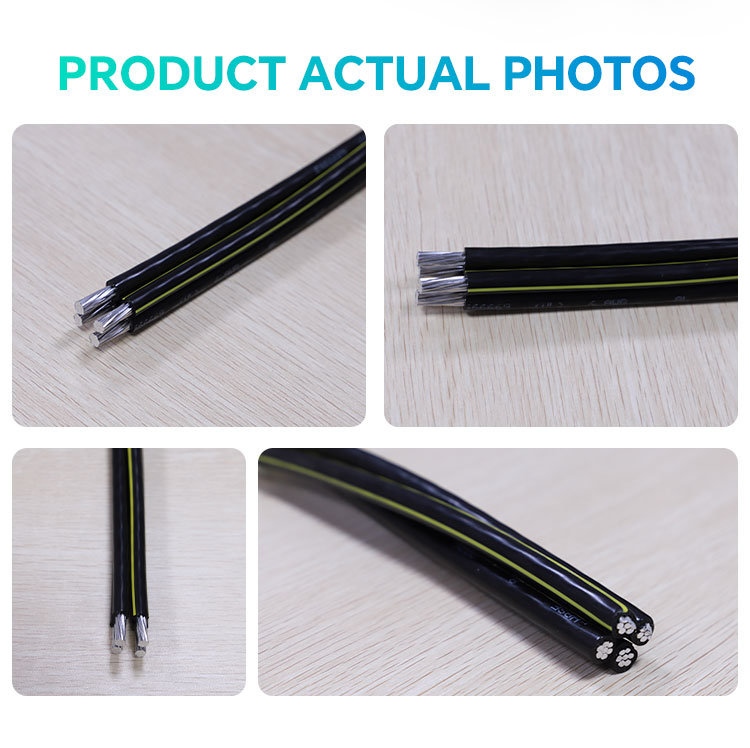
- Neutral identification — neutral conductor with yellow stripe for easy identification
Conclusion
Triplex URD aluminum cable is the engineering standard for single-phase, three-wire secondary distribution in underground residential developments across the Americas.
Its advantages are clear:
- Twisted three-conductor assembly delivers installation efficiency that single conductors cannot match—one reel, one pull, saving 40-50% of installation labor
- XLPE insulation provides 90°C wet/dry performance, compliant with UL 854 and ICEA S-105-692
- Compressed aluminum conductors offer cost-effective, lightweight power delivery while reducing conduit size requirements
- Geometric symmetry of the twisted construction ensures consistent neutral impedance, addressing unbalanced phase loads common in residential applications
Selection is straightforward:
- Triplex for 120/240V single-phase residential service
- Quadruplex for three-phase commercial/industrial service
- Single conductors for primary distribution and custom phasing
When your underground residential project requires reliable, cost-effective secondary distribution, triplex URD aluminum cable is the engineered choice.
Need triplex URD aluminum cable for your underground distribution project? Contact JZD for technical specifications, sizing assistance, and certified cable solutions.